Dramatic Therapy: Stylish Re-enactments in Hitchcock's The Birds and Marnie
By
2011, Vol. 3 No. 04 | pg. 1/1
KEYWORDS:
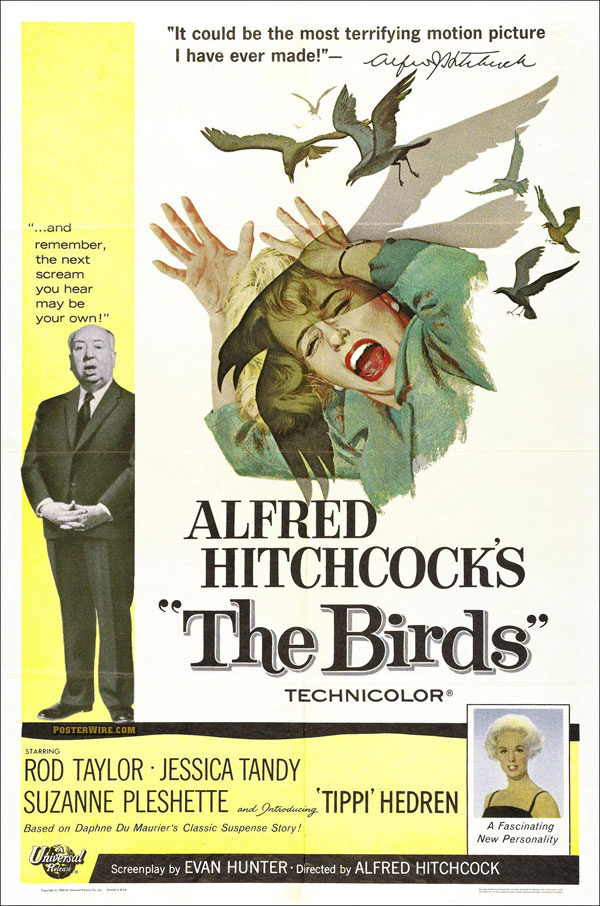
Alfred Hitchcock’s first three films of the 1960s, Psycho, The Birds, and Marnie, feature alliterative blonde bombshell leads with distinctly avian qualities—Marion Crane, Melanie Daniels, and Margaret “Marnie” Edgar, respectively—and in the course of each film the woman seeks a resolution of deep-seated feelings of isolation, abandonment, and self-hatred relating to parental figures and often represented by birds.1 In the latter two films, the character is played by the same actress (Tippi Hedren), and given the thematic similarities of the two films, we can view the sequence as another of Hitchcock’s cycles in which he explores the particular nature of identity through multiple character interpretations by a particular actor or actress.2 In this case, as Richard Allen notes, “the stories of both films center upon searching for and sustaining contact with others” (Framing Hitchcock, 287), with Tippi Hedren in both cases having to reconcile herself to a traumatic childhood event in order to forge meaningful relationships with men (Rod Taylor and Sean Connery, who both function as lovers and father-figures) and women (Jessica Tandy and Louise Latham as mother-figures and Suzanne Pleshette and Diane Baker as friends/competitors). In both cases, climaxes occur when Hedren has to in some way relive her traumatic childhood. These scenes not only define her character, but identify the stylistic philosophy employed by Hitchcock in each film.
Once this connection between birds and the rage of human isolation is understood, the main locomotive force of the movie pushes us towards Hedren’s resolution of the tension within herself. This occurs when she enters Cathy’s room (Cathy having just turned 11, the age at which Melanie’s mother abandoned her) and directly confronts her turbid emotions in avian form. In the sequence beginning at about 1:47:15 into the film, she hears the birds in the room and decides to enter it anyway. Juxtaposed close-ups of her hand (wavering on the doorknob) and face (from a low angle, glancing back to the sleeping family, pressing on without calling for assistance) assure us of her thought and subsequent determination. She enters the room (filmed from the birds’ perspective, slightly low angle across the room), notices the hole in the roof, expresses surprise, but then steps further into the room, allowing the door to close, and points her flashlight at the birds. Logically, she should not do this, but of course Hitchcock is not “documenting the reality of a bird attack” but rather portraying a woman’s confrontation of her emotional issues in a highly affected expressionist style. As the birds beat Hedren down, and all we see is the frenzy of images of her attempts to protect herself against the frenzy of wings, beaks, and claws. Realistically, she probably could turn around, grab the doorknob, open the door, and run out, but for the integrity of the film she has to be broken down before she can start to rebuild herself in the context of family harmony. After Taylor saves her and she regains consciousness and is able to leave the ‘fortress,’ the birds grant the new family peace, but Hedren is noticeably shaken: we do not know to what extent her psyche has been thoroughly broken by the attack; in essence, whether or not she’ll survive the ordeal. The most important aspect of this scene is that it is absolutely terrifying. The noise of the birds, the quick shot changes (there are dozens of individual shots in only two or three minutes of film), the flashes of violence, and the flashes of Hedren’s sheer desperation in repelling the attacks and grappling for the door,3 heighten the intensity to a nearly unbearable point. Hitchcock uses the ridiculous nature of the bird attack to play off primal fears: violent attack, hopeless abandonment and desolation. When Hedren collapses, Taylor must save her, but her own body holds the door shut against him: the odd angle of her body makes this even more difficult, and in the end it takes a ‘miraculous’ new shot that skips most of the necessary dragging and turning process to show Taylor lifting her out.4 After Hedren invokes the attack of the birds by entering the realm of her psychoses (physically represented by her surrogate Cathy’s bedroom), it makes sense that Taylor has to break through the door just as the birds have progressively broken through doors, windows, chimneys, and roofs, this time literally saving Hedren from herself just as Connery will later do for ‘Marnie.’ However, the difference between this scene and its parallel in Marnie is that knowledge of the metaphorical importance of this sequence as a resolution of childhood trauma is neither granted explicitly by Hitchcock nor necessary for a true understanding of the film. Marnie presents a remarkably similar storyline with a drastically different stylistic approach to Hedren’s character. The fatherless woman once again transgresses (by embezzlement, an offence greater only by circumstance than Melanie’s pranks that begin her association with Taylor in The Birds) as a method of coping with feelings of abandonment that prevent her from having ‘normal’ interpersonal relationships. In this case, however, Hedren’s psychoses are manifested internally, in the form of dramatic negative reactions to the color red, tapping noises, and sex. These psychoses present themselves more and more frequently, building tension until, like Melanie, Marnie can confront them directly by reliving her traumatic childhood. This is foreshadowed numerous times by the portrayal of her recurring nightmares, during which she speaks in a child-like voice. This voice indicates her internal conflict with the childhood murder, and only occurs in dreams or in a trance: when she screams “No!” to Connery’s sexual advance, answers Connery’s questions about her dream before snapping to reality, and at the end of the film. When Connery finally manages to force her to re-live the event, she confronts her feelings of abandonment, admitting to her personal failings and seeking treatment and absolution. The scene of resolution of childhood trauma occurs in a very straightforward manner, beginning about 1:59:00 in the film. Having accidentally provoked Hedren by fighting with her mother (Connery’s white shirt resembles the sailor’s outfit, and the storm completes the triggering of the flashback), Connery proceeds to ask her about the occurrence, and in her trance she replies. Music heightens the emotional atmosphere, and finally Hitchcock proceeds to the actual flashback. In both the present-day and flashback scenes, the music parallels the narrative, and zooms, dolly shots, and quick shots of scuffling define the sequence in Hitchcock’s trademark style. We see the exact sequence of events, from Marnie being woken up and laid down by her prostitute mother, to her being abused by the drunken sailor,5 to her mother’s struggle with the sailor, the child Marnie screaming, her mother’s ‘accident,’6 and finally to Marnie’s murder of the sailor. There are similarities to the corresponding scene in The Birds—for instance, Marnie’s pronouncement “There, there now” recalls her mercy-killing of her horse just as Melanie’s entrance of Cathy’s room recalls her similar self-sacrifice in the schoolhouse—but the style in which this scene fulfills the narrative is completely different. Re-enactment is not a new theme for Hitchcock—in Vertigo, Jimmy Stewart has to dramatize for himself a traumatic event (literally in the case of Kim Novak’s death and figuratively in the case of his partner’s death) in order to cure his fear of heights, and in Spellbound Jeremy Peck has to relive the death of his psychiatrist in order to assuage his multifarious crippling feelings of guilt.7 However, each depiction of this cathartic phenomenon differs drastically by Hitchcock’s mode of film-making. Specifically, The Birds stands out among all of Hitchcock’s films as by far the most abstract.8 For almost every scene in Marnie and The Birds, we can see a direct parallel to the other. One of the other more prominent examples would be the depictions of children singing: while both songs are only diagetic to a degree: the children are singing, but Hedren’s perception of their singing moves the song from reality towards participation in an ornately constructed set piece. But whereas Marnie’s children subtly divulge a bit of character information (“nothing says the woman in the alligator purse” as Hedren enters her mother’s house, alligator purse in hand), the schoolchildren in The Birds sing an absurd, monotonous, nonsensical poem meant only to heighten the tense absurdity of the scene as Hedren smokes, alone, to the backdrop of gathering ravens.9 It is thematically useful because, as previously shown, “Hitchcock draws a strong analogy between children and the death-birds” (Allen, Framing Hitchcock, 293), and yet its main power derives from the song’s melodic and lyrical inanity, and its length.10 Another example would be Hedren’s clawing at Taylor in The Birds after her traumatic attack, paralleled by her verbal clawing after reliving her nightmare in front of Connery in Marnie. In nearly every example, the sequences from The Birds are less relevant to the narrative line of the film, but carry a large emotional impact due exclusively to Hitchcock’s mastery of proportionality and perspective in his choices of shot angles and lengths, camera movements, and sound. Only one type of shot separates Marnie from The Birds and Psycho, and that is the extreme high angle shot: while we get “God’s point of view” to accentuate the drastic ferocity of the birds’ attack, and a stuffed bird’s point of view of Arbogast’s murder by Mrs. Bates, Hitchcock never sees fit in Marnie to grant us this perspective. Marnie’s narrative structure forbids such an inexplicable perspective, but the expressionist collage of the previous films allows Hitchcock room for such powerful additions simply because of their collaborative effect on the audience’s psyche. In each case, Hitchcock is telling the same story with a different method. The Birds is ultimately different because it is a nearly complete abstraction of the idea of pure cinema: images are jumbled together that, in and of themselves, do not present a coherent story with universal human relevance, but in a carefully constructed context, create an emotional atmosphere that tells such a story in an arguably more powerful way than linear narrative explication of a sequence of events. As Richard Allen demonstrates, it takes a very high degree of erudition to understand the method of Hitchcock’s metaphor in The Birds,11 and yet the film’s cultural, artistic, and commercial impact testifies to the fact that the juxtaposition of images and sounds in the film masterfully impacts the audience. The Birds shows how Hitchcock at his artistic best was concerned not with outlining the plot of a story, but with directing the attention and emotions of the audience towards the material in such a way as to maximize the impact of its theme. 1.) Most obviously in the attacks of the birds in The Birds and Norman Bates’s pre-occupation with stuffing dead birds in Psycho. Interpretations of this phenomena are given by critic Richard Allen in “Avian Metaphor in The Birds” (Framing Hitchcock, Ed. Sidney Gottlieb. Detroit: Wayne State University Press, 2002). 2.) This idea has been mentioned frequently in class; the most prominent examples are in the 1950s films featuring Jimmy Stewart and Cary Grant. 3.) An unverified comment on wikipedia.org claims that “Hedren was told mechanical birds would be used for the terrifying and brutal attic scene. Instead, live birds were hurled at her by prop men for a week. When one nearly gouged her eye she became hysterical, collapsed and spent a week haunted by "nightmares filled with flapping birds."” This is believable given the insanity of the scene, but probably is not true. 4.) Allen notes that the imagery of that shot invokes Christ being pulled off the cross. 5.) The degree of this abuse is ambiguous—Marnie screams that he was kissing her, but he seems quite tender and fatherly. The scene is creepy regardless, but its ambiguity connects it to the possible rape scene with Connery that foreshadows the final flashback. In both cases the degree of sexual assault is open to question, but it does not entirely matter as Marnie’s perception of each event is what characterizes the thematic material. 6.) One very quick shot at 2:02:45 seems to indicate that the sailor damaged not the leg, but the vagina of Marnie’s mother. While this cannot be substantiated, it would be in keeping with Marnie’s preoccupation with the vagina (primarily not having men touch it) as manifested many times by Hitchcock’s portrayal of her handbags and luggage. It would also explain her mother’s evasion of prison in the aftermath of the murder. 7.) In fact, Marnie is very much a re-telling of Spellbound, as far as the plot is concerned. However, it is the most applicable of Hitchcock’s films in comparison to The Birds because of the continuity of the Hedren character. 8.) At least, of those films viewed in this class. 9.) To be fair, the lyrics by scriptwriter Evan Hunter do have significance, but to his later work on Marnie, rather than The Birds: a closer look through the gibberish reveals the ominous lyrics “I bought my wife a horse one day…she let the critter get away…I asked my wife to wash the floor…she gave me my hat and showed me the door…I married my wife in the month of June…I carried her off in a silver spoon…she combed her hair but once a year…with every rake she shed a tear.” 10.) A more interesting parallel to this scene would be Cary Grant’s incredibly long wait in the dry Indiana corn country preceding the airplane attack. The juxtaposition of long periods of flatness and inanity with quick shots of terrifying intensity is a defining trait of Hitchcock’s films, regardless of the degree of abstraction. 11.) Personally, I found the most contiguity with the film in the context of Jacques Derrida’s writings on Deconstructionism and Difference. This would place the film artistically very closely with post-modernist works in other media in the 50s and 60s, such as Gyorgy Ligeti’s color-based orchestral and choral works, the deconstructionist architecture of Frank Gehry, or the paintings of Jackson Pollock. Allen mentions Hitchcock’s pre-occupation with Difference in this period, and critics such as Peter Brunette and David Wills in Screen/Play mention Hitchcock’s relevance in this context, but at the moment I am unprepared to address Hitchcock from this critical perspective. 
From the Inquiries Journal Blog   Monthly Newsletter SignupThe newsletter highlights recent selections from the journal and useful tips from our blog. Suggested Reading from Inquiries Journal
Inquiries Journal provides undergraduate and graduate students around the world a platform for the wide dissemination of academic work over a range of core disciplines. Representing the work of students from hundreds of institutions around the globe, Inquiries Journal's large database of academic articles is completely free. Learn more | Blog | Submit Follow IJ


Latest in Film & Media |