Nuclear Weapons Testing in the United States: Sacrificing Health for National Defense
By
2011, Vol. 3 No. 06 | pg. 1/1
KEYWORDS:
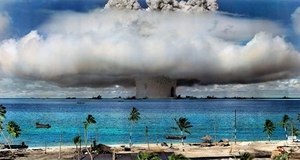
As WWII ended, and the Cold War began, America began to strengthen its national defense against the Soviet Union. Alliances were created resulting in the formation of NATO and the Warsaw Pact. The United States began to create an arsenal of nuclear weapons in order to protect the freedom of its citizens, and the freedom of the world. But freedom from communism would come with a price for the American people, and they would become victims of the United States government’s most lethal form of national defense, nuclear weapons. Despite early public support, victims of the tests eventually reacted, and began to question the government. Is national defense more important than our health? In the early 20th century scientists around the world, especially physicists, began to create an international community with a free exchange of ideas. Through this cooperation scientific advancements were made possible. During WWI scientists were able to continue a limited exchange of ideas, but after the war ended collaboration was back to normal. This cooperation continued until Nazi-Germany invaded Poland, and WWII began. Coincidentally 1939 was the same year two men; Niels Bohr and J.A. Wheeler published a paper that was the key to the atomic bomb. After two and a half years of research the atomic bomb was invented. The first nuclear weapon was tested on July 16th, 1945, and less than a month later “Little Boy” was dropped on Hiroshima.[1] Following Hiroshima and Nagasaki, the Japanese government filed a protest against the United States, claiming that the use of the atomic bomb was illegal because of the disaster it caused. As the war was ending the Allies were creating a new code for international law, this code was that aggressors were guilty of a crime against the world. Because Japan was an aggressor, and there was no law yet built regarding use of nuclear weapons, the United States was considered innocent of the Japanese claims. With international support the United States was able to continue to develop nuclear weapons, and test them.[2]The first successful nuclear weapons test took place in New Mexico, but following WWII America moved its test sites to the Pacific. For nearly a decade the United States continued to conduct tests on the islands of Palau, Mururoa, and the New Hebrides. But after only five tests the government began to test the majority of its weapons in Nevada. Testing in the Pacific was expensive, and the government was experiencing problems from the inhabitants. Many sights were considered, but the climate, geology, security, and access made the Nevada Test Site the final location for testing. Although the government had a new location, the Pacific Test Site was still used for testing, specifically intercontinental missile testing.[3] Public support was imperative in order to test in the continental US. The Atomic Energy Commission, or AEC, became the head of public relations for nuclear testing. The AEC used three strategies in order to maintain public support. The first strategy used the fear of communism to convince Americans that testing was crucial for national defense against the Soviets. The next strategy was educating Americans about the peaceful benefits of the program, and its contribution to nuclear power. And the final strategy was an assurance that testing was done in a safe environment, that had minimal risk to Americans health. The AECs public support campaign was successful because Americans believed that the government had their best interests in mind, and they were unaware of the hazards of radiation. In 1949 the Soviets had their first successful test, and the AEC was given freedom to test how they saw fit. The AEC maintained public support through keeping the public ignorant. From the beginning the AEC was able to restrict information that could implicate the government negatively. The government used media outlets like The New York Times to help sell the bomb. Pop culture was also a tool utilized by the AEC to maintain public support. The mushroom cloud became a symbol for the generation. Walt Disney, the Boy Scouts, and Musicians were all part of the campaign for nuclear weapons. Because of the media, pop culture, and communism, the AEC had an easy job preserving public support, but eventually scientists became skeptical and began to research the effects of radiation. [4] After a nuclear weapon is detonated a radioactive dust cloud forms which is commonly known as fallout. This cloud can rise up to forty thousand feet into the atmosphere, and depending on wind patterns, can travel very quickly. For instance fallout originating in the Marshall Islands took a week to travel to San Francisco, four thousand miles away. Eventually fallout travels across the entire planet, and by 1962 it was estimated that every person on Earth was exposed to radiation. Fallout has three emissions of radiation, alpha particles, beta particles, and gamma radiations. Alpha and Beta particles are the most destructive but are quickly absorbed through air, and they do not often affect humans. But Gamma radiations are deposited on the ground, and therefore are more likely to enter the human system. Effects of gamma radiation last a life time. In the first six months, the majority of deaths occur, and survivors experience radiation sickness. During these months survivors experience itching, nausea, headaches, and hair loss. The next phase of a survivor is the time between these early months and their death. Women are greatly affected by exposure to radiation, and many have reproductive problems, resulting in miscarriages, and deformities. The lasting effects take form in genetic mutation, which will continue to affect future generations. Another deposit from fallout is Iodine-131, or I-131. I-131 is radioiodine that is consumed by grazing animals. When an animal, specifically a cow, ingests I-131 it eventually secretes into its milk. I-131 remains in the milk and is eventually ingested by humans. Once consumed the thyroid gland absorbs the toxin. The thyroid gland is located in the throat, and uses iodine to function. I-131 then accumulates in the thyroid, and eventually decays there, causing damage to the gland. Because the milk supply is contaminated, I-131 can eventually effect a very large population depending on the distribution of the milk.[5] St. George is a small town in Southern Utah located a little over a hundred miles east of the Nevada Test Site. The residents were excited about being able to witness the mushroom clouds, and their concerns subsided when the AEC told them that they should not fear the fallout. On May 19th 1953 the government detonated a weapon named Dirty Harry, and an unexpected wind pattern caused the fallout to hit St. George. Some of the citizens were directly hit with radiation, and immediately felt the nausea and headaches caused by exposure to gamma radiation, but the worst was yet to come. The fallout cloud deposited radioiodine on the ground, and it entered the food chain, it was only a matter of time before humans were ingesting I-131. Dirty Harry received media attention, and some people began to ask questions. One student wrote a letter to a local editorial page questioning the AEC and their failure to inform the public. But the local government ignored this student, and waited for the AEC to respond to the Dirty Harry incident. Some citizens demanded compensation for their losses, the Bulloch brothers were sheepherders who were caught in the fallout of Dirty Harry while on the range with their sheep. As the brothers made their way back to Utah they noticed their ship were losing hair, and white blisters were forming on their backs. The ewes were giving premature birth to deformed lamb. Once the brothers returned home their sheep began to die, sometimes as many as fifty a day. Eventually the Bullochs decided to sue the government. Unfortunately the AEC produced evidence that claimed the sheep did not die from radiation, but from cold weather. Because the Bullochs could not produce evidence to refute this claim the judge ruled in favor of the AEC. [6] The islands of Palau, Mururoa, and the New Hebrides, make up the Marshall Islands. These islands were put under a trusteeship agreement with the US after WWII. The agreement was that the US could build military bases on the islands, and in return the inhabitants would be under the protection of the United States. On March 1st 1954, a bomb called Bravo was detonated. This bomb was a significantly more destructive than “Little Boy” and it was designed to maximize fallout. Islands that had previously been evacuated before a test were left unaware, and experienced the fallout. A Japanese fishing boat called the Lucky Dragon was caught in the fallout, and one of the crew members died from blood damage. This death created international concern, and the Japanese would not allow a death of their citizens by the hands of the United States go unanswered. The press caught wind of the incident, and The Times headed the coverage. In their reports they wrote of the Japanese government’s reaction to the incident, and their efforts to seize all the radioactive fish from the Lucky Dragon. The Japanese called the incident a second Hiroshima, and diplomatic action was taken. Eventually the United States gave the Japanese government two million dollars in reparations. As years passed, conditions continued to worsen for the local populations, their lives were changed by the testing, they lost land that had been theirs for generations, and their way of life was lost. From the beginning the people protested peacefully, trying anything to get their land back, only to be imprisoned, or fined. Eventually their protests made an impact, and the US provide compensation.[7] Despite the disastrous effects of fallout, the AEC was able to maintain public support through publication of safety reports. The media didn’t report many of the incidents, because they didn’t want to scare the public, and didn’t want to be seen as unpatriotic. Scientists who contested these reports were stifled and discredited. As the Cold War was beginning to thaw and policy of the United States towards the Soviet Union was détente, international policies were being made to create safer testing. In 1963 the United States, Soviet Union, and Great Britain agreed to stop atmospheric testing. Once the mushroom cloud disappeared, so did the public’s fear of fallout. Once scientists discovered that fallout was still being vented into the atmosphere, the AEC covered up the studies. Eventually the AEC was unable to contain information leaks and the public became more aware of the dangers of radiation. [8] It wasn’t until the 1970’s that public support began to decline. In 1976 a veteran name Paul Cooper was diagnosed with leukemia, and was admitted to a Salt Lake City hospital. Here he was treated by Dr. Thomas Cosgriff, who worked in Hiroshima and Nagasaki, and felt that Cooper’s sickness was caused by exposure to radiation. Dr. Cosgriff discovered that Cooper had been present at a testing in Nevada, and filed service connected disability through Veterans Affairs. After Cooper’s claim was denied three times he contacted the Disabled American Veterans and went public with his story. He received national attention, and eventually the VA accepted his claim, and Cooper received his benefits. His story moved many people to question the AEC and the truth behind atmospheric testing.[9] The media attention Cooper received caused an awareness to arise among the public. Toward the end of the 1970’s Americans became educated and reevaluated the nuclear policies. Three Mile Island melted down and a world-wide anti-nuclear movement was developing. People began to associate their sicknesses with radiation, and in order to receive compensation for their ailments the people went to court and sued the government. The process to receive compensation was difficult, and the plaintiffs had to produce evidence that their illnesses were caused by radiation. This was difficult to do because evidence was rare; and much of the evidence available favored nuclear testing. Reports from the AEC showed that testing was not harmful, the press covered the testing positively, and scientists were divided on the effects of radiation. NATO did a study on effects of radiation on humans and concluded that I-131 had a small effect on the thyroid, and that radiation is not likely a cause of leukemia. Despite the complicated process of receiving compensation some persisted, and sued the government, with little success. When the people realized that the courts would not help them, they went to Congress. Congress decided that the negligence of atmospheric testing lead to sickness of those downwind from the site, and that the animals that died in 1953 from Dirty Harry can be attributed to fallout. Despite these discoveries Congress failed to create a legislation that benefited the test victims.[10] The Berlin Wall fell in 1989; it was a symbolic event which would be known as the unofficial end to the Cold War. Because of this Congress began to respond to America’s outcry and created legislation to benefit victims of nuclear weapons testing. In 1990 they created the Radiation Exposure Compensation Act, which gave money to three categories of the exposed. If adequate evidence was produced that connected illnesses to exposure the Department of Justice would give compensation. The three groups that received compensation were uranium miners, employees who were related to the test site, and “downwinders,” or the people that lived downwind from the test site. But no downwinder has ever received their compensation because evidence shows that exposure was low, and was not likely linked to cancer. Which is concerning considering the increase in thyroid cancer rates during the twenty years of testing.[11] Looking back the United States government sacrificed the health of its citizens in order to maintain a high level of security against the Soviet Union. Once the Soviet Union dissipated nuclear weapons were no longer imperative to national security, and the citizens became more of a concern. The AEC’s strategy for support was beginning to fail. The fear of communism had disappeared, clean energy became a concern with the meltdown of Three Mile Island, and the AEC could no longer tell citizens that there are no adverse health effects to radiation. The AEC’s public support campaign was so successful because the lack of research in relation to radiation. If the effects of radiation were known, it is unlikely that Americans would have been willing to sacrifice their health for security.[12] ReferencesPrimary Davidson, Professor Harold O. Biological Effects of Whole-Body Gamma Radiation on Human Beings. Baltimore: The Johns Hopkins University Press, 1957. National Research Council and Institute of Medicine. Exposure of the American People to Iodine-131 from Nevada Nuclear-Bomb Tests: Review of the National Cancer Institute Report and Public Health Implications. Washington, D.C.: National Academies Press, 1999. Frere, Maurice H. The behavior of radioactive fallout in soils and plants (National Research Council). Washington, D.C.: National Academy Of Sciences-National Research Council, 1963. Shapiro, Charles. Atmospheric Nuclear Tests: Environmental and Human Consequences (NATO ASI Series / Partnership Sub-Series/ 2. Environment). 1st ed. New York: Springer, 1998. Secondary Dibblin, Jane. Day of Two Suns: U.S. Nuclear Testing and the Pacific Islanders. Chicago: New Amsterdam Books, 1990. Fuller, John G. The Day We Bombed Utah: America's Most Lethal Secret. New York: New American Library, 1984. Keever, Beverly. News Zero: The New York Times and the Bomb. Monroe: Common Courage Press, 2004. Titus, A. Constandina. Bombs in the Backyard: Atomic Testing and American Politics. 2nd ed. Las Vegas: University Of Nevada Press, 2001. Endnotes[1] A. Constandina Titus. Bombs in the Backyard, 2-10; National Research Council and Institute Of Medicine. Exposure of the American People to Iodine-131 from Nevada Nuclear-Bomb Tests, 11. [2] Beverly Keever, News Zero, 65-70. [3] Jane Dibbline, Day of Two Suns, 8; A. Constandina Titus, Bombs in the Backyard, 56. [4] A. Constandina Titus, Bombs in the Backyard, 19; Beverly Keever, News Zero, 65-70; Ibid., 138-140; A. Constandina Titus, Bombs in the Backyard, 70; Ibid., 101. [5] Harold O. Davidson, Biological Effects of Whole-Body Gamma Radiation on Human Beings, 9-11; Charles Shapiro, Atmospheric Nuclear Tests, 37; Beverly Keever, News Zero, 202; Jane Dibblin, Day of Two Suns, 35; National Research Council and Institute Of Medicine. Exposure of the American People to Iodine-131 from Nevada Nuclear-Bomb Tests, 45-50. [6] John G. Fuller, The Day We Bombed Utah, 33-45; Ibid,. 14-18; Ibid., 26; Atmospheric Nuclear Tests, 14. [7] Jane Dibblin. Day of Two Suns, 22; Ibid., 83; Beverly Keever News Zero, 202. [8] A. Constandina Titus. Bombs in the Backyard, 101; Beverly Keever News Zero, 163; John G. Fuller. The Day We Bombed Utah, 180-182. [9] A. Constandina Titus, Bombs in the Backyard, 107-108. [10] A. Constandina Titus. Bombs in the Backyard , 121; Atmospheric Nuclear Test, 47-49; A. Constandina Titus. Bombs in the Backyard , 124. [11] Atmospheric Nuclear Tests, 56. [12] A. Constandina Titus. Bombs in the Backyard , 169. 
From the Inquiries Journal Blog   Related Reading Monthly Newsletter SignupThe newsletter highlights recent selections from the journal and useful tips from our blog. Suggested Reading from Inquiries Journal
Inquiries Journal provides undergraduate and graduate students around the world a platform for the wide dissemination of academic work over a range of core disciplines. Representing the work of students from hundreds of institutions around the globe, Inquiries Journal's large database of academic articles is completely free. Learn more | Blog | Submit Follow IJ


Latest in History |