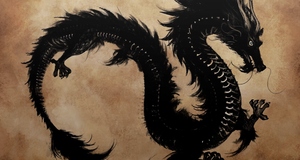
Qi (Chi) in James Cameron's Avatar
By
2010, Vol. 2 No. 10 | pg. 1/1
KEYWORDS:
A nine-foot-tall, royal blue giant creeps low to the ground, brushing by exotic foliage. He holds a proportionally large bow and arrow in hand. In an instant he pauses, keeping entirely still, before loading an arrow into his weapon. He pulls back steadily, locking his arm tightly behind his shoulder. He breathes in, holds, and releases. The arrow glides through the hollow air before burying itself in the chest of a six-legged beast. The giant leaps up and rushes to his prey, dragging a dagger across its throat as he offers a brief prayer in a foreign tongue: “I see you Brother, and thank you. Your spirit goes with Eywa, your body stays behind to become part of the People” (Cameron 66). The Na’vi people of James Cameron’s epic blockbuster Avatar put their unflinching faith in a deity they call Eywa, or the All-Mother. Eywa is not so much of a conscious being, as in traditional conceptions of God, but rather a collective energy of all that is living and dead in the fictional world of Pandora. What at first glance appears to be the clever invention of a creative genius bears a striking similarity to the classic Chinese philosophical concept of qi. Like Cameron’s Eywa, qi is a continuous, flowing, immaterial life-force which connects all that exists in the world. An examination of the presence of qi in Cameron’s Avatar reveals that the fundamental concept has bridged not only cultural boundaries in Asia, but the four light-year boundary between Earth and Pandora. Self-CultivationThe Na’vi have a deeply spiritual connection to the energy of each other and the world around them. In their society, great emphasis is placed on cultivating this energy to become “one with Eywa,” to become more in tune with nature, wisdom, and humanity. A trained member of the society will have an acute sense of the flowing energy that unites all things. Wisdom is attained not only through meditation and observation of the cosmos, but also through physical training. The goal is to center one’s energy with the flow of Eywa. A truly wise Na’vi fully in tune with this flow earns the title Tsa’hik and is revered as a spiritual guide.The practice of self-cultivation in the Na’vi culture is likely derived from similar principles in Neo-Confucianism. The Tsa’hik title is analogous with the Chinese sage, a wise, deeply philosophical spiritual guide. Adler’s description of the essential understanding of qi prescribed by Zhu for sagehood further exemplifies the presence of qi in the Na’vi way: In his system, [Zhu] is emphasizing here the crucial linkage between the metaphysical principle of li - the single order that incorporates both the natural order (tianli) and the moral order (daoli) - and the phenomenal world constituted by qi in all its forms. The significance of this linkage […] is that it provides access by the functioning human mind (xin), which is also a form of qi, to the inherent goodness of human nature (xing), which is the principle (li) of being human. […] “Spirit" (shen) plays a significant role in this process. (8) To be a sage, Adler suggests, one must cultivate a sense of connection with both the humanity that defines us as a people and the qi which connects us to the rest of the world. This qi acts as a metaphysical bridge between the human mind, human nature, and the collective flow of energy. One who is declared a sage in the Chinese tradition would clearly also be counted as a Tsa’hik in Na’vi culture, as the criteria for each overlap almost precisely. Like Na’vi warriors seeking spiritual enlightenment, students of Chinese philosophy “rely on the wisdom of the sages recorded in the Classics” to tap into their special linkage with qi (Adler 9). Self-cultivation of qi, however, does not end with relying on the texts of the sages. NatureThe Na’vi people have not only a physical, but also a deeply spiritual relationship with the land of their home planet. The unity they feel with the forest is, in large part, due to the flowing energy that they sense between themselves, the flora, and the fauna of their habitat. They devote hours to meditating among the sacred trees, observing the beauty of nature, connecting with spirits, and channeling the flow of Eywa. In order to become more in tune with qi, one must, much like in the lore of Avatar, explore the world exterior to oneself. Self-cultivation does not only take place within, but also comes from the energy of the outside world – in the case of the Na’vi, from the forest. According to Adler, Zhu Xi and Cheng Yi predicated that “it is […] easier to perceive the underlying order [of qi] outside oneself, in nature, human affairs, and books” (9). The Na’vi emphasis on finding Eywa in the natural world and in the traditions of other tribes complements the Chinese emphasis on finding the “underlying order” qi in nature and in the graces of other people. Based on the Na’vi lifestyle it would seem that they take this practice to heart, as many of their actions are determined by their perception of the flow of Eywa, the flow of qi, both within and out of themselves. This position is also shared by Evelyn Tucker who writes that “there is the need for both discernment to practice virtue and discrimination to explore nature; they are part of a single continuum of sustained effort [that is] generated [to] expand the human mind-and-heart to embrace the larger society, the natural world, and the universe itself” (66). Not only does Tucker place additional emphasis on exploring and tapping into the energy of nature, but she also brings up the concept of mind-heart, which has a place in the Na’vi philosophy of Eywa. Tribe members say to each other, “oel ngati kameie” or “I see you.” When one says this to another, one is stating that one sees all that the other is – all that he believes and knows, all the energy that composes him. Essentially, one is saying that one recognizes the other’s mind-heart and the other’s qi. Karen Lai states that “Chinese thought places emphasis on observations of the concrete phenomenal world as the basis of reflection” (213). This sentiment differs slightly from the more metaphysical conceptions of qi or Eywa which dominate Na’vi philosophy, but still plays into their culture. The Na’vi are very much in touch with the phenomenal world, but this relationship is overseen and determined by the will of Eywa, by the flow of the energy. This marriage of the phenomenal and metaphysical is most clearly illustrated by the literal physical connectedness of the Na’vi to their land; each Na’vi is endowed with a “queue,” a small collection of tendrils which allows them to form a physical and spiritual bond with the other living beings on Pandora. This bond can be seen as a flowing of qi from one creature to another, a physical manifestation of a metaphysical concept. Life & DeathThe Na’vi culture observes death in a very solemn, peaceful, and comforting manner. While they recognize that in death, the body dies, they observe that the energy of the spirit returns to the collective energy of the world. The film’s protagonist, Jake Sully, a human observing the Na’vi culture for the first time, is given the opportunity to attend a Na’vi burial ritual. Following this ritual, he reports a simplified summary of the Na’vi understanding of life and death: “They see a network of energy that flows through all living things. They know that all energy is only borrowed, and one day you have to give it back” (Cameron 80). Within this short explanation, Sully relates the Na’vi sentiment that life is a finite event dependant on a spiritual energy which sustains us. This Na’vi conception of death is eerily similar to the sentiment held in the Neo-Confucian tradition. Neo-Confucian philosopher Zhu Xi explains their philosophy of death: While humans have much qi, there must come a time when it is exhausted. When it is exhausted, then the hun qi returns to Heaven and the physical po returns to earth and they die. […] This is why when there is life there must be death; when there is a beginning there must be an end. What gathers and disperses is qi. (Zhu) Zhu relates a similar sentiment to the Na’vi rationale of “borrowed energy.” In his description, people are endowed with a certain life-force which gradually depletes, returning to “Heaven,” much like the Na’vi energy returns to Eywa in death. Zhu recognizes a fundamental difference between the human body, po, and the soul, hun. Like in Na’vi lore, the hun qi, or the energy of the soul, leaves the physical domain while the po qi, or the physical energy of the body, remains on the physical earth, committing its energy to the ground. This Neo-Confucian principle is also demonstrated in the Na’vi hunting prayer above; the hunter believes that the hun qi of his prey returns to Eywa, while the po qi, the energy of the prey’s body, remains behind to be assimilated by the Na’vi. The Na’vi are comforted in times of loss by the notion that ancestral souls, though they die in a physical sense, live as ghosts in the energy of Eywa. Although the idea of ghosts and spirits is a common cross-cultural concept, their place in Na’vi lore most closely resembles a Neo-Confucian conception of ghosts that centers on the energy of the soul, but is mostly limited to sages and ancestors. Adler reports that Neo-Confucians “interpreted [ghosts] as functions of the natural processes of qi, implying that at least some forms of ghosts and spirits lacked conscious personal wills” (4). This fits in line with the ghosts of Avatar which aren’t portrayed as visual entities but simply as disembodied energy of Eywa. _____________________________ Avatar is a major accomplishment for one of the world’s most visionary directors. Not only is it a visual masterpiece, but it incorporates important themes from the Chinese philosophical tradition, as well as other fascinating cultures from around the world. A closer examination of the film reveals that as he was writing his script, director James Cameron was very much in touch with his qi.
Adler, Joseph A. "Varieties of Spiritual Experience:." Kenyon.edu. 19 April 2010 . Avatar Screenplay. Dir. James Cameron. 2009. Lai, Karen. An Introduction to Chinese Philosophy. New York: Cambridge University Press, 2008. Tucker, Mary Evelyn. The philosophy of qi: the Record of great doubts. Columbia University Press, 2007. Xi, Zhu. Zingli daquan shu 28.13a (n.d.): 614. 
From the Inquiries Journal Blog   Related ReadingMonthly Newsletter SignupThe newsletter highlights recent selections from the journal and useful tips from our blog. Suggested Reading from Inquiries Journal
Inquiries Journal provides undergraduate and graduate students around the world a platform for the wide dissemination of academic work over a range of core disciplines. Representing the work of students from hundreds of institutions around the globe, Inquiries Journal's large database of academic articles is completely free. Learn more | Blog | Submit Follow IJ


Latest in Film & Media |