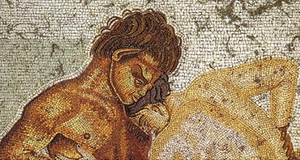
Examining Greek Pederastic Relationships
By
2010, Vol. 2 No. 02 | pg. 1/1
KEYWORDS:
Pederasty is an ancient Greek form of interaction in which members of the same sex would partake in the pleasures of an intellectual and/or sexual relationship as part of a socially acceptable ancient custom (Hubbard: 4-7). The question of whether the ideal pederastic relationship was the most common form of pederasty in Greece, or whether the reality of ancient same-sex desire involved relationships between males of the same age, is one that has been contested between scholars for many years. The ideal pederastic relationship in ancient Greece involved an erastes (an older male, usually in his mid- to late-20s) and an eromenos (a younger male who has passed puberty, usually no older than 18) (Dover, I.4.: 16). This age difference between the erastes and the eromenos was of the utmost importance to the scheme of the ideal pederastic relationship. The power dynamics involved in such a relationship, with the erastes always in control, ensured that the erastes kept his dignity as a fully-functioning member of Greek society, while the eromenos grew up under the tutelage of such a man and as such could become a great citizen when he reached adulthood. Both people in an ideal pederastic relationship would have practiced great sophrosyne, or taking no indulgence to excess (Dover, II.C.5.: 97). The erastes shows restraint in his “pursuit” rather than his “capture” of the young boy, and the eromenos would similarly show restraint by not immediately giving into the older man’s sexual desires. Ideal pederastic couples were ones whose relationship directly benefitted their Greek society. Another important reason for the age difference between the erastes and eromenos was that the older male was responsible for teaching the younger male about Greek politics, military, and social gatherings (Hubbard, Introduction: 12). The ideal erastes was meant to be more of a teacher than a lover. The eromenos would receive this training in exchange for the sexual favors he provided to his erastes. Also important to the ideal pederastic relationship was the fact that the eromenos supposedly did not enjoy the sexual actions that he performed with his erastes, adding to the idea of the older male acting as a teacher: “Boy, my passion’s master, listen. I’ll tell no tale/That’s unpersuasive or unpleasant to your heart./Just try to grasp my words with your mind. There is no need/For you to do what’s not to your liking” (Theognis, 1235-38: 40).There are many examples of the ideal pederastic couple in ancient Greek literature. One of these examples is Harmodius and Aristogeiton, who were known in the ancient Greek world as the ideal pederastic couple. Harmodius was an Athenian youth who at one time was propositioned by Hipparchus, the brother of the Athenian tyrant Hippias. Harmodius turned him down, of course, because he was the eromenos of Aristogeiton, a Greek middle class citizen. When Aristogeiton found out about Hipparchus’ advances, he immediately began plotting to overthrow the tyranny. Hipparchus, in the meantime, had found a way to insult Harmodius as revenge for his inability to attain the young man. The tyrant’s brother enlisted Harmodius’ sister to participate in a sacred procession, then recanted his invitation, stating that she was unworthy. This only enraged Aristogeiton more; he put together a small band of men to attack Hipparchus. In the end, Harmodius and Aristogeiton attacked Hipparchus and killed him; Harmodius was killed on the spot, while Aristogeiton was killed later after having escaped the bodyguards. Thanks to the daring of Harmodius and Aristogeiton, the tyrant was eventually overthrown and democracy was established in Athens (Thucydides, 6.54.1-4, 6.56.1-59.2: 60-61). Another example of an ideal pederastic couple was Zeus and Ganymede. Zeus was so taken by the beauty of the mortal Ganymede that he made the boy immortal: “Boy-love is such a delight, since even the son of Cronus,/King of the gods, once came to love Ganymede,/And seizing him, brought him up to Olympus and made him/Eternal in the lovely flower of boyhood” (Theognis, 1341-50: 45). The pederastic relationship of Zeus and Ganymede was ideal because of their age difference, but more importantly it was a sign to the Greeks that it was okay for them to participate in the same kind of relationship. After all, whatever was acceptable for the gods (and especially for the king of the gods) was also acceptable for mortals. This also meant that anything outside of the model pairing presented by Zeus and Ganymede was less than “ideal.” Another case to be considered when discussing ideal pederastic relationships is that of Agathon and Pausanias. Agathon was a young poet who hosted the dinner party that was the setting for Plato’s Symposium, and Pausanias was his erastes (Plato, 178A-185C: 180-182). Their relationship was ideal in the sense that they differed in age by about 10 years, having started their relationship when Agathon was 18. However, Agathon and Pausanias stayed together far longer than the typical pederastic couple. It seems from the evidence available that neither man ever took a wife or had children. In fact, when Agathon emigrated to Macedonia sometime between 411 and 405 to continue his career as a dramatist, Pausanias went with him (Dover, II.C.4.: 84). While not completely different from the ideal pederastic relationship, Agathon and Pausanias prove that there were forms of same-sex desire and interaction in ancient Greece that went outside the ideal. The evidence for the ideal pederastic relationship being the most common in Greece is overwhelming, but the case for atypical relationships is not completely lost. There is documentation for the existence of same-sex couples who were of the same or similar ages when they were together. The ideal pederastic relationship was not the only type possible for the ancient Greeks. The first major example of a pederastic couple that was not ideal was Achilles, the legendary Greek hero, and Patroclus. These two were similar in age, and there is much dissension as to which of them was the erastes and which was the eromenos. In the Greek tragedy Myrmidons, Achilles is depicted as the lover and Patroclus is depicted as the beloved, though Phaedrus presents a good argument for the opposite in Plato’s Symposium, in reference to Achilles exacting revenge on Hector, the person who killed Patroclus: “Incidentally, Aeschylus’ view, that it was Achilles who was in love with Patroclus, is nonsense. Quite apart from the fact that he was more beautiful than Patroclus…and had not yet grown a beard, he was also, according to Homer, much younger. And he must have been younger because it is an undoubted fact that the gods…are most impressed and pleased, and grant the greatest rewards, when the younger man is loyal to his lover, than when the lover is loyal to him” (Plato, 178A-185C: 183). The fact that Achilles, one of ancient Greece’s most famous heroes, was involved in a pederastic relationship that was anything other than ideal lends credence to the existence of other same-age, same-sex couples. Another pederastic relationship featuring partners of similar ages was that of Alexander the Great and Hephaestion. The two were lifelong companions, and their relationship is reminiscent of that of Patroclus and Achilles, for whom Alexander held a great respect. Alexander and Hephaestion always traveled together and fought in battles together; Alexander even went so far as to refer to Hephaestion as an extension of himself during an encounter with the abandoned mother of the king Dareius: “So at daybreak, the king took with him the most valued of his Friends, Hephaestion, and came to the women. They both were dressed alike, but Hephaestion was taller and more handsome. Sisyngambris took him for the king and did him obeisance. As the others present made signs to her and pointed to Alexander with their hands she was embarrassed by her mistake, but made a new start and did obeisance to Alexander. He, however, cut in and said, "Never mind, Mother. For actually he too is Alexander” (Diodorus, 17.38). The closeness between Alexander and Hephaestion, as well as the similarity of their ages, points to their pederastic relationship being one outside of the ideal, and provides more evidence that the ideal was not the only type of relationship practiced in ancient Greece. There can be no doubt that the ideal pederastic relationship was one of great prominence in many ancient Greek city-states. One could even argue that it was the most common, given all the documents available on the subject. However, accounts and reports of relationships between people in our current society are not always representative of relationships as a whole; it is quite possible that the ideal pederastic relationship portrayed in writing may not have been the most commonly practiced form of same-sex interaction in Greece. So, although the ideal pederastic relationship was perhaps the most popular type of relationship in ancient Greece, it was by no means the only one possible. ReferencesDover, K.J. Greek Homosexuality. Massachusetts: Harvard University Press, 1978. Hubbard, Thomas K., ed. Homosexuality in Greece and Rome. California: University of California Press, 2003. Plato, 178A-185C (Hubbard 5.7). Siculus, Diodorus. Library of History, Volume IV, Books 9-12.40. 17.38. 4 March 2009. Theognis, 1235-38 (Hubbard 1.45). Theognis, 1341-50 (Hubbard 1.70). Thucydides, 6.54.1-4, 6.56.1-59.2 (Hubbard 2.2). 
From the Inquiries Journal Blog   Related ReadingMonthly Newsletter SignupThe newsletter highlights recent selections from the journal and useful tips from our blog. Suggested Reading from Inquiries Journal
Inquiries Journal provides undergraduate and graduate students around the world a platform for the wide dissemination of academic work over a range of core disciplines. Representing the work of students from hundreds of institutions around the globe, Inquiries Journal's large database of academic articles is completely free. Learn more | Blog | Submit Follow IJ


Latest in History |