Hobbes' Leviathan and Views on the Origins of Civil Government: Conservatism by Covenant

Now Accepting Submissions
By Katherine J. Wolfenden
2010, Vol. 2 No. 12 | Page 1 of 1
Citation Email Article Printable Version

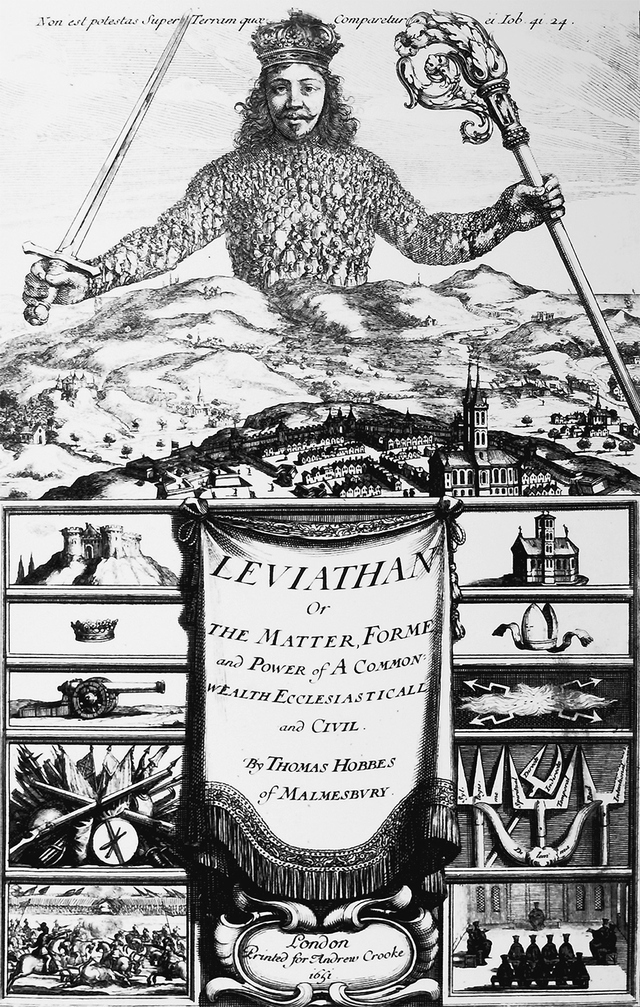
In his seminal text, Leviathan, the philosopher Thomas Hobbes offers what was then a radically novel conception of the origins of civil government. Hobbes’ ideas of the commonwealth are predicated upon his views of human nature and the state of mankind without government, and so he establishes his position on these concepts before addressing the commonwealth’s creation. First Hobbes writes of the natural condition of human beings, which he believes is inherently troublesome; the state of nature that exists without a government, which to Hobbes is terrifyingly chaotic; and then the laws of nature that he says can, but do not always guide human behavior towards self-preservation. Once these presuppositions are established, then Hobbes writes of the formation and design of the commonwealth. The Leviathan’s creation through a covenant is voluntary, rational and necessary, Hobbes believes, because is it the only way to guarantee man’s peace and security and the only way to escape the dreaded state of nature. Continuing along this line of thought, Hobbes decides that the most powerful government is best, and so he concludes that a monarch with unlimited rights should rule.

Hobbes’ ideas are mostly well reasoned, but there are a few problems with his arguments. First his theoretical conception of the covenant ignores practical considerations; the idea of a citizenry coming together to agree to a covenant has never before been realized. Second, Hobbes places an inordinate amount of faith in his all-powerful sovereign, making several assumptions that are likely implausible; and lastly, his ideas regarding the sovereign’s rights conflict with some of the other ideas he expresses.

The first idea Hobbes articulates that is fundamental to his conception of the commonwealth is that the natural condition of human beings, which is antagonistic, definitively condemns men to lives of violence and misery without a strong government. In contrast to animals, which are able to live together in society without a coercive power, Hobbes says that men are unable to coexist peacefully without a greater authority because they are quarrelsome by nature. Hobbes says that “in the nature of man we find three principal causes of quarrel: first, competition; secondly, diffidence, thirdly, glory,” and then list’s man’s primary aims to be gain, safety and reputation (13, 6, 76). Unlike animals, for men the common good is not the private; men can only be happy if they are better off in comparison to others, men feel the need to change their government, men “[trouble] their peace at the pleasure” and “men are continually in competition for honour and dignity . . . and consequently, amongst men there ariseth, on that ground, envy and hatred, and finally war” (13 6-10 108). Because of these instinctive desires and consistent behavioral patterns, Hobbes believes that the natural condition of human beings is troublesome, and leads only to a state of chaos and conflict.

This state, the natural condition of mankind, or the state of nature, is decidedly undesirable and should be avoided at all costs. Hobbes says that while “men live without a common power to keep them all in awe, they are in that condition which is called war, and such a war is of every man against every man” (13 8 76). In this state of war, all men are each other’s enemies, and the ideas of right and wrong, justice and injustice do not apply, because there is no governing body (15 5 91). Without a common power, each man is his own lawmaker and judge; Hobbes says, “everyone is governed by his own reason and there is nothing he can make use of that may not be a help unto him in preserving his life against his enemies” (14 4 80). In fact, the right of nature allows each man to seek self-preservation and to do what he believes is necessary to achieve that end (14 1 79). Each man will turn against the others, and in this state, “the life of man [is] solitary, poor, nasty, brutish, and short” (13 9 76).

Without society, no laws exist, but Hobbes lists several “[laws] of nature” that could improve the lives of man if they were consistently followed (14 3 79). These natural laws, Hobbes says, are general rules discerned through reason that prohibit man from self-destructive behavior or behavior that would work against his self-preservation (14 3 79). The first and fundamental law is “to seek peace, and follow it,” and the second is “that a man be willing, when others are so too, as far-forth as for peace and defence of himself he shall think it necessary, to lay down this right to all things, and be contented with so much liberty against other men, as he would allow other men against himself” (80 14 5). Put more simply, in the interests of self-preservation, man should seek peace and make covenants. However, these laws are unenforceable constraints, and man will only keep them “when he has the will to keep them, when he can do it safely” (17 2 106). Unfortunately, the laws of nature run contrary to man’s nature, and without a strong power men will not reliably choose to follow them (17 2 106).

Given the troublesome nature of mankind, the “miserable condition” of the state of nature and the limited likelihood that men will adhere to the laws of nature, Hobbes believes that the creation of a commonwealth is both logical and necessary (17 2 106). Hobbes says that the only way to erect the common power needed to maintain peace and security is through a covenant, in which men give their power to one man and submit their wills to his will and their judgment to his judgment (17 13 109). The state of nature is so bleak, Hobbes believes, that men will willingly cede their right of self-governance (17 13 109). The covenant is “more than consent, or concord,” but a “real unity” of the multitude into one person, the Leviathan, which is ruled by a man who is called the Sovereign (17 13 109). With the authority given to the commonwealth by every man ruled by it, the Sovereign can use terror to coerce his people into a state of peace (17 13 109). And so out, of reason and necessity, the commonwealth is created, as “one person, of whose acts a great multitude, by mutual covenants one with another, have made themselves every one the author, to the end he may use the strength and means of them all, as he shall think expedient, for their peace and common defence” (17 13 109). Of course, men do not consciously make these covenants when governments are formed, and Hobbes supplements this theoretical explanation of the formation of government with a practical conception of how the commonwealth is created. He gives two ways in which sovereign power can be attained: one, by force, creates a commonwealth by acquisition, and the other, when men voluntarily agree to submit to his authority, a commonwealth by institution (17, 15, 109-110). However, in both instances, the commonwealth is thought to be created through a covenant, and even if the subjects are forced to submit to the sovereign’s authority they are bound to the covenant’s demanding terms.

To understand Hobbes’ ideas of the commonwealth’s creation, we must also examine his description of the form it should take. Because he believes that mankind is so fundamentally flawed, and because he is so frightened of the state of nature, Hobbes decides that a sovereign with unconstrained power should rule the commonwealth indefinitely. Hobbes argues that the sovereign should have unlimited rights, with no dissent or dissolution. He says that whichever way the sovereign comes to power, his rights are the same: “His power cannot, without his consent, be transferred to another; he cannot forfeit it; he cannot be accused by any of his subjects of injury; he cannot be punished by them; he is judge of what is necessary for peace, and judge of doctrines,” et cetera (128 20 3). There is no judge above him or power to punish him and so he is above the law (29 9 213). He says that because the sovereign acts in place of his subjects, his actions are technically theirs, and that because no person can injure himself the sovereign can therefore do no harm to his subjects (18 6 113). Hobbes says that because the sovereign’s goals are peace and defence for his people, “whosever has right to the end has right to the means” (18 8 113). He then dismisses dissent and dissolution, saying that dissenters, having submitted to the covenant, must “consent with the rest,” and that the subjects as a whole “cannot without [the Sovereign’s] leave cast off monarchy and return to the confusion of a disunited multitude (18 5 112; 18 2-3 110). To those who would argue that subjects are generally unhappy under powerful rulers, Hobbes responds that men will never be entirely happy and that a civil war would create an incredible amount of misery (18 20 118). Essentially, Hobbes believes that once the commonwealth is formed, the contract is binding.

Hobbes also addresses which regime type the sovereign should take, deciding that a monarch is superior because it most directly concentrates power without constraints. He lists three kinds of commonwealths, each defined by the difference of the sovereign, but decides that a monarchy is far superior. Aristocracies, in which a part of the population rules, and democracies, in which a representative assembly governs, are weaker than a monarchy, according to Hobbes, because they are less able to produce peace and security (19 4 120). Monarchs, he says, are subject only to the inconsistency of one person’s human nature, while assemblies have inconsistencies of number as well (19 6 120). Assembly members can disagree with one another, and start a civil war, Locke says, and the benefits of favoritism of a monarch are few while the favorites of assemblies are many (19 8 121). Due to these perceived benefits, Hobbes believes that the covenant-created commonwealth should take the form of a monarchy.

While Hobbes provides detailed arguments for most of these ideas, some of his arguments are flawed. The first problem is that his theoretical explanation of the formation of government does not allow for practical application. Hobbes claims that all governments are created through a covenant, but it is certain that governments are often imposed on unwilling subjects. Hobbes seems to justify this by asserting that all men acting rationally would want to consent to the commonwealth, because the alternative (the state of nature) is so unappealing, but without any means for men to actually choose to give their consent, this is unknowable at best. Of course, even if a sovereign was chosen by the people, his successors would not come to power under the same circumstances, and the subjects’ descendants would not have been given a choice. Hobbes states that there is no difference between the rights of a sovereign who comes to power by force and a sovereign who is elected to power through political means; he even responds to potential critics who “hold all such covenants as proceed from fear of death or violence void,” saying that “if it were true, no man in any kind of commonwealth could be obliged to obedience” (20 2 127). Given the demands Hobbes makes of citizens because they have (supposedly) voluntarily consented to the covenant, it seems incredibly unfair that most subjects are not actually able to choose whether or not they would want to consent.

The second criticism of Hobbes’ arguments is that he relies heavily upon a benevolent sovereign who is able to put aside his own interests to work for the benefit of his citizens (an unlikely possibility). In fact, one of the most eloquent critiques of Hobbes’ argument for unlimited monarchical power comes from the author himself, when he writes, “Whosoever beareth the person of the people . . . beareth also his own natural person. And though he is careful in his politic person to procure the common interest, yet he is more (or no less) careful to procure the private good of himself, his family, kindred and friends, and for the most part if the public interest chance to cross the private, he prefers the private; for the passions of men are commonly more potent than their reason” (19 4 120). Hobbes’s counter argument is that under a monarchy, the private and public interest are the same, because a monarch’s riches, power and honor come from that of his subjects, but oftentimes this simply is not true (19 4 120). History has consistently shown that absolute power corrupts absolutely, that when leaders are allowed to act however they wish they more often than take what they want at the expense of the state and their citizens. Hobbes’ reliance on a monarch who would somehow be able to ignore his personal desires for the good of the country makes his political regime seem much less practical.

The last problem with Hobbes’ arguments is that they contain contradictory statements, specifically regarding the ability to make covenants with a multitude of people. When he writes of the covenant in which the commonwealth is formed, Hobbes writes, “it is a real unity of them all . . . made by covenant of every man with every man, in such manner as if every man should say to every man I authorize and give up my right of governing myself to this man . . . ” (17 13 109). Hobbes says that each man has made a covenant with every other man in the commonwealth. Yet later, when Hobbes discusses the rights of the sovereign, he says that the Sovereign made no covenant with his subjects because there are too many of them for him to have made a covenant with (18 4 111). He says, “with the whole, as one party, it is impossible, because as yet they are not one person” (18 4 111). Far from a technical distinction, this idea is used to justify a sovereign’s unquestioned ability to act as he pleases and the inability of his subjects to rebel; Hobbes says that because the sovereign did not make a covenant with the people, “there can happen no breach of covenant on the part of the sovereign, and consequently none of his subjects, by any pretence of forfeiture, can be freed from his subjection” (18 4 111). These contradictions discredit Hobbes’ arguments and lead to questionable conclusions.

Working off of his ideas of human nature and the state and laws of nature, Hobbes theorizes that governments are formed through covenants of the citizens, who choose to cede their rights to one leader or group of leaders who assumes their authority and makes decisions on their behalf. Because humans are so quarrelsome and the state of nature is so intolerable, Hobbes feels that a powerful monarch can best keep law and order in society. Most of what Hobbes says is logical, if not universally accepted, but he does not address sufficiently how governments are formed in real-life situations. His ideas of a monarch do not take into account human weakness, and some of his statements are conflictual. Ultimately, his ideas are interesting and valid, but not all of the arguments supporting them survive a critical examination.


References

Thomas Hobbes. Leviathan. Ed. Edwin Curley. Indianapolis: Hackett Publishing Company, 1994.

Share This Article:

Citation Email Article Printable Version

About Student Pulse:

Student Pulse helps undergrads, graduate students, and recent graduates from a wide range of academic disciplines publish their work for the benefit of a global audience.

Representing the work of students from hundreds of institutions around the globe, Student Pulse's large database of academic work is completely free. Learn more »

To find out about publishing your work in Student Pulse, please visit our Submissions page.

Follow Us on the Web: