George Bush and No Child Left Behind: A Federalist Perspective
By
2010, Vol. 2 No. 06 | pg. 1/1
IN THIS ARTICLE
President George Bush came into office in 2001 after both a campaign and outcome that shook the nation. Following the controversial Presidential election results, George W. Bush promised the American people that he was the right person to do this challenging job, acting as the next President of the United States. He wholeheartedly believed that his fierce agenda and revamped outlook on conservatism would create benefits to all across the United States. Through his strong Republican ideals a stronger country would be the product. President Bush campaigned under the slogan “A uniter, not a divider” proclaiming that he would bring both Democrats and Republicans together on key policy issues. When he came into office he attempted to bring that same idea into practice within the White House. "But ambitious encroachments of the federal government, on the authority of the State governments, would not excite the opposition of a single State, or of a few States only. They would be signals of general alarm... But what degree of madness could ever drive the federal government to such an extremity" - James Madison, Federalist No. 46, January 29, 1788
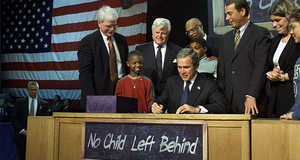
In his first inaugural address on Saturday, January 20th, 2001, President Bush presented his blueprint for his next four years in office. He stated “While many of our citizens prosper, others doubt the promise, even the justice, of our own country. The ambitions of some Americans are limited by failing schools and hidden prejudice and the circumstances of their birth”. 1 He went on to elaborate that thought, commenting “I will work to build a single nation of justice and opportunity”. 2 Through his pledge to reconstruct the American public education system, both George Bush’s personal views and compassionate conservative ideals became apparent to Americans. In his bold address to his country President Bush announced his choices of policy that he would prioritize during his administration. On September 11th, 2001, the Bush Administration was hit with unexpected terrorist attacks on the Twin Towers and the Pentagon. The immediate reaction of President Bush’s administration involved expanding the President’s power to keep our nation secure and free from further harm. George Bush got what he wished for, and for the beginning of his term, there was a united Congress who approved of these increases power in order to protect the country. In an ABCNews/Washington Post Poll, they found that in May of 2001, 55% of the American public approved of how the President was doing his job in office, while 40 % of the public disapproved. In comparison, directly after the attacks on September 11th, President Bush’s approval ratings soared to 90% approval with only 6% disapproving of his actions. This approval remained high, to over 80% approval until the spring of the following year.3 4President Bush laid out his domestic policy agenda before this attack and with this new power and support, he struck while the iron was hot. While handling foreign policy matters, new wars and American security at home, the President also had to continue improving his own domestic policies. Throughout his campaign the President preached about his compassionate conservative values. “By his choice of campaign issues and themes, Bush offered himself as a different kind of Republican”. 5 Tactfully, the President appealed to a larger base by presenting himself not as an elite while male, but a man who could also commiserate with the masses and who understood their needs. The constituent support was there and Congress had willingness for negotiation in the forefront of their minds. The opportunity to get his first priority on his domestic agenda passed was now. Congress had rallied behind the President and was ready to stand united and prove America was still strong, both within the states and how the country presented itself as a united nation to the rest of the world. Although choosing a “compassionate conservative” issue as his first victory, his strict Republic ideology nevertheless could not be stripped away. President Bush presented a new education package to his Congress, one that raised the bar, restructured failing public schools, and gave American parents and students choices in their education. “The President’s basic strategy is to put strong government in the service of conservative values. The central value for Bush is freedom”.6 President Bush believed that the additions of accountability and personal responsibility would be the solution to the inherent and structural problems in the American public school system. As Governor of Texas, President Bush triumphed in creating meaningful and tangible state education reform. The Texas model was the state version of the No Child Left Behind Act with standards and accountability the overarching themes. Seeing success in his own state, President Bush used his expertise on this subject to proclaim that this solution would work best by applying the same reform nationwide. At the end of the fall with his country and Congress on his side, President Bush audaciously moved forward with his new education policy, the No Child Left Behind Act. His personal commitment to this issue was apparent throughout the entire process, and also became a great example of how the President’s conservative values would be woven throughout his domestic policies. President George Bush had a fairly flawless execution when it came to federal education moving through the legislature. When examining Bush’s leadership in the context of success in this domestic policy area, it is apparent that the stage was set for this accomplishment. Much of this success was not actually President Bush’s doing, but he strategically used this “political time” by aggressively taking advantage of the situation. He utilized this political context, took his strong personality traits, and used his vision to get this through Congress and signed into law. In the book, The George W. Bush Legacy, Campbell looks at the opportunities handed to the President in the scope of the historical and political context of that time in history. The “policy windows” and risks taken go hand in hand. George Bush saw this occasion to use this time in history to create progress, while not actually participating heavily in the political maneuvering within Congress. With that opportune timing, the modernization of the Elementary and Secondary Education Act of 1965 began. Federal Education Policy: The ESEA RestructuredWhen Reagan came into office, his education priority was to cut back the responsibility of the federal government and give control to states and localities. Through his Omnibus Reconciliation Act (1981), President Reagan cut the amount of federal aid and also the amount of regulation of public schools. Reagan’s policy focused on devolution and after implementation, cut federal aid to schools by $1 billion dollars. Reagan believed in one principle; that the federal government did not need to work towards any specific education goals and emphasizing block grants to assist the states, while not controlling them. Following Reagan, President George H.W. Bush came into office declaring that he was going to be the “Education President”. Bush Sr., like Reagan, believed that the federal government could not solve the education problems through the country, but by creating strict and comprehensible goals, progress could be made. During the first two years of his presidency, no education legislation was enacted. During those years he began to meet with business leaders and conducted an Education Summit involving all the Governors of every state. This collaboration developed into principles that in turn became the national performance goals. After a few years and turnover in his administration, President George H.W. Bush presented America 2000. This plan was to create more than 500 schools across the country, all receiving direct federal aid. In addition, it included support for the local organizations and gave partial aid to private school vouchers. While this legislation was discussed in both the House and Senate, with changes continually being made, it did not pass, even at the end of Bush’s term. Alternatively, he was successful in creating the National Council on Education Standards and Testing in 1992. This was a bipartisan group which would learn how implementation of setting nationals standards would affect the states and local school districts. This Council issued a final report that acknowledged the need for national goals and assessments, but emphasized that these assessments and goals should not affect state curricula. President Clinton came into office with the commitment of an increased role in education policy. After utilizing information and research from the previous administration, President Clinton developed legislation titled Goals 2000, which incorporated input from the bipartisan council with improvements from the experiences the States had with the previous reform. “It was an unusual federal program because it did not target a particular group of students or subject areas”. 7 The Act encouraged reform across the board – the States knew that the federal government was emphasizing standards and assessment to measure school standings. The federal funds that the States served multiple purposes and States took advantage of that flexibility and originality. Notably, one of the largest recipients of this funding was Texas, where George W. Bush was Governor, receiving over 100 million dollars. This funding was discharged into creating state standards and assessments. This individuality handed to each state put the President in a difficult situation, and Bill Clinton proposed creating the National Education Standards and Assessment Council to ensure that all States exams and standards were of high quality, but because of Republican fear that it would increase federal control and state decisions, the legislation disintegrated. At the same time of this passage, Clinton reauthorized the ESEA, renamed as Improving America’s School Act. It received bipartisan support because the Act required all students, regardless of background, to meet the same standards. The legislation, which required equal treatment of all students, also required the same standards and accountability for all students. With the passage of this Act, IASA became the largest single federal funding source for elementary and secondary education. States received funding dependent on their acceptance to promising and altering their standards and testing. After the 1994 election the Republican controlled Congress set to eliminate many of the Goals 2000 initiatives and reduce the federal role in this area. Although Congress blocked new legislation in Clinton’s second term, education appropriations rose by 15% during his last year in office, up to $6.5 billion dollars. Following President Clinton would be George Bush’s opportunity to put his spin on it. President Bush’s Inner Circle: Education Policy Decision MakingThroughout his two terms in office, President George Bush behaved as though he was employed in a business setting within the White House. To his liking, he surrounded himself with advisors and cabinet members who shared the same views as him. This style involved a select group of consultants and carriers of information that suggested procedures and policy ideas to the President; upon which he would swiftly process the information, and make a decision. George Bush was not looking to seek varying opinion in the White House, he wanted information that tailored to his own personal opinion, and that is exactly how the White House operated. This CEO style included a bold agenda that was rigidly set, and the President would not veer off that course, no matter what new situation or information. The process involving his education policy was no different. The President delegated this policy area to a few advisors who shared his same viewpoints on controversial education topics. Not surprisingly, Bush chose his top education group from people in his past that he could trust. Rod Paige, Bush’s first Education Secretary, was superintendent of Houston’s Independent School District Superintendent, the nation’s seventh largest school district. He grew up in a segregated school district and saw the administration’s NCLB Act as a practical and imperative solution to closing the achievement gap. Margaret Spellings, Bush’s second Education Secretary was a friend of Karl Rove, who introduced her to George Bush during his campaign for Governor. She became his top aide in Austin and traveled to Washington as Chief of Domestic Policy. While working as an educational aide she helped oversee accountability reforms that developed into the No Child Left Behind Act. It is important to note that because President Bush surrounded himself with a few advisors who had the same value system as him, their education vision and priorities throughout Bush’s eight years changed very little. Instead of adjusting the implementation of education legislation, they stayed committed to the plan. This type of behavior while in office aided in the passage of the NCLB Act, but later became detrimental to Bush and his educational policy advisors. This inflexibility showed by the Administration was the source of the conflict between the Federal Government and the States. In 2001, while the No Child Left Behind legislation was being developed, Rod Paige, Education Secretary at the time, John Boehner, one of Bush’s key Republicans involved, Representative George Miller, and Senator Edward Kennedy who drafted the language and mechanisms of the bill. Like every other aspect of the Bush White House, Bush’s commitment to stand by his decision extended to his interaction with these players. These officials became part of Bush’s inner circle and helped the President pitch these ideas to the rest of Congress. Getting Education Policy PassedBush’s decision making style, while detrimental in later policy processes, complemented his first legislative victory. “On many important issues, such as the No Child Left Behind bill, the decision process worked well”. 8 Congress and the public rallied with George Bush because he sold this policy in a very effective manner. President Bush’s personality was superb for campaigning. He was enthusiastic, assertive, and extremely personable, all characteristics that were valuable in getting a strong coalition together to support this issue. He used his tactics in governing by campaigning to push this top priority through Congress. It fit his personality well, as he had to delegate work and broadly talk about the legislation aggressively and moved this legislation forward. “Even when he has taken stands, Bush typically has not taken a personal role in negotiating details of legislation until late in the consideration of a bill”. On his priority issues, he has tended to focus on a few essentials, cede ground when necessary to reach his ultimate objective, and rely on Republican leaders to keep the troops in line”. 9 This is a prominent example of how Bush operated within his administration, acting as the chief delegator, but never becoming involved in policy detail. This process involving the No Child Left Behind Act matched President Bush’s style and it worked well in getting this priority through the Legislature. The importance of President Bush’s commitment to education change was not just personal, but was used, in part, to help shape Bush’s legacy. The administration knew that they wanted a new expansive federal education policy to prove that the GOP was moving in a different direction. It would be the President’s first deterrence from Republican standards; it would become an action that would define his Presidency. Bush broke away from the GOP’s opposition to a lively federal role in education policy and politics. George Bush stayed the course and turned away from previous conservative positions such as the 1994 Contract with America and the 1996 Republican Party platform which had promised to abolish the United States Department of Education. The focus on passage of this Act would be to get this group on board. The Republican ideology had traditionally been unreceptive to expansion of government into education, claiming that an expansive federal policy would become an intrusion into the lives of American citizens. Even House Majority Leader John Boehner in the lead up to the election that, “it is clear that the current experiment of having the federal government heavily involved in education has failed,” and voted to abolish the Dept. of Education. The new “compassionate conservative” President would use this accomplishment to show America that Republicans could deliver on an issue that Democrats had championed in the past. It was a strategic move, changing America’s outlook on Republicans while gaining respect politically for compromising with the opposition. It worked and bipartisanship on the bill came together. With the help of a close group working within the White House, President Bush would see his ideas begin to develop. This focus on general principles, gut instinct, and loyalty were the aspects of the office that George Bush acted and reacted upon. He used his “Decider” power when his agenda was not going according to plan. “He found success not by compromise but by working with Democrats who shared his goal to fashion a policy whose time had come. Bush’s knowledge of education and his ebullient personality combined to make him an effective salesman for policies that elites had already by and large accepted”. 10 As previously mentioned, President Bush enjoyed the top-down approach, where he would be the puppeteer and watch from afar the progress that his close allies were achieving in Congress. With the passage the Bush administration set out to close the inherent achievement gap in the American school system and push to create outstanding academic institutions for all students. The NCLB enactment became an imprint of the legacy of George W. Bush. That success was a combination of the right place at the right time in tandem with President Bush’s personality commitment to education and need for results. With this passage, he proved to America that he was the correct person to the job, and lived up to what he set out in his campaign. The House of Representatives passed the bill on May 23, 2001 (voting 384-45) and United States Senate passed it on June 14, 2001 (voting 91-8). President Bush signed it into law on January 8, 2002. The Continuing Issue of States Rights in Education PolicyOne of the struggles since the birth of America has involved the concept of federalism. Our reasoning from breaking away from our mother country was to proclaim independence, for individuals to have choices; to be the rulers of their own destinies. Explicitly stated in the United States Constitution, powers not granted to the national government nor prohibited to the states by the constitution of the United States are reserved to the states or the people. Federalism is a sacred concept in America and one that this country actively scrutinizes when there is doubt of its application. Every State Constitution in America guarantees a citizens’ right to education, while in the United States Constitution no language contains that promise at all. Although public education is predominantly an affair that states and localities are responsible for, the federal role in American schools has grown drastically since the Federal government thought it had obligations in a child’s education. Now it is the ever-changing partnership that has become increasingly complex and conflicted in nature. The United States, even in the early years of our developing society, had some type of schooling. Education had become the responsibility of the states and in the 19th century, the public school system was developed. As the country grew, there was unanimous agreement that to have a bright future, all children must receive an education to become active citizens. Free public schooling for all children was the solution. Eventually, all states developed their own departments of education, school curricula, and methods to finance public education. It became the tradition for the power to lie in each individual state. Funding for local education was based primarily on local property taxes. This strategy has historically been an area of controversy in the political arena. The federal government began to trickle into that state empowered policy area because they saw this deficit as an unfair system. Federal commitment to improving the public school system increased in 1958 with the National Defense Education Act and with Lyndon B. Johnson’s Elementary and Secondary Education Act of 1965. The purpose of this bill was to create equity in the education system. If the playing field was leveled and the Federal Government poured money into disadvantaged areas, the result would be success for all students. That was the plan in the latter half of the 20th century, and this notion has grown into a huge overhaul of education in contemporary America. As George Bush reiterated again and again, he wanted to give a fair shot to every single child in America. When a community does not have the income to pour into their public school system, those students have a significant disadvantage in their education compared to more privileged towns, which would affect their entire course of life. A Federalist Perspective on the NCLB ActWhile President Bush and the White House had great success through the legislative process getting the No Child Left Behind bill pass, the difficulty appeared in how the administration would pick and choose the components within the legislation. “The most important question was not whether the provisions were well-designed but whether they created a sense of urgency and spurred innovation”. 11 There could be different ways to refurbish the education system and it was through the Administration’s pitches that the standards and accountability became the driving force. Education, which tends to be a Democratic Party forte, was taken into the hands of a rigid Republican administration, who tried for numerous reasons to participate equally in this reform. The final piece of legislation was designed for accountability measures to be put into place, along with a heavy increase in the use of federal dollars, with state independence and flexibility becoming secondary priorities. The No Child Left Behind Act was undoubtedly the most interventionist federal education policy in United States history, and a departure from conservative ideals against an invasive government. President Bush stuck to his Republican way of thinking on many other policy issues, but let this legislation come together within the Republican umbrella, with only some compromise. Personal choice, one of President Bush’s republican pillars, was evident throughout the document. When schools were deemed “in need of improvement”, students within the school had a choice to change schools. Accountability and results, another conservative principle, was a key component of the Act, with standardized test scores examining adequate yearly progress in exchange for federal dollars or repercussions. All of these components led to the controversy involving the Act, that the States’ requirements needed further resources. “The NCLB legislation was a complicated mix of federal mandates and state discretion: states are required to put standards and tests in place and create a system for dealing with failing schools, but they set the rigor of these themselves”. 12 On paper, the negotiations looked impressive, but implementing all the facets within this Act would be the integral part of this education overhaul. President Bush, as previously noted, was a leader who “stayed the course” and, once committed to a specific solution, would not change his mind. This personality trait became very apparent while executing the NCLB Act. “Given these cross-cutting currents, much would depend on the way in which the law was implemented by the Bush Department of Education and how the department handled states’ requests for flexibility, extensions, and waivers”. 13 To President Bush, the idea was a simple one: states would comply with the federal mandates, make changes where necessary, and work hard to ensure that every child was receiving a quality education. Staying true to his CEO style as President, he thought his tough position on this legislation and perk of increased federal funds would suffice, and the states would respond positively to these requirements. States and school districts would get rewarded by this obedient behavior while educating America’s students and closing the achievement gap. The powerful new law presented by the administration was in line with Bush’s ideals and after enacted, the President was ready to see his priorities put into action. He did not foresee his expansive education renovation to be as controversial as it became in the coming years. “One awkward question was how the Bush administration would respond to states that pushed back against the law’s requirements in the name of federalism. The administration faced a thorny choice: acquiescing and accepting the efforts to undercut NCLB, or aggressively challenging states that threatened to forfeit dollars in order to opt out of the NBCL regime. In a decision that caused consternation among conservatives concerned about federal overreach and the integrity of federalism, the administration opted to use every tool at its disposal to keep states in line”. 14 This conflict between standards and resources to enact these new requirements caused the States pressure, and as tension grew, the States began to act. Feeling threatened and pushed around, the States began to speak out against the Federal Government. In 2005, the states began flexing their muscles and went against the Federal Act. Texas Education Commissioner Shirley Neeley defied the federal rule requiring most special education students to meet the same standards on the same test as students with no disabilities. This action made the former Governor Bush’s state the first to overtly challenge the NCLB mandate. President Bush’s Administration fined the state $444,000 for not complying with all the requirements. In addition, Utah’s Governor Jon Huntsman signed a bill that ordered state officials to blatantly ignore the federal education law provision that conflict with Utah’s education goals or that would use state money. In the summer of 2005, Virginia lawmakers commanded more flexibility on NCLB requirements. They submitted a “symbolic resolution” asking Congress to exempt Virginia from the Act. Many states acted, creating solidarity and a unity that told Congress that this new policy was not working for them. Legal challenges brought forth by states allowed these entities to voice their concern and put a check on the executive and legislative power. In the United States District Court case of Connecticut v. Spellings, Connecticut, led by Attorney General Richard Blumenthal, argued that the Secretary of Education's rejection of the State’s existing testing plan was “arbitrary and capricious.” Under the law, to qualify for funding the State must submit a plan that laid out standards, challenges, and assessments, and follow through with that plan. The case derived as a result of Connecticut’s proposal to assess special education students at instructional levels rather than grade levels. Within the Act itself, the Secretary of Education has the power to issue regulations to ensure compliance with the Act. The Secretary of Education struck down Connecticut’s plan. The State claimed that the power and discretion of the Education Secretary's interpretation of the NCLB Act violated the Act's provision prohibiting "unfunded mandates." Connecticut simply stated that without the proper funding in place, the changes were not feasible. The case was dismissed but the conflict between the Administration and individual States did not end. In 2008, the case of School District of the City of Pontiac v. Spellings came before the United State Court of Appeals for the Sixth Circuit. It involved the National Education Association, school districts from several states, and ten NEA affiliate associations bringing suit over the mandates incurred by the No Child Left Behind Act. The groups argued that, “Because of the act’s “Unfunded Mandates Provision” (UMA), at 20 U.S.C. § 7907(a) (2005), the court held that states did not have the clear notice of their liabilities under NCLB that is required by the Spending Clause of the U.S. Constitution. The provision reads: "Nothing in this Act shall be construed to authorize an officer or employee of the Federal Government to mandate, direct, or control a State, local educational agency, or school's curriculum, program of instruction, or allocation of State or local resources, or mandate a State or any subdivision thereof to spend any funds or incur any costs not paid for under the Act." 15 At the time, Secretary of Education Margaret Spelling stated that all States must comply with the NCLB requirements. The argument put forth by the plaintiffs was that the laid actual language of the NCLB Act does not require compliance beyond what the federal funds will pay. She continued to commit to her initial beliefs, stating that even if funding was not provided, it was the responsibility of the States to comply with all requirements. Within the opinion of the Court, the plaintiffs wanted an explicit statement making a declaratory judgment “that school districts are not required to spend non-NCLB funds to comply with NCLB mandates”. In a press conference after the decision stating that the law was unclear on the liabilities states incur when they accept the NCLB funds, the NEA’s Bob Chanin stated “You’ve been saying for six years that this is the best thing since sliced bread for education. If you really believe it, you’re going to have to put in another $70 billion. The only way you can compel states is if you give them the money to do it, you can’t have it both ways”. 16 While all these cases were dismissed, the lawsuit will have implications for the comings years, raising question about funding for education and spending priorities for America. At the heart of the issue is the state versus federal power struggle. The States became fed up with the mandates that were required by the federal government but were not met with adequate funding. There was an inability of the States to get their unique problems heard to the Federal Government. No Child Left Behind: The FutureOne of the chief sculptors of the infamous Act, Representative George Miller, stated, “I would give [NCLB] an A in terms of the goals it has set… in trying to develop a system to make sure that each and every child is proficient. I would give it an F for funding…. And on implementation, I would give it a C.” 17 Two years after the execution of the federal expansion, 24% of American school fail to make adequate yearly progress, many of them regarded top notch in the states. There is one thing for certain, the testing and accountability President Bush required by this policy is now drilled into the American school system. The culture of testing and pressure and high standards shown through the use of standardized testing has changed the school system. In addition, this issue that was supposed to bring both Democrats and Republicans together sparked major polarization within Congress. Before the 2008 presidential election, the Democratic candidates had a platform that tore the Act apart, creating pillars of new reform to come with a new president. With many parties agreeing the components of the law need to be altered, the question now is a political one. The new questions involve what will be kept and what will be thrown out the window. Bush’s agenda of reforming education met his goal, but in the long run, this “uniter” deeply divided the country due to this piece of legislation. President Obama’s legislation acknowledges the needs for flexibility, while keeping that strong drive for improvement. If schools miss their target, they still get funding for that year. That administration understands that individual states are going to need different approaches in increasing school excellence. Final ThoughtsBy the summer of 2007, the GOP had rallied together to repeal this law, claiming that the goals of the Act were unrealistic and was an embarrassment to standard GOP principles. While the uproar continued to gain movement, the Bush administration chose to stay the course, and complete their mission of providing a quality education through the means of the No Child Left Behind Act. Over the coming years, what would follow would be numerous Supreme Court cases that argued the No Child Left Behind Act forced states to comply with unfunded federal mandates. States across America did not see these goals achievable under the lacking of funding and time sensitivity involved. States criticize the Act for being overly intrusive and an outlandish overtake of local and state control of education. In the Fiscal Year of 2009, over $25 billion dollars has been allocated to use for the No Child Left Behind Act. It is interesting to note that while proclaiming “compassionate conservatism” in a few areas, while pushing education legislation through he neglected to other areas that hand in hand with other funding with services that are connected to a high quality life of an individual. While in office, President Bush cut taxes that helped the wealthy and created a heavy burden for the lower and middle class, and pumped funding into faith-based initiatives to delegate those services to private institutions. There is hypocrisy with that type of thinking, one that does not create a visionary administration, who thinks holistically about their executive power and actions. “Over the last 50 years. A robust historical record will be a significant resource for those who shape federal policy, including NCLB and its successors, in a new context of international competition and strife, which is forcing the United States to take a fresh look at its "federal"-local, state, and national-approach to many functions, especially education.” 18 President George Bush had to look at education from a Presidential perspective and create a plan to combat the issue of educational funding and take a close look at how each individual school system and state would receive that funding. He placed his values at the conservative end of the spectrum increasing accountability and personal choice in his restricted ESEA. He could have made the Act more flexible after taking that initial approach, but he did not, he stayed the course. The Administration should have been done is been more open minded and less rigid in regards to own states needs and modes of operation. If he let the states administer their own educational policy and oversee it without an iron first, the States may have responded more positively to the reform. In the end, “The attitude many educators, politicians, and the general public have toward NCLB can be characterized in a single word: conflicted”. 19 George Bush came into office to put education as a focal point, did so, and in the end, he will be remembered for how he carried out that important and personal piece of legislation. The No Child Left Behind Act sought to aggressively restructure the public school system, and did so by changing the states interactions with the Federal Government. This policy solution did not work out in George Bush’s favor because he forgot one key factor, the ideal of federalism in American political policy. If he had created and implemented a bill with this concept in mind, the outcome may have turned out differently for President Bush. In the aftermath, the new Obama Administration knew it was a key policy area that he could champion because he saw his predecessor take this unbending approach towards implementation of policy. This observance will only continue to make President Bush leave a terrible legacy in America and allow for President Obama’s legacy to grow. 1.) Bush, George. First Inaugural Address. 20 January 2001. West Front, U.S. Capitol. 2.) Ibid. 3.) Polling Report, Inc. 2010. ABC News/Washington Post Poll. “Do you approve or disapprove of the way George W. Bush is handling his job as president?" Jan. 13-16, 2009. http://www.pollingreport.com/BushJob1.htm 4.) Consequently, as the executive’s power was expanding in areas of homeland security, Bush’s plan to expand executive power in other domestic policy areas may have been overlooked. 5.) Jacobson, Gary. A Divider, Not a Uniter. San Diego, CA: Pearson Education. 2008. 50. 6.) Edwards, George. Governing By Campaigning. NY, NY: Pearson Education, Inc. 2008. 17. 7.) States’ Impact of Federal Education Policy. “Federal Education Policy and the States, 1945-2009”. http://www.archives.nysed.gov/edpolicy/research/res_essay_reagan_state_responsibility.shtml 8.) Heiss, Frederick and Patrick McGuinn.“George W. Bush’s Education Legacy: The Two Faces of No Child Left Behind”. In Judging Bush edited by Maranto, Lansford, and Johnson. Standford, CA: Stanford University Press. 2009. 9.) Edwards, George. Governing By Campaigning. New York, NY: Pearson Education, Inc. 2008. 181. 10.) Maranto, Robert, and Richard Redding.”Bush’s Brain (No, Not Karl Rove)”. In Judging Bush edited by Maranto, Lansford, and Johnson. Standford, CA: Stanford University Press. 2009. 11.) Heiss, Frederick and Patrick McGuinn.“George W. Bush’s Education Legacy: The Two Faces of No Child Left Behind”. In Judging Bush edited by Maranto, Lansford, and Johnson. Standford, CA: Stanford University Press. 2009. 159. 12.) Maranto, Robert, and Richard Redding.”Bush’s Brain (No, Not Karl Rove)”. In Judging Bush edited by Maranto, Lansford, and Johnson. Standford, CA: Stanford University Press. 2009. 164. 13.) Heiss, Frederick and Patrick McGuinn.“George W. Bush’s Education Legacy: The Two Faces of No Child Left Behind”. In Judging Bush edited by Maranto, Lansford, and Johnson. Standford, CA: Stanford University Press. 2009. 165. 14.) Ibid, 166. 15.) United States Court of Appeals Opinion For the Sixth Circuit. School District of the City of Pontiac v. Secretary of the United States Department of Education. January 7. 2008 16.) Ridgod, Joan. “No Child Left Behind Act”. DCBar. April 2008. http://www.dcbar.org/for_lawyers/resources/publications/washington_lawyer/april_2008/no_child.cfm 17.) Heiss, Frederick and Patrick McGuinn.“George W. Bush’s Education Legacy: The Two Faces of No Child Left Behind”. In Judging Bush edited by Maranto, Lansford, and Johnson. Standford, CA: Stanford University Press. 2009. 165. 18.) Neill, Monty. “Making Lemonade from NCLB Lemons”. Rethinking Schools. Fall 2003. http://www.rethinkingschools.org/special_reports/bushplan/nclb181.shtml 19.) Miners, Zach. “No Child Left Behind Loses Support”. US News and World Report. Dec 9 2009. Nation and World Section. http://www.usnews.com/articles/news/2009/12/09/no-child-left-behind-law-loses-support.html From the Series: Years of Tumult: Retrospective Analyses of the George W. Bush PresidencyA compilation of articles researched and composed by a class of Northeastern University Political Science students, edited by Chris Federici and Nicole Wilkins. I: Economic PolicyII: Compassionate Conservatism and Domestic Policy
III: Media, Elections and the Politicization of Governing
IV: Law and Politics
V: Bush's Anti-Terrorism Policies
VI: Foreign Policy and International Relations
From the Inquiries Journal Blog   Related ReadingMonthly Newsletter SignupThe newsletter highlights recent selections from the journal and useful tips from our blog. Suggested Reading from Inquiries Journal
Inquiries Journal provides undergraduate and graduate students around the world a platform for the wide dissemination of academic work over a range of core disciplines. Representing the work of students from hundreds of institutions around the globe, Inquiries Journal's large database of academic articles is completely free. Learn more | Blog | Submit Follow IJ


Latest in Political Science |