Mikhail Bulgakov and Antun Gustav Matos: Two Authors and Periods Collide
By
2010, Vol. 2 No. 02 | pg. 1/1 The eccentric literary style used by the popular nineteenth-century Croatian writer Antun Gustav Matos in his opera is a good starting point to draw a comparison between him and the great Russian author, Mikhail Bulgakov. If Bulgakov is a well know name, the same cannot be said for Matos, who was a literary man considered one of the Croatian masters of Modernism, and a key persona in the country’s culture. He was not only a writer, but also a poet, a journalist, and an essayist. 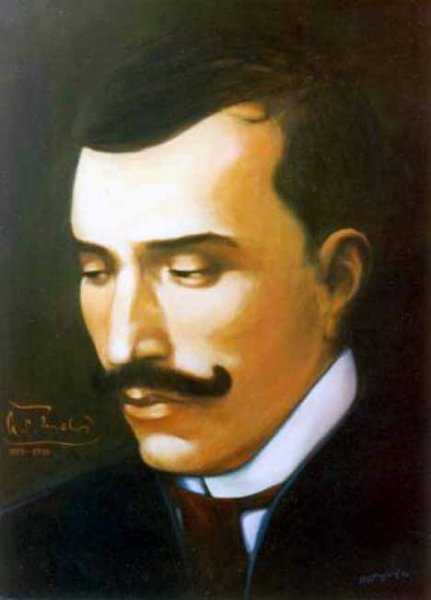 Despite there being a time difference between the two authors, it is relevant to draw comparison between them. Matos' career spanned the 1800s and 1900s, while Bulgakov published only in the twentieth-century, releasing masterpieces like The Master and Margarita, Heart of a Dog, and Fatal Eggs. It was in these operas that Bulgakov was closer to Matos as an imaginative writer. Despite there being a time difference between the two authors, it is relevant to draw comparison between them. Matos' career spanned the 1800s and 1900s, while Bulgakov published only in the twentieth-century, releasing masterpieces like The Master and Margarita, Heart of a Dog, and Fatal Eggs. It was in these operas that Bulgakov was closer to Matos as an imaginative writer.
Both authors leave the realist modernism on the second course in order to enrich the story with fantasy elements which often verged on magic and grotesque, especially in Bulgakov's work. In Matos' short prose piece Camao, first published in 1900, the most important character is an animal, Camao, a parrot which brings the name of a legendary bird who dies when a wife betrays her husband. And the parrot will confirm its ominous nature as he will be the cause of the tragic end of the story. Bulgakov also features an animal as one of the key characters in The Master and Margarita: Behemot, a huge black cat who acts and talks like a human and has a curious food fixation. Both narrations mix up in a masterly fashion reality and fantasy, through an enthralling rotation of events fragmented by sci-fi like flashbacks. Both operas end with the death of the protagonists, thus having a further commonality. They are two events far and near at the same time. The Master and Margarita's couple will not die tragically like Kamenski and his unnamed lover. While Matos’ protagonists die violently after being caught by the woman’s husband (and betrayed by the parrot), Bulgakov’s characters were poisoned after “Professor” Woland’s order, getting thus a “soft” death. But then, after a divine intervene, The Master and Margarita will be destined to live in an alternative world in which the two can keep on loving each other, as per Margarita’s wish. The death theme, deeply analyzed in both narrations, is thus developed differently. The love theme presents fewer differences, even if Bulgakov draws more of a romantic story, while Matos’style is more symbolist. If love between the Master and Margarita is “true, faithful, eternal”, Kamenski’s love toward her female partner is a forbidden love, unfaithful, as the lady is married to another man. It is a love that can only end up in a tragedy, as it will promptly happen at the story's end. The woman is seen as a symbolist poetry’s symbol, a non-present detail in Bulgakov’s masterpiece. As stated earlier, symbolism is influential in both authors' work. Symbolic elements appear in both operas, especially the theme of apocolypse, the destruction, and Satanism. Matos appeals many times to both, as Kamenski’s forbidden love flows into death and destruction, while in Bulgakov’s book Satan is embodied by the mysterious Professor Woland. Not surprisingly, Woland is one of mythological German names of Satan. Even if Bulgakov and Matos are different in style, we can draw parallels between them. Both authors distinguish the meticulous description of the characters’ psychology, which are the true core of the opera, even more than the plot or the events, especially in Matos’ prose. To get more into the death, forbidden love and nocturnal themes, the Croatian novelist ties the plot and the events’ development, focusing more on the heroes’ description, and on the impact of the fantastic events on the narration itself. The books are not short on autobiographical allusions. Alfred Kamenski shares many traits with his creator: both live a “bohemian” life, are not particularly welcome at home, and, equally important, both are artists. The same can be said for Bulgakov, where many qualities of the Master can be seen in Bulgakov himself, from the sociopolitical persecution that overwhelms the Master in the narration and Bulgakov in Soviet Russia, to the ritual of the burned manuscript, as Bulgakov himself will burn some early writing of The Master and Margarita, a scene recreated in the book, that introduced the famous quote “manuscripts don’t burn” (287). ReferencesAntun Gustav Matos, Zagreb: Croatian Writer's Association, 1994. The Master and Margarita. Trans. Richard Pevear, Larissa Volokhonsky, London: Penguin Classics, 1997 
From the Inquiries Journal Blog  Monthly Newsletter SignupThe newsletter highlights recent selections from the journal and useful tips from our blog. Suggested Reading from Inquiries Journal
Inquiries Journal provides undergraduate and graduate students around the world a platform for the wide dissemination of academic work over a range of core disciplines. Representing the work of students from hundreds of institutions around the globe, Inquiries Journal's large database of academic articles is completely free. Learn more | Blog | Submit Follow IJ


Latest in Literature |