Conducting Business in a Fast-Paced World: The Importance of Change Management
By
2010, Vol. 2 No. 10 | pg. 1/1
IN THIS ARTICLE
KEYWORDS
Today companies strive to find new strategies and ways to dominate their markets. With the rapdily changing technological realm, companies are faced with a great many options of how to conduct their business. This also means that enterprises that have been around for a long time need to change to accommodate these new advances and improve their own workflows. How these companies choose to face these changes falls under the topic of change management. Analysis of the FieldChange management is becoming an increasingly popular field of study. One researcher, David Frantz (2004) cited many reasons for the increased focus on change management. Table 1 lists some of the reasons that Frantz identified.
Table 1: Changes in Business Environment
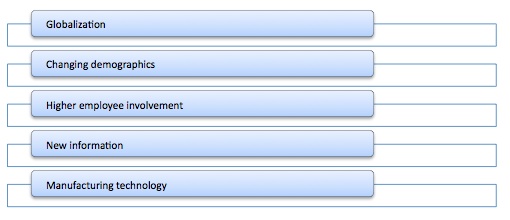
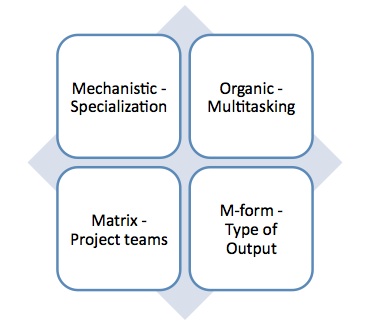
With these significant changes in the business environment, it is not surprising that a number of new theories have surfaced in the field of change management. Frantz (2004) suggests that these new theories fall under two categories. The first of these categories is called the organic models. According to Frantz (2004), these models encompass new approaches that focus on natural phenomena as an explanation for how organizational change takes place. Included in this grouping is the widely discussed complexity theory which focuses on the complex interactions between components of the system. Another collection of theories in the field of change management fall under the category of organizational stage models. According to Frantz (2004), these models focus on the life-cycle of products and services. Specifically, these theories propose that change should be handled differently based on whether the product is close to the introduction phase or close to the obsolescence phase (Frantz, 2004). In addition to characterizing the change management models, another key to understand this field is to understand the forces that bring about change. Frantz (2004) summarizes three methods to classifying these forces. The first of the change forces is referred to as technical versus adaptive approach. This approach explains that technical problems may require more traditional remedies and that other problems may require more adaptive leadership skills (Frantz, 2004). The second force is called the systems approach. The systems approach is an organizational behavior-based approach. It concentrates more on organizational learning and systems thinking. Specifically, the focus of the systems approach is to study the interdependency of all of the actions an organization takes (Frantz, 2004). The last change force is called the incremental versus discontinuous approach. This approach concentrates on the pace at which changes and impacts take place. For instance, those organizations that face incremental change see a starting place and a stopping point for each period of change. On the other hand, a company with discontinuous change find themselves in a constant state of change and transition (Frantz, 2004). As mentioned previously, several models and theories have been proposed in the area of change management. With change such an important topic for companies, it is important that companies have the right people to management change. It is important that companies look to internal leaders to help them through the change process. The Study of Change ManagementWithin this area of study are several subsectors that help to define the role of change management. One of these subsectors is the study of leadership. Leaders are a valued asset to companies for several reasons. They are the key employees that help to shape an organization’s values and image. And for this reason, leaders are an important part of implementing change in any business. Researcher Kimberly Boal (2004) points out in one of her recent writings that there are several a couple of different kinds of leadership skills. Supervisory theories focus on person-oriented and task-oriented skills of leaders. Strategic leadership theories focus on the skills of those who have overall responsibility within an organization. Whether considering the role of the supervisory leader or the strategic leader, both play a large part in the successful implementation of change. Managers and leaders that fall under the category of supervisory leaders can have a direct impact on the motivation and attitude of their subordinates. In a recent article, Robert House (1996) revisited his study of the path-goal theory of leadership effectiveness. His theory suggests that managers and leaders have a direct effect on the motivation of lower-level employees and those employees’ satisfaction with their job (House, 1996). With such a direct impact, it is apparent that these managers and leaders could shape and mold the attitudes of their subordinates through their showing of approval and positive attitude towards changes that are made. Strategic leadership roles also play an important part in implementing change in a business. According to Boal (2004), strategic leaders are able to affect the behavior of the entire organization as a whole. These are the leaders and managers who dictate corporate vision and set the rules for how the organization will run. In this position, these managers and leaders are the ones that will set the tone for the change to come. They will start the process of building a positive image of the change that will occur and reinforce the direction the company will go strategically. As companies move forward and strive to enforce change, it becomes increasingly important to identify those employees that are, or can become, leaders. In order for companies to identify these leaders that can manage changes, they need to understand what characteristics to look for. Boal (2004) identified three categories of cognitive ability that leaders should have. The first skill that leaders should exhibit is the ability to learn (Boal, 2004). According to Boal (2004), the ability to learn is referred to as the capacity to absorb new information and use the new information. Furthermore, the ability to absorb and use this new information is affected by a person’s cognitive complexity (Boal, 2004). Cognitive complexity is the terminology that describes the amount of categories and dimensions a person uses to understand stimuli and understand relationships between these categories and dimensions (Boal, 2004). This ability to learn could be valuable to companies as these leaders will be more skilled at learning and understanding new ideas and reasons for change. The second skill needed by potential leaders is the ability to change. The second skill needed by potential leaders is the ability to change (Boal, 2004). This skill is evident in a person when they show flexibility and adaptive capacity. Like the previously described skill, the ability to learn, the ability to change also requires a person to be cognitively complex and also, behaviorally complex (Boal, 2004). This ability to change within a person plays a crucial role in a person’s ability to accept and understand change as dictated by their employer. If a person exhibits the characteristic of flexibility they will perform better through changes. A third skill in Boal’s (2004) list is referred to as managerial wisdom. Essentially, managerial wisdom encompasses the concept that some people have a stronger ability to perceive when change needs to happen (Boal, 2004). These are the people that are commonly said to have “good business sense.” They can tell when the business environment is changing and they act accordingly to accommodate these changes. This skill will help businesses manage change. Companies have an advantage when they have managers and leaders in place that are particularly skilled sensing when change needs to happen. In addition to Boal’s (2004) list of skills that are present in leaders, other theories exist that aim to show specific personality traits that contribute to the success of leaders in the workplace. Several researchers have pinpointed one trait specifically that helps employees to shine at work. That personality trait is charisma. Charismatic individuals are often natural leaders as people are drawn to those individuals. Charismatic people are often good at persuading others to share their opinion (Conger, 2004). This makes them particularly powerful if they are in the high managerial positions within the company. While it is obvious that charismatic individuals can be valuable to companies because of their persuasiveness, researchers have identified other important aspects of the charismatic trait. In their recent study, De Hoogh and Hartog (2009) tested the ability of charismatic leaders to withstand the pressures of their job. They looked at the incidence of job burn-out among managers and found that those who are characterized as being charismatic were less likely to burn out (De Hoogh and Hartog, 2009). This means that it is likely that these individuals not only are able to help persuade other employees to accept changes but they also deal well with the pressures and other negative aspects of change in the workplace. The charismatic trait within company leaders looks to be beneficial. However, managers need to know how to identify which employees have this trait. Conger (2004) points out that charismatic leaders show certain behaviors that point to the existence of the trait. The first behavior that is shown by charismatic leaders is sensitivity to their environment (Conger, 2004). Charismatic leaders are able to pinpoint problems and inefficiencies with the company. Conger (2004) also points out that these managers are often involved in starting the change process and even seek to implement small changes in slow times. When change is needed, they demand it. The second type of behavior shown by charismatic leaders is the search for an idealized future (Conger, 2004). And, they not only search for this ideal situation but they strive to implement their ideas and bring about change. The important part of this characteristic of charismatic leaders is that they have the ideas and work to implement them. Some leaders fall short and have great ideas but are unable to follow through and have the plans to implement the ideas. This is where the charismatic leader can be especially valuable to a company. The third type of personality trait and behavior that sets apart a potentially successful, charismatic leader from other managers is the ability to achieve their vision. Conger (2004) points out that charismatic leaders need to be able to follow through with their plans for change and inspire their coworkers. They also need to show that they have the confidence in their own abilities to help reach the shared company goal (Conger, 2004). Through their natural magnetism and confidence, these leaders play a valuable part in companies because they are able to convince other employees that change is good and that is can be successful. After looking the many advantages of having charismatic leaders in management positions, there is one potential negative side that companies need to consider. While the appeal of these leaders can be used in a positive way to campaign for change within the company, there is the danger that these leaders could be against a change that management wants to make. With their high appeal among their coworkers, it would be easy for a charismatic leader to push anti-change ideas among the workforce. If the other employees decide to follow this leader, the company will experience a strong resistance to change and face a situation where it may be difficult to successfully implement the change. In simplistic terms, company leaders and upper management will want to make sure that the charismatic leader is on their side. Future Directions in Change ManagementThe study of change management has seen a number of transformations over the past several years. As companies continue to build their presence on the internet and through other modern forms of business, the need for managers to lead and implement change will continue. They always say that the only thing certain in business is change and, with that, comes the need to successfully manage and implement change. While business processes have changed significantly due to the internet, one of the biggest underlying areas of change is the structure of business. As companies see greater efficiencies and new ways of doing business via the internet and other technologies, they are also striving to create structural efficiencies and to reinvent structures that are flexible enough to work under these new conditions. For years, businesses operated under the typical hierarchical, top-down structure that was popular and worked well for brick and mortar companies. Several researchers over the years have introduced new structures that differ slightly from the hierarchical structure. However, in the most recent years is when companies have been the most experimental (Gonzales, 2006). In fact, Gonzales (2006) summarizes four types of organizational structure. Chart 1 illustrates each of the four types of organizational structure and what each structure focuses on. The first type of structure is the mechanistic type of structure. This structure is characterized by vertical coordination and high task specialization (Gonzales, 2006). This form might best be utilized by a company that focuses on a narrow product line and does not diversify into complicated forms of doing business. The second structure described by Gonzales (2006) is the organic structure. This structure is characterized by multitasking, lateral coordination and facilitative leadership (Gonzales, 2006). The type of business that may use this structure is a business startup company with a trendy, innovative product that is marketed through several venues. Chart 1: Types of Organizational Structures Another type of business structure is the matrix (Gonzales, 2006). The matrix structure is best illustrated through its use of project-oriented teams that are made up of members of the company from several different divisions (Gonzales, 2006). The type of company that may use this structure is a success, stable company that is looking to reinvent the way they do business. They might use this team-oriented structure to help uncover new ideas and strategies. The final form of organizational structure is the M-form (Gonzales, 2006). The M-form organizational structure is classified by multiple divisions that are organized by the product they produce (Gonzales, 2006). Companies that use the M-form structure might include companies that have several, established divisions that make diverse products. After studying each of these newer forms of business structure, it is obvious how leaders could play an important role in helping companies to organize these new structures or transition to these structures from more traditional structures. A significant change like this will require strong leaders that can build confidence and influence others. Change management is an ever-changing field of study. As the business environment continues to evolve and change, companies will need to be able to successfully implement changes. A key part any change management program is to utilize strong leaders within the company to plan for the change, implement the change, and operate after the change. Through the identification of these leaders, companies can hope to make change management a smooth process. ReferencesBoal, K. “Strategic Leadership.” Encyclopedia of Leadership. 2004. Conger, J. “Charismatic Theory.” Encyclopedia of Leadership. 2004. DeHoogh, A. & Hartog, D. (2009). Neuroticism and locus as moderators of the relationships of charismatic and autocratic leadership with burnout. Journal of Applied Psychology, 94(4), 1058-1067. Frantz, D. “Change Management.” Encyclopedia of Leadership. 2004. Gonzales, A. “Organizational Structure.” Encyclopedia of Governance. 2006. House, R. (1996). Path-goal theory of leadership: Lessons, legacy, and a reformulated theory. Leadership Quarterly, 7(3), 323. 
From the Inquiries Journal Blog   Monthly Newsletter SignupThe newsletter highlights recent selections from the journal and useful tips from our blog. Suggested Reading from Inquiries Journal
Inquiries Journal provides undergraduate and graduate students around the world a platform for the wide dissemination of academic work over a range of core disciplines. Representing the work of students from hundreds of institutions around the globe, Inquiries Journal's large database of academic articles is completely free. Learn more | Blog | Submit Follow IJ


Latest in Economics |