Featured Article:The Macdonald Sisters: How They Visually Created Equality Between Men and Women
By
2011, Vol. 3 No. 09 | pg. 1/1
KEYWORDS:
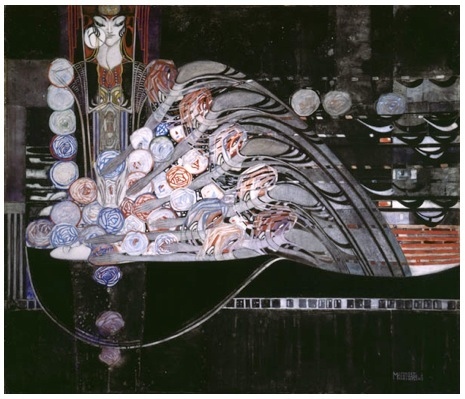
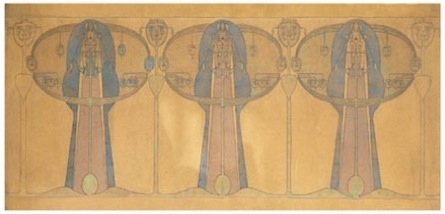
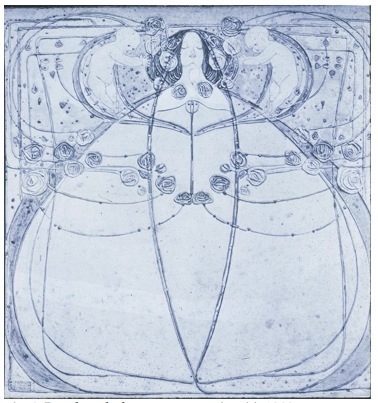
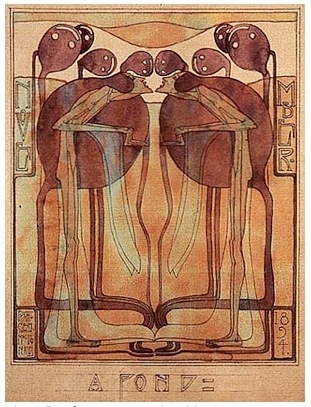
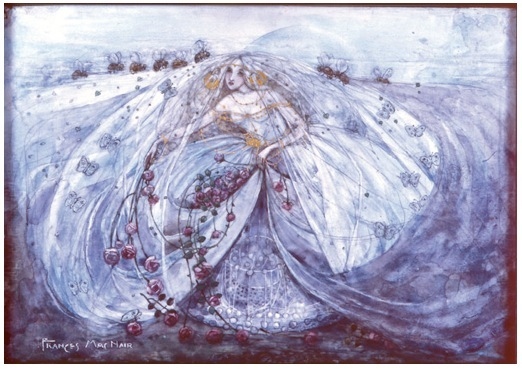
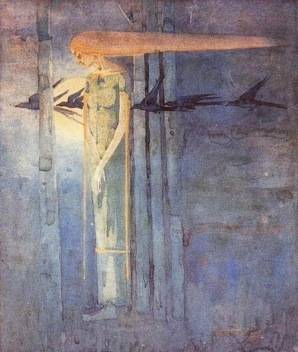
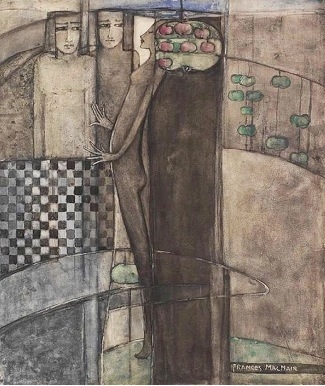
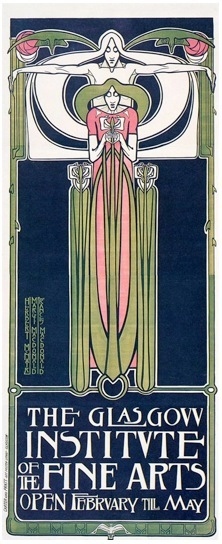
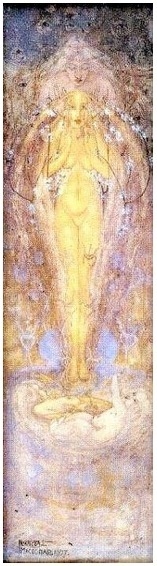
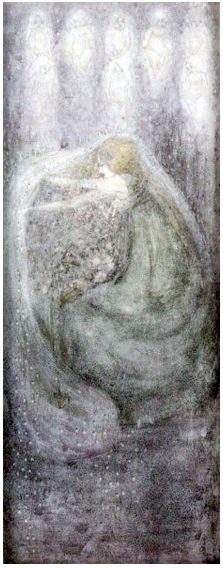
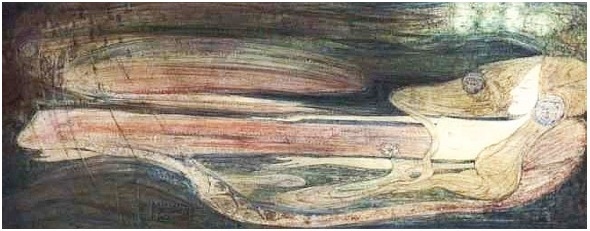
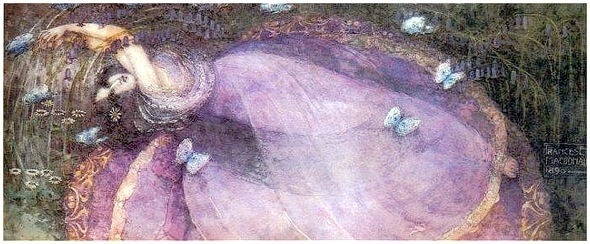
The prevailing issue of fin-de-siècle France was the increasing autonomy of women. Independence for women threatened traditional social and gender roles, and consequently men’s civil power. Margaret and Frances Macdonald embodied this “new woman” with their status and education as professional artists and the visual motifs that they accordingly employed. They managed to combine feminine and masculine characteristics into one figure in their works, effectively establishing an androgynous figure. In the process they managed to establish an equality, if not superiority, of women and men. Margaret Macdonald was born in November of 1864 and Frances was born in August of 1873. Being raised in an upper-middle-class family enabled both sisters to attend art school and to initiate innovations in the art world. The social position of the Macdonald family ensured that they were educated and that they had a certain amount of independence. From the beginning, they were enrolled in the most progressive schools, including the Orme Girl’s School. This institution pioneered female education including Latin, French, German, English, mathematics, music, natural sciences, ancient and modern history, and art in their curriculum. Margaret enrolled in the Glasgow School of Art in 1884 with her sister closely following her in 1890. As early as 1878, it was understood that many of the day students were women1. The director, Francis H. Newbery, was committed to an excellence in art that combined functionalism with beauty while encouraging individuality and experimentation among his students2. Here the instructors trained the Macdonald girls as professional artists. This is also where they met their future husbands, Charles Rennie Mackintosh and James Herbert McNair. These four youths came to be known as the “Glasgow Four” during their time at the school. They had their first group exhibit held at the Arts and Crafts Society in 1896. Around this time, Margaret and Frances set up their own studio at 128 Hope Street in the city of Glasgow. The Glasgow Four often collaborated on posters and artworks submitted to the school Magazine, a student-based publication that showcased various works of art and literature. This extensive collaboration between the youths caused them to often be classified as the “Spook School” by their critics in the community. Their furniture and graphic designs were recognized as original, if not thoroughly eccentric, for they were influenced by Celtic art and Symbolism3.Part of the curriculum at the Glasgow School was learning from the nude model. However, neither the Macdonald sisters nor any of their female friends made ‘life-like’ representations of the nude figure except for these classes. The figure that entered their compositions was always a stylized, de-sexualized figure and crossed the boundaries of debates about representation of the female body. Margaret was elected a member of the Royal Scottish Society of Watercolours in 1898, thus establishing her place in the public eye. She also exhibited at the International Society of Sculptors, Painters, and Gravers in London and at the International Exhibit of Art in Venice in 1899 near the end of her Glasgow career. Also around this time, Frances married Herbert McNair. Although it is assumed that Margaret was involved with Charles at this point in time, they did not marry until 19004. Margaret and Frances grew apart after their marriages, and, more often than not, aligned themselves with their husbands’ art rather than each others’. Frances’ work, especially, changed after the birth of her son in 1900. It experienced a transformation from an interest in gothic elongation to distorted female figures surrounded by a female ‘sweetness’. From this time until her death in 1921, Frances made some jewelry, some decorative art with her husband, particularly for their home in Liverpool, and watercolor drawings. In nearly every instance the watercolors elaborate upon phases of the female experience5. In 1908, Herbert and her returned to Glasgow. There, they resignedly accepted low-pay positions as instructors at their former alma mater. Margaret, on the other hand, had a significant amount of freedom after her marriage. The lack of children resulting from this union opened up possibilities for furthering their respective careers. This allowed Charles and her to travel and participate in numerous exhibitions all over Europe. As a result, their popularity and acclaim in the art world soon out-paced that of the McNair’s. In 1902, she participated in the Esposizione Internazionale d’Arte Decorativa Moderna in Turin. She again, in 1909, participated in an exhibit of women artists at the International Society of Sculptors, Painters, and Gravers. After moving to Chelsea and Collioure, Charles died of cancer in 1928. Margaret lived on her own in London until she died in 1933 in her studio in Chelsea6. Work done by the Macdonald sisters, on account of their sex, was often attributed to their respective husbands. Consequently, scholarship that covers them is far and in between. P. Morton Shand, in 1933, was recorded as claiming that “while Margaret was her husband’s ‘constant inspiration and collaborator,’ she was nonetheless ‘of a decidedly inferior artistic calibre’.” Even as late as 1990, Jocelyn Grigg stated that “Charles may have ‘exaggerated her role in his work’.” The fact is that there was, and still is, a gendered hierarchy in the art world - architecture and commerce as masculine, decorative design and teaching as feminine7. This hierarchy, and resulting bias against female artists, continues today. In the definition for “Macdonald” at Oxford Art Online, it states that “at times weak and whimsical in design and execution, [Macdonald] production[s] are often of considerable originality…”8. The following discussion will be an attempt to categorize, and create an argument for the positive and distinctive valuation of the Macdonald’s work. Starting with Margaret, her work was often gentler than that of Frances9. Solitary depictions of the female figure are mostly seen in her early posters from the Glasgow School. Yet there are some examples that feature a particular type of woman whose elongated body and expressive features combine with a heavily symbolic content10. In La Mort Parfumee 1921 (Fig.1), the rose is used as a symbol for the feminine. There are other female figures present, but they are seen in a supplicating positing, bent over the flowers that are being presented to the prominent female figure. This “leader” is seen wearing some type of elaborate headdress and seems to be in command of the roses, or, by association, her femininity. Thus, this can be conceived as a visual representation of the power Margaret felt later in life as a female artist. The contrast between the dark background and the pastel-colored roses emphasize this distinction between the “dark”, critical world and her individual competence as a feminine figure. The headdress, itself, would have perhaps been classified in fin-de-siècle France as Amazonian due to its primitive and geometric structuring. The Amazon woman was often seen as a “threat” to the established cultural roles. She embodies everything that put traditional social and gender roles in peril; the independent and strong woman. This “new woman” was a rising concern as the increase of autonomous females emerged into the French scene. While Margaret stayed within the “safe” boundaries of the decorative arts, she increasingly pushed the public’s limits with her success and innovation in the art world. She focused on the female figure, seen in groups of three or more, throughout her career. This motif safely asserted feminine solidarity. Camaraderie is present in her well-known, The May Queen 1900 (Fig.2). This piece was made for the 1900 Vienna Secession and was shown on a wall with a mirror and brass/ivory clock underneath. The clock Margaret created herself as part of her experimentations with metal-work. The mirror, however, took many of the visitors by surprise. Some suggested that it “led the viewer into a remote, ghostly world which, once the alien aspects of it were understood, could be recognized as poetical, magical, and spiritual”11. The painting itself depicted five, stylized women in three distinct groupings. The middle figure is isolated from the other two groups on either side of her. Again, there are roses seen as a symbol of the figures’ femininity and the side figures are holding strings of the flowers across the image. They cross over the middle figure, yet it is unclear whether she is also holding the strings or has her hands hidden. Nonetheless, the emphasis is put on her as the central figure and the one with the most femininity. This central figure is thus assumed to be “The May Queen”. The title alone evokes the tradition of the May Pole. As a pagan tradition, the activity centers around their concept of the goddess which symbolizes the fertility of earth. As a result, the viewer can assume that this “May Queen” is the epitome of femininity due to her overwhelming fertility. Even the inside fold of her robe seems slightly labial. Although the pole is traditionally seen as a phallic symbol, here the female figure becomes the phallus. Thus she gains phallic power normally possessed by male figures. The strings of flowers are seen as the ribbons that are used to wrap the May Pole, while the flowers themselves suggest spring. Continuing the theme of powerful female figures, Margaret often depicts that of the maternal figure. She creates many images of the female figure with children, most often infants, although she herself never reproduces. One such example is a panel (Fig. 3) that decorates a desk presumably made by her husband. It depicts a female figure in a huge, bulbous gown with no visible arms, hands, legs, or feet. Two figures of children float on either side of her head, reaching towards her. Roses, again, decorate this image although the figures are not manipulating them this time. The woman’s eyes are closed and she seems to have a gratified smile on her face. These maternal images are perhaps an attempt at fulfilling societal expectations of reproduction that the artist has failed to fulfill with her own body. The labial folds, evocative of maternal fertility, is seen at the center of the image. Thus she asserts the power of motherhood. The available image is made up of various tones of blue, yet it may not be an accurate copy of the work of art itself. If the blue tones are authentic, though, they may be interpreted as a calming environment that corresponds with the serene smile on the woman’s face. She has created a very definite, if not unsuccessful, attempt to create a style of decoration which owes virtually nothing to past artistic style12. Frances’ work, similar to Margaret’s, was characterized by the use of decorative linear patterns and gaunt, stylized human and plant forms13. Yet the reading of Frances’ imagery of the female sexuality and maternity in the light of the often “sad” circumstances of her life take on a special poignancy14. Frances’ art defies categorization within modernity; rather, her art was displaced by a Modernist critical discourse and labeled mysterious, feminine, or fairytale-like, resulting in her subsequent disappearance from the discourse and from the archive. While she does depict all female figures like her sister, isolation often envelops Frances‘ figures. They speak of women’s continuing struggle for equality and recognition15. She presents a sexuality that is either not available or available but melancholy; we see loneliness, despair, and, finally, a shift from confrontation to resignation. She creates unique images of a woman’s search for identity and as such they are explorative rather than definitive and efficacious. Frances’ work provides women some control over their own representation thereby allowing them to explore femininity and sexuality. In her Pond 1894 (Fig.4), she radically opposes prevailing standards of female sexuality. The nudity combined with sexlessness effectively distances it from the Pre-Raphaelite beauty, the Victorian maiden, and the fin-de-siècle femme fatale. This figure, being created at the beginning of her career, significantly contrasts her later figures produced after her marriage. This change is particularly seen when comparing Pond to Girl and Butterflies (Fig.5). Pond’s figures are virtually nude as their angular joints show through their thoroughly transparent robes. Their hair blossoms out behind their torsos then forms skinny streams that run to mid-calf and pool together in the center. Smiling “ghosts”, eerily suggestive of sperm, float behind them as their tails fall behind the figures’ hair and mix with the various streams. These figures nearly represent the opposite of the figure seen in Girl and Butterflies. Here, the woman is completely covered by her bulbous skirts and enveloping veil. Roses make an appearance here, continuing her sister’s symbolic usage. There is some type of cage, or perhaps a crib, revealed under her skirts which may contain a child presumably still in the womb. If so, she echoes Margaret’s maternal themes. However, the meaning changes because Frances does reproduce and fulfill societal expectations. Frances, although she conforms with this one aspect of “womanhood”, is far from embodying the ideal woman of the period. Isolation is the theme most prominently portrayed through her use of the female figure. The combination of pale greens, blues, and mauves surrounding the woman’s attenuated body convey a sense of remoteness, aloofness, and aloneness in Ill Omen 1893 (Fig.6). This woman exists independently in a world of her own making16. This particular image is the first of many to depict the struggle between fancy and reality. Here, the figure is alone against a backdrop of mixing colors while black crows fly by behind her. Her hair is also trailing behind as if she stands erect against an intense wind, hoping to blow her away. This “wind” may be the many cultural conventions Frances was fighting to displace, but this point is up for debate. She may also be seen as a phallic symbol, thus possessing the power conventionally reserved for male figures. Continuing the theme of isolation, Frances creates many images in which the woman is caught between various choices. She specifically contrasts the isolated woman against various influences. The title is self-explanatory in Prudence and Desire 1912-15 (Fig.7). The woman depicted is obviously rejecting both for a life of isolated alienation. She stands with her abdomen thrust forward and hands visually pushing away the male figures meant to personify Prudence and Desire. These male figures seem to embody the criticizing looks of a unwelcoming public with their squinted eyes, down-turned eyebrows, and thin mouths. The form behind the woman’s head looks to be filled with apples, which conveys biblical connotations. This is perhaps a comment on, or illustration of, Eve being expelled from Paradise. While both sisters portray the female figure and use some of the same themes, they infuse their images with different meanings. Many of these meanings come from their experiences in marriage. Margaret and Charles had the more public relationship of the group, mostly due to their lack of children and their resulting mobility. Frances and Herbert, however, have often been called “’two artistic people’ who had ‘produced one baby and a multitude of spooks‘”17. Just from this, one can gather that the public looked more favorably upon Margaret and Charles’ relationship, although they weren’t the ones to conform to the expectations of reproduction. When directly comparing the two sisters, it is required to examine the work they completed together while attending the Glasgow School of the Arts. One such work is a GSA Poster from 1895 (Fig.8). It is easy to see that both of their styles originated from the same place. What is interesting is how each sister evolved artistically. The two female figures depicted are angular and linear, geometrically symmetrical with the rest of the composition. Frances retains this androgynous form for a significantly longer period of time than Margaret. This linear androgyny may be perceived as the first assertion of their female figure embodying the phallus, thus possessing its power. Stylized labial folds are seen along with the rose motif to characterize the feminine, but in moderation. The Macdonalds also completed a four seasons series, starting with Spring (Fig.9) by Frances in 1897. This series was originally exhibited in metal frames also created by the sisters. To really look at these works, it is essential to consider the frames for they exemplify a marked contrast between the soft watercolors and the hard metal. Again, the dichotomy between feminine and masculine aspects of the artwork is seen. Spring, especially, is seen as a fertile, maternal figure with her sex organs clearly delineated. There is also the faint outline of a child figure at her feet. The frame contains bulbous forms that provide the gendered opposite in the form of testicles or sperm. While Frances made Spring and Fall, Margaret created Summer and Winter 1898 (Fig.10). The various seasons markedly signify fundamental differences in the sisters‘ styles. Spring and Fall, as seasons, are very similar in temperature and epitomize change. Thus they are seen as liminal seasons. Summer and Winter, on the other hand, are opposites in terms of temperature and represent the two extremes. Thus they are seen as dichotomous seasons. Frances, as an individual and as an artist, floats in this realm of liminality. She struggles throughout her life with not fitting in, caught between the world of motherhood and the world of public power. On the other hand, Margaret exists in a truly dichotomous realm. She is accepted publicly as an artist, albeit through her husband, yet does not conform to reproductive expectations. Frances spends her life looking for a niche, arguably creating the most dynamic artwork of the pair, while Margaret easily fits into society as a woman, albeit a phallic woman. The foremost difference between Margaret and Frances is visualized in their respective representations of the famous literary figure, Ophelia. She is well known in western culture as the epitome of the victimized female. In Shakespeare’s Hamlet, she is caught in the archetypical dichotomy between the virgin and the whore. She eventually goes mad and commits suicide, unable to endure unjust expectations. Frances was the first to visualize this subject in 1898 (Fig.12), while Margaret created her Ophelia in 1908 (Fig.11). Many visual differences surface in this decade. Frances thoroughly rejects androgyny in her depiction of the literary heroine. This woman has curves and can almost be considered an ideal beauty. Her brunette hair demurely frames her face as her hands delicately reach up to cup a fish. It is hard to tell whether Ophelia is actually dead in this image, for she still possesses a life force. Her dress floats around her and butterflies hover on the surface of the water. Margaret, on the other hand, depicts her Ophelia as excessively elongated and definitively dead. Her eyes are closed and her skin has lost all color of life. There are roses present, but this figure is clearly androgynous and phallic. It would almost seem that these two images are mixed up. Margaret’s is more like Frances’ style, and vice versa. Yet it is the content that makes each Ophelia characteristic of each sister. Margaret shows Ophelia as fin-de-siècle culture viewed her; as a subversive female figure. The public approved of Ophelia as dead, because then she lost all of her phallic power and was thus a victim of castration. If Ophelia was alive, as Frances has depicted her, she still threatened the established social and gender roles. She served as a constant reminder that the expectations derived from the virgin/whore dichotomy are thoroughly and utterly unreasonable. And that maybe the gender roles, so heavily enforced into the twentieth century, were unwarranted and unfair. Frances infuses her Ophelia with a life force that has the possibility to obliterate the survival of traditional gender roles. Margaret and Frances Macdonald embodied the “new woman” of fin-de-siècle France because, through their art, they attempted to become phallic women. The power of the phallus provided them with an autonomous existence. Not only were they educated and raised to be independent, professional artists, they continued this power through their art. Their respective artworks challenged the status quo in an effort to provide femininity and motherhood with the respect of the phallus. Their androgynous figures, and eventual phallic maternal figures, were the perfect balance between the feminine and the masculine. Thus the women they depicted possessed an equality, if not superiority, to men.
FiguresFig. 1 La Mort Parfumee Margaret Macdonald, 1921 Fig. 2 The May Queen Margaret Macdonald, 1900 Fig. 3 Panel on desk Margaret Macdonald, 1902 Fig. 4 Pond Frances Macdonald, 1894 Fig. 5 Girl and Butterflies Frances Macdonald, 1907 Fig.6 Ill Omen Frances Macdonald, 1893 Fig.7 Prudence and Desire Frances Macdonald, 1912-15 Fig.8 GSA Poster Margaret & Frances Macdonald, 1900 Fig.9 Spring Frances Macdonald, 1897 Fig.10 Winter Margaret Macdonald, 1898 Fig.11 Ophelia Margaret Macdonald, 1908 Fig.12 Ophelia Frances Macdonald, 1898 Footnotes1.) Helland, Janice. The Studios of Frances and Margaret Macdonald. Manchester University Press; Manchester & New York (1996). 2.) Helland, Janice. “Glasgow Style.” Oxford Art Online. http://www.oxfordartonline.com/subscriber/article/grove/art/T032760?… 3.) Chilvers, Ian. “Glasgow Four.” A Dictionary of Twentieth-Century Art. Oxford University Press, 1999. 4.) Vigué, Jordi. Great Women Masters of Art. Waston-Guptill Publications; New York, pg. 321-324 & 341-346 (2002). 5.) Helland, Janice. The Studios of Frances and Margaret Macdonald. Manchester University Press; Manchester & New York (1996). 6.) Vigué, Jordi. Great Women Masters of Art. Waston-Guptill Publications; New York, pg. 321-324 & 341-346 (2002). 7.) Simpson, Pamela H. “The Studios of Frances and Margaret Macdonald [review]”. Woman’s Art Journal; vol.19 no.1, pg. 44-45 (Spring-Summer 1998). 8.) Robertson, Pamela R.. “Macdonald”. Oxford Art Online. http://www.oxfordartonline.com/subscriber/article/grove/art/T052754?… 9.) Helland, Janice. “Frances Macdonald: The Self as Fin-de-Siecle Woman”. Woman’s Art Journal; vol.14 no.1, pg. 15-22 (Spring-Summer 1993). 10.) Thompson, Jan. “The Role of Woman in the Iconography of Art Nouveau”. Art Journal; vol.31 no.2, pg. 158-167 (Winter 1971-72). 11.) Helland, Janice. The Studios of Frances and Margaret Macdonald. Manchester University Press; Manchester & New York (1996). 12.) Weltge, Sigrid W.. “ Women in Design: Will They Find Their Place in History?”. Women’s Studies Quarterly; vol. 15 no. ½, pg. 58-61 (Spring-Summer 1987). 13.) Robertson, Pamela R.. “Macdonald”. Oxford Art Online. http://www.oxfordartonline.com/subscriber/article/grove/art/T052754?… 14.) Seddon, Jill. “Review: [untitled]”. Journal of Design History; vol.10 no.2, pg. 235-236 (1997). 15.) Helland, Janice. “Frances Macdonald: The Self as Fin-de-Siecle Woman”. Woman’s Art Journal; vol.14 no.1, pg. 15-22 (Spring-Summer 1993). 16.) Helland, Janice. “Frances Macdonald: The Self as Fin-de-Siecle Woman”. Woman’s Art Journal; vol.14 no.1, pg. 15-22 (Spring-Summer 1993). 17.) Simpson, Pamela H. “The Studios of Frances and Margaret Macdonald [review]”. Woman’s Art Journal; vol.19 no.1, pg. 44-45 (Spring-Summer 1998). 
From the Inquiries Journal Blog   Monthly Newsletter SignupThe newsletter highlights recent selections from the journal and useful tips from our blog. Suggested Reading from Inquiries Journal
Inquiries Journal provides undergraduate and graduate students around the world a platform for the wide dissemination of academic work over a range of core disciplines. Representing the work of students from hundreds of institutions around the globe, Inquiries Journal's large database of academic articles is completely free. Learn more | Blog | Submit Follow IJ


Latest in Visual Arts |