Making Contact: The Photographer's Interface with the World
By
2009, Vol. 1 No. 11 | pg. 1/1
KEYWORDS:
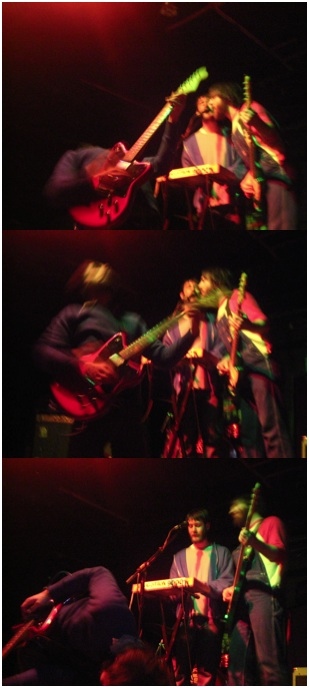
Walter Benjamin (1892-1940), a key twentieth-century cultural theorist, has been influential in various fields, including art and literary criticism. He wrote “The Work of Art in the Age of Mechanical Reproduction” in 1935 to examine revolutionary changes in the arts due to monumental advances in technology associated with modernity. He argues that in the age of mechanical reproduction, art becomes reproducible and thereby gradually loses its traditional and ritualistic value, causing it to lose “aura” and “authenticity.”1 About a century earlier, Karl Marx (1818-1883) wrote Capital, which alluded to how technology could be expected to affect the superstructure, including art, in the future. Benjamin uses Marx as a starting point for his own essay, saying that Marx has a sound argument, but that technology had been in its infancy in Marx’ time, and it was time to reevaluate the topic. The “Work of Art” was published in an effort to construct a theory of art that would be useful for the formulation of revolutionary demands on art. In other words, in the age of mechanical reproduction, Benjamin proposes—from a point of view most closely associated with Communism—that art should be based on politics instead of, as the Fascist view would have it, that politics should be based on art. In the same way that Benjamin modernizes Marx, the purpose of my essay is to bring Benjamin’s own essay up to date. Benjamin wrote during a time when the process of manual photography was considered as quick as digital photography is today. Because the earliest photographic prints took at least eight hours of exposure, the thirty-minute exposure time in the 1930’s was seen as a technological leap into the future.2 The digital developments in the twenty-first century mimic this technological leap and force us to once again, redefine art and the laborious processes that art requires. Benjamin focuses on the “aura” and “authenticity” of art as they pertain to painting and photography.[3] I will deal with this same issue, but will focus on the transition from traditional photography to digital photography and the effects the change has wrought on the concept of aura. Benjamin believed that photography accelerated the destruction of aura, but the invention of the digital camera demands that we revisit this assumption. It can be argued that the traditional camera, which Benjamin believed destroyed the aura of the artwork, has become an authentic form of art since the invention of the digital camera. Indeed, the question of which art forms have “aura” therefore changes with the introduction of new technologies. As a result, “aura” is a historically relative concept, dependent upon technological change.The growing popularity of photography and film in the early 1900’s influenced Benjamin’s essay. The invention of the camera and the intrusion of machinery into the process of creating art, as opposed to the “hands-on” technique of painters and sculptors, is the basis upon which Benjamin argues the aura and authenticity of the work of art have eroded in the age of mechanical reproduction.4 Now, about eighty years later, the digital camera has taken the place of the manual camera, and the manual camera has become the new paintbrush. In a sense, traditional photography, it can be argued, maintains the same relation between the artist and his work of art that painting in Benjamin’s time did, whereas the digital photographer is as disconnected from his photographs as the traditional photographer once was. With the introduction of new technology, the status of the work of art changes. The introduction of new forms of technology into art means that Benjamin’s original concepts of “aura” and “authenticity” must be redefined. Section I: “The Work of Art in the Age of Mechanical Reproduction”In the first section of the essay, Benjamin briefly explains the history of the reproduction of art going back to the coins of Ancient Greece. Following the reproduction of coins, the techniques of engraving and etching were introduced in the Middle Ages. These in turn laid the foundations for the art of lithography in the beginning of the nineteenth century. Lithography was important because it was the first form of reproduction to keep pace with the printing press, but was surpassed in this respect only a few decades later by photography.5 The swift evolution from lithography and printing to photography was an exciting change for the public, as photography marked the first form of art to accelerate the transference of what the artist sees with his eye to what he presents in his work of art: “The eye perceives more swiftly than the hand can draw, the process of pictorial reproduction was accelerated so enormously that it could keep pace with speech.”6 The brief timeline Benjamin lays out helps to explain how photography had such a profound impact on art and perception. It is in the second section that Benjamin introduces two crucial concepts: “aura” and “authenticity.” Merriam-Webster’s Dictionary (2008) defines “aura” as: “a subtle sensory stimulus (as an aroma), or a distinctive atmosphere surrounding a given source.”7 Benjamin’s understanding of aura is more aesthetic in that the word is used with reference to the awe and reverence that is experienced by someone viewing a unique piece of art. The aura of a work of art is first introduced as the element that is eliminated when an original work of art is mechanically reproduced. Benjamin states that aura is the first element of art to wither in this age of mechanical reproduction, which in turn contributes to the “shattering of tradition.”8 This “shattering of tradition” is both mourned by Benjamin, and is seen as opening political possibilities not previously available to art. Benjamin’s notion of aura, as opposed to the dictionary definition, connects it not only to the work of art and the viewer, but also to the environment and to the history of the art. For Benjamin, the history of ownership of a work and its exhibition and cultural value are also factors in determining the aura of a work of art; mechanical reproduction takes the viewer so far from the original work that its aura dissipates. Film and photography erode aura since, because of their infinite reproducibility, there is no such thing as an original version. In addition, technology also causes the connection between the original setting in which the work of art was created and the work itself, to be ruptured. Merriam-Webster’s Dictionary (2008) defines “Authenticity” as: “a: worthy of acceptance or belief as conforming to or based on fact; b: conforming to an original so as to reproduce essential features; and c: made or done the same was as an original.”9 Benjamin takes this definition a step further. The history of the work of art, its physical conditions, process of creation, and the tradition if its ownership are all considered by him to be elements that contribute to the authenticity of a work of art. The authenticity of a work of art simply means that quality of the work is genuine and not corrupted from the original. In the early pages of the essay, Benjamin uses the concept of authenticity to prove that the reproducibility of a work of art takes away from the work because it destroys its authenticity.10 Art Critic, John Berger (1926) wrote Ways of Seeing forty years after Benjamin’s “Work of Art.” Berger discusses Benjamin’s essay, elaborating on the differences between the original and its reproduction. He also points to the new potential opened up by technology: In the age of pictorial reproduction the meaning of paintings is no longer attached to them; their meaning becomes transmittable: that is to say it becomes information of a sort, and, like all information, it is either put to use or ignored… It is not a question of reproduction failing to reproduce certain aspects of an image faithfully; it is a question of reproduction making it possible, even inevitable, that an image will be used for many different purposes and that the reproduced image, unlike an original work, can lend the reproduced image itself to them all.11 Like Benjamin, Berger understands that uniqueness belongs to the original and that the copies lack aura. Technology allows an object that was once unique to be reproduced and thereby to be made accessible to people otherwise unable to have access to this object. It also permits new uses not open to the original. Benjamin believes the erosion of aura is due in part to people desiring to bring things closer—in both a spatial sense and a human sense—in an attempt to connect to elements of the world: We define aura as the unique phenomenon of a distance, however close it may be. If, while resting on a summer afternoon, you follow with your eyes a mountain range on the horizon or a branch, which casts its shadow over you, you experience the aura of those mountains, of that branch... The desire of contemporary masses to bring things “closer” spatially and humanly, which is just as ardent as their bent toward overcoming the uniqueness of every reality by accepting its reproduction. Every day the urge grows stronger to get hold of an object at a very close range by way of its likeness, its reproduction.12 People are no longer forced to adjust to their surroundings because technology enables them to adjust their surroundings to suit their desires. Be it a mountain range, a view of the coast, an opera, or a painting in the Sistine Chapel, mechanical reproduction destroys both aura and authenticity, in the sense that aura is dependent upon the original context of the work of art, and authenticity is dependent upon the original connection between the work of art and the outside world. Once the work of art is copied, its aura and authenticity degrade even further. Expanding the notions of aura and authenticity, Benjamin provides examples of how the mechanical reproduction of a work of art can be brought so far from its original context that it enters situations completely out of reach for the original piece. For example, it is no longer necessary to travel to Paris to just see what the Mona Lisa looks like because now there are coffee mugs and t-shirts printed with an image of the original painting, and are marketed worldwide. Instead of having to buy tickets and physically go to a theatre to listen to the opera, it is now possible to simply buy a record and bring the opera into your own living room to listen to at your leisure. For Benjamin, once the environment is changed, the quality of the work of art is depreciated; the essence of the painting or the symphony is altered entirely and now lacks the aura of the original piece.13 This relationship between the work of art and reality is central to Benjamin’s understanding of aura, and will be central to my own redefinition of the term. Benjamin discusses how photography exemplifies the loss of cult value of the work of art as exhibition value became increasingly more important. And yet, the earliest photographs are portraits attempting to capture the faces of loved ones. They maintained their cult value because they contained the aura, the sense of presence, of the absent subjects. Although that moment in the subjects’ life will never be experienced again, its capture by the camera allows for the aura to persist. In this sense, traditional photography does have aura. French Literary critic, Roland Barthes (1915-1980) attests to the idea that traditional photography does have aura. He wrote Camera Lucida in 1980 as an examination of photography and as a eulogy to his own mother. Barthes makes the point that a photographic image is one of the most accurate representations of a lingering presence from an absent subject. A large section of Camera Lucida is about the family photographs he looks through, while searching for the “best” photograph of his mother. When he finds one of her as a child, Barthes feels as though her spirit is resurrected: he uses photography to hold onto his mother’s presence. Barthes considers the aura of an image to lie within the subject; the aura and presence of the person being photographed gives the work of art, aura. For these reasons, it is important to Barthes that he holds onto an image that captures the true essence of his mother. Benjamin’s definition of aura is further explained in terms of the relation of a work of art to its original function in ritual or religion.14 Early art was related to ritual or to “magical” phenomena that were later associated with religion. When the work of art is set apart from its ritual meaning, the aura is devalued and the authenticity of the work of art is no longer maintained.15 Benjamin points out that art in the time he is writing is no longer based on ritual; instead, the work of art has gradually been transformed into a work of art designed solely for exhibition or for reproducibility. Once the meaning of art has faded behind the importance of its exhibition to the public, the existence of the work of art does not matter as much as its being displayed; the cult value that Benjamin believes maintains the aura of a work of art begins to wear away as the exhibition value is enhanced. The paintings on cathedral ceilings are meant for religious worship more than exhibition value while remaining invisible to the people on the ground floor. The cult value of these paintings is far more than the exhibition value, and the authenticity and aura of the work of art are strong because the work has continued in its original environment and can serve its intended purpose. By contrast, a sculpture that is transportable from museum to gallery, from country to country, has a decreased cult value because it is so far from its original locale and begins to serve the purpose of exhibition rather than ritual. While technical reproduction enhances the exhibition value of a work of art, the cult value is so depreciated that art, according to Benjamin, takes on a political value and potential. Section II: The Case of PhotographyBenjamin uses photography as an example of how the technology of reproduction takes away from the aura of a work of art: “…from a photographic negative, for example, one can make any number of prints; to ask for the ‘authentic’ print makes no sense.”16 However, were he to write this essay today, the digitalization of photography would take on the role in his essay that the chemical process once did, as the agent that erodes aura. The manual camera can be seen as the updated paintbrush, and the digital camera is now in the position that the manual camera once was. This addition of a new form of technology changes the definition of “aura” as articulated by Benjamin showing it to be a precisely relational concept, tied to the history of technology. Benjamin argues that the technology in his time that allowed for reproduction of works of art degrades aura and authenticity. In this sense, photography, which became accessible in the late 1800’s, is not an art form characterized by aura in that a machine is inserted between the artist and his subject. In his view, the machine creates the masterpiece and the photographer merely presses a button to make the machine work. While this is a valid way of understanding the situation, it is time to revisit the issue since photographic technology has made monumental advances in the last eighty years. The concept of a film-less camera was invented in the late seventies, but there is no sure evidence that the project was executed. The earliest digital cameras in the 1980s were desirable neither in their price (at least $20,000) nor in the quality of their black and white images. The digital camera that is globally accessible today was first brought to market in 1991 and cost roughly $13,000. It was in 1999 that the introduction of a Minolta digital camera under $6,000 was marketed for high-end consumers and professional photographers. Four years later, the Canon digital camera was introduced as a Digital Rebel available under $1,000 and intended for consumers.17 With Canon’s first marketing push of the twenty-first century, digital cameras became a highly-marketed consumer product. Ranging in cost from seventy-five US dollars to a few thousand, the digital camera has enough models in production to satisfy any type of person, from a child hanging out in a park to a professional photographer who makes a living in fashion photography. Why is the digital camera such a successful product? Its simplicity and accessibility, matched with its ability to produce clear images with enhanced colors and sharp details, are only a few of the advantages. The images taken with a digital camera are immediately displayed on a screen for instant viewing, and can be recorded with sound and deleted to free storage space. The camera itself is typically light and compact, and the tiny memory card within the camera can store thousands of images. Automatic aperture adjustment, white balance, color contrast, speed adjustment, focus and even the instant removal of red-eye are featured in most current camera models. Due to all of these features, there is a significantly less personal investment that the photographer puts into the production of a photograph. The following photographs were taken with a Canon PowerShot SD1100 IS Digital ELPH set to a Manual setting without a flash. When I took the first picture (not shown) at this concert, I was able to manipulate the color settings on the camera itself to make sure the blurring of the musicians wouldn’t blend the composition together. The digital camera took five photos within two seconds, which allows for a “flip book” sequence of photographs.
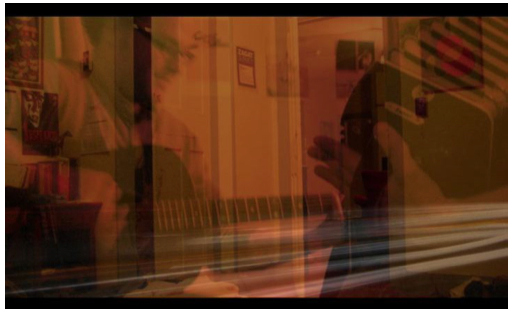
While the digital camera is quick and convenient, the traditional camera requires time, patience, and hands-on labor during every stage of its process. The effort that is put into a manually shot roll of film is far greater than that required in digital photography where the images are stored on a memory card and can be erased instantly if they are not satisfactory. An image taken on a manual camera may be perfect or may be flawed, but the photographer will not know until it is developed later, and at that point the moment in time that was once worth capturing is gone forever. The immediacy of the digital camera is helpful to a commercial photographer whose job entails capturing a thousand photos in an hour and who will later sit in front of a computer to edit twenty of them. However, it is not conducive to improving the manual skill and technique of the photographer because it not only detracts from the connection a photographer has to his camera, but also alters the act of taking the picture in significant ways. The chemical process that Benjamin believes is inauthentic art is now far more personalized than the digital process of the twenty-first century. Digital cameras allow “snap-shots” more easily than manual because the photographer doesn’t even have to bring the viewfinder to his eye since the display screen is typically three inches wide. The ability to crop an image is possible when manually processing an image, but when a manual photo is captured the photographer spends more time with his eye to the viewfinder, making sure he is capturing exactly what he wants. A main reason why Benjamin says that photography does not have aura is because the eye does the work, not the hand. Compared to the labor of the digital camera, manual requires a huge amount of hands-on labor, appearing now as a form of craft. Like painting, manual photography entails an immense amount of trial and error. When painting a picture, the color may be off, the brush stroke might be too rough, or the composition might be skewed. However, once the paint has dried, the artist has the opportunity to go back and fix what he wants. With photography, this process of trial and error includes damaging a number of rolls of film and producing unprintable photos or ruined negatives. Furthermore, even if the film has been loaded correctly and each image has been exposed as desired, the photographer may be in the final stages of developing his roll of film, and a sliver of light enters the darkroom as the film is being loaded into its canister, that roll will be ruined. Each step necessary to print a photograph requires a connection between the photographer and the image they have chosen to capture. Similar to a painter, a photographer chooses what his composition should be, what angle the image might look best from, and how much light to let in. A particular eye for such an art is required, and while Benjamin is correct that the camera is doing the actual capturing of the image, that camera would be a useless object if not for someone to pick it up and work with it. Besides, a paintbrush comes between the painter and his canvas; it may not be a piece of machinery, but it is a form of technology, no matter how primitive. The aura of a work of art is not the thing separating a painter from a photographer, in Benjamin’s essay. He uses an analogy concerning an operation by a surgeon, and an operation by a magician as compared to—respectively—a cameraman, and a painter:* The surgeon represents the polar opposite of the magician. The magician heals a sick person by the laying on of hands; the surgeon cuts into the patient’s body. The magician maintains the natural distance between the patient and himself; though he greatly reduces it very slightly by the laying on of hands, he greatly increases it by virtue of his authority. The surgeon does exactly the reverse; he greatly diminishes the distance between himself and the patient by penetrating into the patient’s body, and increases it by little by the caution with which his hand moves among the organs. In short, in contrast to the magician—who is still hidden in the medical practitioner—the surgeon at the decisive moment abstains from facing the patient man to man; rather, it is through the operation that he penetrates him.19 Benjamin uses this analogy to exemplify how a painter maintains in his work a natural distance from reality, but the cameraman breaks in and maneuvers through reality. The cameraman may be hidden behind a piece of technology, but the painter is hidden behind his canvas; further, the cameraman has less room for interpretation of reality than the painter, whom interprets and represents his own perception of reality. Susan Sontag (1933-2004), an American theorist and philosopher influenced by Benjamin, wrote On Photography in 1973. She expresses her views on photography—in an art form, in a photojournalist form, and in the form of “personal souvenirs” from a family vacation. Sontag’s comparison of a painter and a photographer also focuses on the connection between reality and the work of art, but she takes a different stand than Benjamin: …Photographic images now provide most of the knowledge people have about the look of the past and the reach of the present. What is written about a person or an event is frankly an interpretation, as are handmade visual statements, like paintings and drawings. Photographed images do not seem to be statements about the world so much as pieces of it, miniatures of reality that anyone can make or acquire.20 To further understand Sontag’s notion of a photographer and the reality he chooses to capture versus a painter and the reality he chooses to recreate, she discusses photojournalism. In complete contrast to Benjamin’s cameraman/surgeon penetrating reality, Sontag says photography is “essentially an act of non-intervention,”21 and in war, when it is a photographer’s job to capture the horrors going on around him there is a choice he has between a life and capturing a photograph, but he chooses the photograph. The reality that is silently captured in that moment is not an interpretation as a painting would be, and it is not a written account of a journalist; but that photograph is the closest and most accurate depiction of that moment that can exist. The image below is a compilation of four digital photographs taken with the Canon PowerShot SD1100 IS Digital ELPH. As with the scenic photograph, each image was cropped and altered to enhance colors. The opacity of each image was adjusted so they could be layered on top of each other but remain visible. Each stage of the digital layering process is done separately and can be fixed automatically if needed. By contrast, the traditional layering of images requires patience in the darkroom and specific timing for the exposure of each image.
Layering images in traditional photography is a more restrictive process than doing so in digital photography, on the computer, because using too many images will result in an image that has been overly darkened by the developer. If the results end up darker than anticipated, the process must be started over, and the exposures must be recalculated. The process is overall a very time-consuming process for the traditional photographer. Another way that the introduction of the digital camera attributes aura to traditional photography has to do with the new relationship between the photograph and reality. In On Photography, written in 1973, Susan Sontag remarks: “Photographs furnish evidence… A photograph passes for inconvertible proof that a given thing happened.”22 Barthes, in comparing the photograph with the actual object being photographed, says: A specific photograph, in effect, is never distinguished from its referent (from what it represents), or at least it is not immediately or generally distinguished from its referent (as is the case for every other image, encumbered—from the start, and because of its status—by the way in which the object is simulated): it is not impossible to perceive the photographic signifier (certain professionals do so), but it requires a secondary action of knowledge or reflection.23 The two photographs shown below are the same, but the second one is an edited version. The image was taken with a Canon PowerShot SD1100 IS Digital ELPH while driving over a bridge. The edited picture was cropped into a panoramic photograph, the contrasts were enhanced to make the water look more vibrant, and a red tint was washed over the image to bring out the color of the trees.
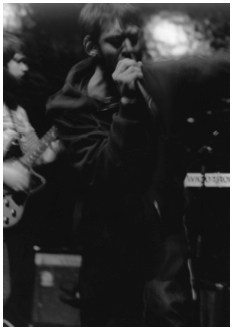
If the same photograph were taken with a manual camera, it would have been nearly impossible to capture the detail of the trees, and the reflections in the water would have been completely blurred together. A digital camera is equipped to capture as accurate a photograph as a traditional camera in the sense that it is not manipulated in color, or composition. However, because the digital photograph has the capability to be easily adjusted and aesthetically enhanced it becomes impossible to believe the images in digital photographs. The traditional photograph is the most accurate and believable image possible. The digital image, by contrast, can be changed, manipulated, and duplicated an infinite number of times. The traditional photograph cannot be altered in the same way a digital one can. This shows that the aura of traditional photography is enhanced by the manual camera, and destroyed by the digital. As Sontag pointedly remarks: “photographs furnish evidence. Something we hear about, but doubt, seems proven when we’re shown a photograph of it... A photograph passes for incontrovertible proof that a given thing happened.”24 The photograph below, of a young man screaming into a microphone was taking with a 35 mm camera. It is dark, it is a little blurry and unclear about what is going on in the background, but the specific moment that is captured is clearly an energetic one. The passion in the singer is obvious, and the darkness of the photograph gives a feel for the venue the musicians were playing in.
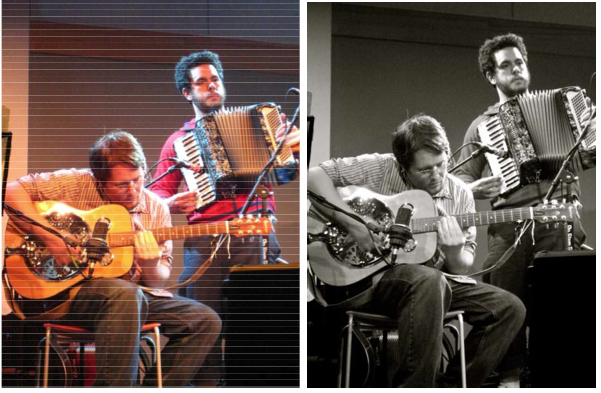
Alternatively, the photograph of the two musicians shown below was taken with a digital camera in an environment that is not clearly depicted. There is less of a connection to these musicians and while it could have something to with their complacent demeanors, it has more to do with the reality of the image itself. The image on the left is the original photograph before the color was removed; the image was cropped and sharpened, and the contrasts and brightness were enhanced. The understanding of photography, and the patience that it requires to shoot the right roll of film, with the right lighting, the right speed, and overall, the right camera is a more complex process than the selection of a digital camera that has automatic settings and produces photos that can be fixed instantly on a computer. Furthermore, the process of developing film in the dark so the negatives are not damaged, the printing on photo paper with an ultra violet light to which your eyes slowly adjust, and the correct mixing of solutions for the image to appear on paper and remain permanent, is again, a more complex process than the loading of photos onto a computer and the automatic filing that is done in a photo program.
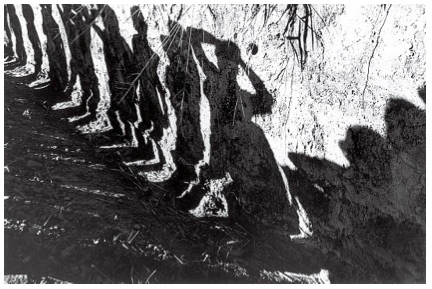
Susan Meiselas’ heartbreaking photograph, Soldiers Searching Bus Passengers, Northern Highway taken in El Salvador in 1980,25 shows the consequences of war with the careful composition of shadows. The shadows are a subtle depiction of the terrors of war, but the obvious division of shadows represents the separation of soldiers and passengers. While the shadows shrink towards the top left corner of the image, the cluster of soldiers in the bottom right corner show just enough shape to make out one soldier crouched with a gun. The reality of the situation is clearly shown even though the image is composed of shadows; even without details showing us the fear on the passengers’ faces, or the defiance in the soldiers’ eyes, the photograph captures the intensity and dangers of that moment. Because Meiselas took this photograph in 1980, there is no doubt she was using a manual camera which in turn, makes the photograph significantly more powerful; it is understood that this image, captured by a traditional camera, has not been altered to look more dramatic and in fact, presents the truth.
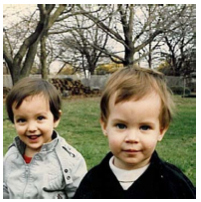
The convenience of a digital camera makes it a popular item for consumers, but the personalization of the manual camera brings aura to the traditional photograph. This image manifests the consciousness of the photographer. The fact that it is not a digitally captured image that was edited and refined later makes it much more powerful. If this photograph were digital, the aura would be immediately destroyed because it would be less believable. Benjamin discusses how photography exemplifies the loss of cult value of the work of art as exhibition value became increasingly more important. And yet, the earliest photographs are portraits attempting to capture the faces of loved ones. They maintained their cult value because they contained the aura, the sense of presence, of the absent subjects. Although that moment in the subjects’ life will never be experienced again, its capture by the camera allows for the aura to persist. Barthes believes certain photographs (particularly of deceased loved ones) have a lasting emotional effect because of the connection between the specific time when the photograph was taken, and the death of the subject of the photograph. An image has the ability to capture a fraction of a second, but the image survives even after the subject has passed away. While Benjamin argues that the aura of a work of art is eroded by mechanical reproduction, Barthes use of photography to hold onto his mother’s essence: “the photograph mechanically repeats what could never be repeated existentially.”26 When someone dies, it is a common experience for the surviving friends and family to weed through collectables and photographs, in effort to both celebrate the life of that person and to mourn their death. Photographs move us backwards through time, which enables us to cling to little pieces of history that we cannot bear to let go of. It is often a trying process to rifle through photographs after someone you love has died, but it is an active part of grieving. After my cousin passed away in 2006, I immediately buried myself in photo albums in desperate attempt to hold onto what I could of him. Similar to Barthes settling on a photograph of his mother as a young girl, I felt finally found a photo of my cousin when he was about four years old. My brother, hardly smiling, is standing closer to the photographer than our cousin, who is smiling with his tongue visible as though he is saying “La,” the way toddlers often do. Despite his living another twenty years after this photo, and despite the fact that I was not yet born when the photograph was taken, the innocence and playfulness in his face is a perfect depiction of how I remember his true character.
Because photographs are physically handled, they are as important as objects as they are for what they show. It puts my mind at ease to keep photographs of the friends I have recently lost, in my wallet and around my room. Keeping a photograph nearby gives me a physical connection to someone I otherwise can no longer have any physical connection to; without these photographs, these people would only be memories. In a sense, I am holding onto these images as “evidence” of their lives, and our friendships that are now in the past. The materiality of a photograph completely changes with digital photography because the physical contact that we have with photographs ceases to exist. Because the digital camera transfers large groups of images into a computer at one time, they are put into an electronic file and usually set aside to hardly look at. When a digital image is printed out and put in a wallet, the image fades quicker than a traditional photograph, and moisture in the air causes the colors to run. The photographic object that Barthes’ holds to bring the essence of his mother back into his own life is no longer real, thus the aura of a photograph is completely destroyed by digitalization. There are new digital frames that store hundreds of images and can be set to display a new photograph every hour, or day. The process of selecting an important photograph to frame and keep on a mantel or night table has disintegrated into electronic photo albums that can be loaded onto the Internet and forgotten about. The authenticity that Benjamin talks about with reference to a work of art includes its history as an object with its material decay and history of ownership. Digital images do not experience a unique history, but traditional photographs are framed, organized into albums, and passed along to family members and friends. The authenticity of a photograph is maintained in its traditional form, but dies in digital. Benjamin is not the only critical writer to pursue the topic of photography, but it can be argued that he essay is the most influential. His essay was not strictly observations and criticism about art in a mechanical age, but can be read as a prediction of how mechanical production and technological advances would affect the arts during the times to come. While he mourns the loss of aura in a reproduced work of art, Benjamin is also looking towards the future and the potential progress in the arts. In “Thesis on the Philosophy of History,” Benjamin uses a Klee painting of the Angel of History to symbolize the connection between experiences in the past, and the progressions in the future: A Klee painting named 'Angelus Novus' shows an angel looking as though he is about to move away from something he is fixedly contemplating. His eyes are staring, his mouth is open, his wings are spread. This is how one pictures the angel of history. His face is turned towards the past. Where we perceive a chain of events, he sees one single catastrophe, which keeps piling wreckage upon wreckage and hurls it in front of his feet. The angel would like to stay, awaken the dead, and make whole what has been smashed. But a storm is blowing from Paradise; it has got caught in his wings with such violence that the angel can no longer close them. The storm irresistibly propels him into the future to which his back is turned, while the pile of debris before him grows skyward. This storm is what we call progress.27 Though in an essay separate from “The Work of Art in the Age of Mechanical Reproduction,” this analysis of Klee’s painting illustrates how advances in technology may destroy the aura of the work of art, as we know it, but new possibilities become available that were inaccessible before. References"Aura." Def. 1. Merriam-Webster Online Dictionary. 2008. Merriam-Webster Online. December 2008. . "Authentic." Def. 1. Merriam-Webster Online Dictionary. 2008. Merriam-Webster Online. December 2008. . Barthes, Roland. Camera Lucida: Reflections on Photography. Trans. Richard Howard. Hill and Wang: New York, 1981. Benjamin, Walter. “Illuminations.” The Work of Art in the Age of Mechanical Reproduction. Ed. Hannah Arendt. Chicken Books: New York, 1968. 217-251. Berger, John. Ways of Seeing. Penguin Books: London, 1972. Kreis, Steven. “Karl Marx.” The History Guide: Lectures on Modern European Intellectual History. 1996. The History Guide. 30 Jan. 2008. . Leslie, Esther. "Walter Benjamin." The Literary Encyclopedia. 7 July 2001. . Leggat, Robert. “How Photography Began.” A History of Photography. 1997. Robert Leggat. 23 Sept. 2008. < http://www.rleggat.com/photohistory/>. Meiselas, Susan. “Soldiers Search Bus Passengers Along the Northern Highway.” Image Ref.: PAR51818. Magnum Photos. 1998. . 3 Dec. 2008. Silverman, Kaja. The Threshold of the Visible World. Routledge: London, 1996. Sontag, Susan. On Photography. Picador: New York, 1977. 1.) Walter Benjamin, “The Work of Art in the Age of Mechanical Reproduction,” in Illuminations, Hannah Arendt, ed., (New York: Schenck Books, 1968), 224. 2.) Robert Leggat, “The History of Photography,” http://www.rleggat.com/photohistory/, 2 Dec. 2008. 3.) Op. Cit., 217-218. 4.) Ibid, 218, 220-221, 224. 5.) Leggat, 2 Dec. 2008. 6.) Benjamin, 219. 7.) “Aura,” (2008) http://www.merriam-webster.com/dictionary/aura, 2 Dec. 2008. 8.) Op. Cit. 221. 9.) “Authenticity,” (2008) http://www.merriam-webster.com/dictionary/authenticity, 2 Dec. 2008. 10.) Benjamin, 220. 11.) John Berger, Ways of Seeing, (London: Penguin Books, 1972) 24-5. 12.) Op. Cit., 223. 13.) Benjamin, 221. 14.) Benjamin, 224-225. 15.) Ibid. 16.) Benjamin, 224. 17.) Leggat, 2 Dec. 2008. * Though Benjamin is specifically referring to a movie cameraman, the same can be said of a photographer as both use a camera in their field of art. 19.) Benjamin, 233. 20.) Susan Sontag, “In Plato’s Cave,” in On Photography, (New York: Farrar, Straus and Giroux, 1973), 4. 21.) Ibid, 11-12. 22.) Susan Sontag, “In Plato’s Cave,” in On Photography, (New York: Farrar, Straus and Giroux, 1973), 5. 23.) Roland Barthes, “Camera Lucida—Reflections on Photography,” Trans., Richard Howard, (New York: Hill and Wang, 1981), 5. 24.) Sontag, 5. 25.) Susan Meiselas, “Magnum Photos,” http://www.magnumphotos.com/Archive/, 3 Dec. 2008. 26.) Barthes, 4. 27.) Walter Benjamin, “A Theses on the Philosophy of History,” in Illuminations, Hannah Arendt, ed., (New York: Schenck Books, 1968), 257. 
From the Inquiries Journal Blog   Related ReadingMonthly Newsletter SignupThe newsletter highlights recent selections from the journal and useful tips from our blog. Suggested Reading from Inquiries Journal
Inquiries Journal provides undergraduate and graduate students around the world a platform for the wide dissemination of academic work over a range of core disciplines. Representing the work of students from hundreds of institutions around the globe, Inquiries Journal's large database of academic articles is completely free. Learn more | Blog | Submit Follow IJ


Latest in Visual Arts |