Featured Article:Privatization: Analyzing the Process of Privatization in Theory and Practice
By
2011, Vol. 3 No. 08 | pg. 1/4 | »
IN THIS ARTICLE
KEYWORDS
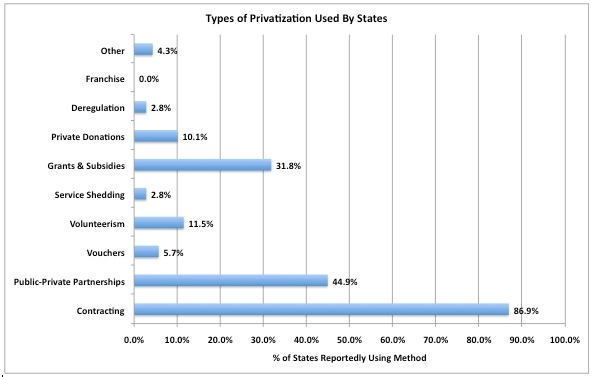
Privatization is the practice of engaging the private sector in some aspect of the functions and responsibilities of government operations. Ultimately, governments must decide if acquiring a desired service is best done through by their own public agencies or if it should be purchased from private vendors at a price dictated by the market. This simple question of ‘make or buy’ is the very essence of privatization policy and process. Arriving at an answer to that question, however, is as complex and diverse as the services governments provide and the public that they serve. While virtually all governments at any level seek some form of service from private service providers, whether for-profit or not-for-profit, the true scope of privatization is widely misunderstood. As a result, political discourse regarding privatization has adopted a simplistic, contentious and often inaccurate understanding of the merits and implementation of the practice. The past twenty years have seen numerous instances of partisan debates over privatization which embrace universal ideologies either in favor or opposed to privatization as a whole. This has led to a myriad of privatization proposals that have failed to benefit the governments enacting them, and, in certain cases, has even served to harm the politicians, workforce, citizens and service recipients in the process. While these failures have led some to believe that privatization is inherently dangerous and should therefore be avoided, others continue to support any effort to shift a public service to the private sector in order to limit the size and role of government. The fact is that privatization is rarely effective, or even possible, when either paradigm is used to examine it merits. In practice, privatization is most successful when used to ensure that government, taking into account its needs, capabilities and limitations, strives to find the best possible answer to the ‘make or buy’ question. This paper will, in four distinct parts, seek to examine nature of privatization in both practice and theory, with particular attention toward fiscal impact, efficiency and quality of service.First, Section II: The Breadth and Barriers of Privatization, will provide a general overview of the current methods of privatization available to governments, what they intend for privatization to accomplish and the degree to which said methods are used. It will also provide an overview of three major issues that virtually all privatization efforts face, the information, accountability/control and competition problems. Section III, Theoretical Explanations, will summarize and examine current theories regarding privatization, including: why service quality is important and how to address it, the role that ideology has in defining positions on and policies regarding privatization, and the effect that privatization, by encouraging competition, has on the efficiency of service provision and how it can work as an effective management tool. Section IV, Cases of Privatization, will use the information offered in sections II and III to examine and evaluate the outcome of propitiation efforts in the Commonwealths of Massachusetts and Virginia. Both of which instituted different methods for privatization and experienced drastically different levels of success. Finally, Section V, Lessons and Steps for Successful Implementation, outlines a number of strategies and conclusions that can facilitate careful and thoughtful privatization decisions. The Breadth and Barriers of PrivatizationDespite receiving a good deal of attention in partisan and electoral politics, the true scope of privatization, where it already exists and its capabilities, are widely under recognized or misunderstood. Privatization is neither new nor is it a trend. Examples of long-standing and successful privatization programs can be found in all levels of government in a multitude of nations around the globe. Bridge repair, public transportation and even the US Post Office, all are areas where privatization has been quietly and successfully implemented. In Massachusetts, for example, most residents are unaware that nearly 50% of the State’s budget is spent directly on private contractors and service providers.1 Unfortunately, discussions over privatization often do not look past the practice of contracting. While contracting is the most utilized and best understood form of privatization, understanding that privatization and contraction are not synonymous is essential in analyzing the merits and implementation of privatization programs. In addition to contracting, there are at least nine other unique forms of privatization that available to public executives and administrators when evaluating their programs and spending. Each of these forms of privatization is discussed below. Forms of PrivatizationContracting – The most common form of privatization in both debate and in practice, contracting refers to when a government enters into agreements with private vendors (either for-profit or not-for-profit) to provide government services.2 The government issuing the contract is able to set the standards of service and terms of the agreement, but the management of the service provision is the responsibility of the service provider.3 In short, public funds pay private vendors to provide public services. The term contracting-out refers to the process of issuing contracts for services that are currently being delivered by public agencies or employees. Contracting-out is a major focus of many privatization programs and their regulation. Vouchers – Vouchers are issued to individual public service recipients and used by those individuals to procure the services for which they qualify. The service provider receives the voucher in lieu of all or part of the cost of the service when rendered, and receive the remainder from the government. This allows the government to set the standards of service, by regulating what services they are willing to remit payment for, while allowing the service recipients to choose the provider that they prefer in the open market.4 Areas where vouchers have been utilized include food stamp programs, transportation, day care and alternative education programs such as charter schools.5 Public-private partnerships – Partnerships between public agencies and private service vendors have seen notable growth in recent years. Public-private partnerships refer to areas where public agencies and private service providers share the responsibility for providing government services. These partnerships are particularly effective when government agencies face situations where their capabilities or man power are suddenly or temporarily overwhelmed by unforeseen demand. Agencies and private sector contractors determine a way in which the two bodies can work together to achieve the same goal.6 Franchise – The state gives a private vendor privileges to act as a local monopoly within a given area. Consumers must choose if they wish to purchase service or not, but cannot choose between multiple vendors offering services. Prominent examples of franchises include toll collection and visiting nurses.7 Grants and subsidies – The government enters into an agreement with a private vendors in which they partially support or subsidize that group in order to offset the expenses of providing a particular service or services.8 These allow governments to encourage the creation and growth of certain private service industries as well as where, when and how they would like that industry to evolve. Asset sale – Governments sell or ‘cash-out’ assets -which could include infrastructural equipment, land or other capitol goods- to private companies in order to recoup a windfall gain and further expand their tax base resulting in increased revenues.9 This is particularly effective when the government owns land that is in high demand or if it owns infrastructure such as heavy machinery previously used to provide services now being contracted. Volunteerism – A government relies on volunteer labor, usually through a non-profit organization, to provide labor intensive public services.10 Prominent examples of volunteerism privatization are seen in AmeriCorps and CityYear programs, where volunteers are relied on for tasks ranging from the maintenance of state forests to teaching in public schools where that are experiencing staffing or budget shortages. Private donation – Governments rely on private donors to provide resources to assist in providing public services. Resources could range from financial support, to personnel, facilities or even equipment.11 Service Shedding – Governments greatly reduce or completely stop offering services to allow private sector companies the opportunity to begin offering them with private resources.12 Deregulation – Governments stop regulating services they monopolize to allow private companies to begin offering the same services in order to encourage competition between the two sectors.13 Despite the many privatization possibilities available to the public manager, contracting remains far and away the largest form of privatization used. A 2002 survey conducted for the Council of State Governments by Keon S. Chi, a respected and widely published expert on privatizations, along with Kelley A. Arnold and Heather M. Perkins, asked state budget and legislative service directors what forms of privatization their state currently implements. The overwhelming majority of directors (86.9%) reported to use contracting, the next most common form was public-private partnership, which was use nearly half as often. The full results of the survey can be seen in the chart below:
Common ProblemsDespite popular right-wing support for a number of recent privatization initiatives, many of these programs fail to achieve the goals for which they are implemented. In Chi, Arnold and Perkin's same survey, over 68% of state budget officers cite "cost savings" as the primary reason they look to privatization.14 While the desire to be fiscally responsible and prevent unnecessary expenditures is a common goal among budget officers, the results of most privatization initiatives suggest that this goal is not being met. In fact, 30% of survey respondents reported no actual cost savings from privatization, while another 38% said they were not aware of any savings.15 This means that 68% of budget officers surveyed cannot claim any known cost savings as the result of privatization. In contrast, only 15% of respondents claim cost savings greater than 1%. This means that despite being the primary reason for implementing privatization, as many as 85% of budget offices have not seen any substantial cost savings. As this data suggests, privatization as a cost saving measure has a high propensity to fail. This fact does not, however, negate the benefits of successful privatization programs. In practice, privatization is not universally harmful or beneficial, but rather is a series of trade-offs that must be considered on a case-by-case basis. Privatization programs routinely face problems with information, control, accountability and competition. In order for public administrators and budget directors to make the decision whether or not to privatize it is crucial to understand the nature of these problems and account for them appropriately.16 The Information Problem Of the respondents to the previously discussed survey 38% of budget officers (the largest group in the set), claim that their cost savings, if any, are completely unknown. This lack of information is another major problem that governments face when attempting to weight the cost and benefits of privatization. The information problem hinders every step of the privatization process from identifying services that ought to be put to the market, to soliciting the true cost of bids, to monitoring and overseeing the implementation of contracts. When attempting to identify programs that are most likely to benefit from the privatization process, it is necessary to have accurate and detailed information about the cost and performance of the agency currently providing the service. Understanding the actual performance of a servicer providing public agency is a daunting task. Budget directors and administrators must attempt to understand both the true cost of providing the service and the current level of service being provided. Understanding the cost of operating any public sector service is particularly difficult since agencies are often tasked with providing multiple services under the same budget appropriations and actual agency spending is only examined in such minute detail during audits, which occur months, if not years, after the conclusion of the fiscal year.17 Similarly complex, is attempting to measure the quality of a particular service, as the implementation of services is often so large that top-down oversight is prohibitively expensive. This dynamic creates an environment where governments are unaware of the current costs, making any cost-savings impossible to accurately calculate.18 The lack of exhaustive, top-down oversight has, in many agencies, led to an environment where state budgets outline the desired service the agency is tasked with providing, but lack specific details as to how these services are to be provided or what specific measures will be used to define success and failure. The specific details of how service programs are to be implemented are left to managers, a dynamic which has led to many contracts being let to private service providers without specific details over what actions the government requires be taken when implementing services. This can lead to cost cutting practices that impact the quality of service being provided to the point that the level of service is below what the government intended for the vendor to provide, without violating the terms of the contract.19 In order to compensate for the lack of information when considering privatizing a service, many governments attempt to estimate the cost public service provision.20 This process requires the use of ‘best practice standards’ and does not consider logistic roadblocks or potential indirect cost savings. The result of using cost estimates instead of actual cost data is that private service providers are forced to submit binding bids that must be lower than theoretical costs rather than real ones.21 The Accountability/Control Problem Another major dynamic that hinders the administrator and budget directors ability to evaluate the option to privatize, is the relationship that exists between privatization and control. When a government decides to transition from a public agency to a private vendor for service provision, it inevitably surrenders a level of control over how those services are delivered.22 This fact is not always undesirable, as relying on private sector management to determine the best methods for delivering a service is a major facet of contracting. The danger for governments comes in the fact that, while surrendering control, the government maintains accountability for the service in the eyes of the service recipients and the tax payers.23 The accountability/control problem becomes ever more daunting when governments consider their response to a situation where a vendor fails to meet the terms of their contract. When privatizing services, governments surrender control not just over the implementation of the contract, but often surrender their ability to resume providing services without significant costs associated with training, agency restructuring, employment and infrastructure. This is especially true in instances where public agencies lay-off public employees or liquidate their capitol assets in order to maximize the savings realized by the decision to privatize. When a government loses the ability to resume providing a service, or fails to account for the possibility of having to do so, it finds itself dependant on private service vendors to continue providing service.24 The Competition Problem Many methods of privatization, particularly contracting, rely on the theory that open competition between capable service providers will result in lower cost to the government looking to purchase services. However, when dealing with contracts for millions, even billions of dollars, purchasing services that are to be implemented across entire counties, states or even nations, public administrators and budget directors must pay close attention to the number of vendors willing and able to provide these services. The need for an adequate number of bids exists not just in the initial decision to privatize, but continues to be crucial as contracts are considered for renewal once they have lapsed. If adequate competition does not exist whenever a contract is being considered, the purchaser is ultimately at a disadvantage to the bidder, as fewer alternative options exist.25 Adequate competition is an essential for privatization to be responsibility implemented. In an effort to increase competitive options, governments often turn to a number of techniques including soliciting bids from public labor unions as well as public agency directors themselves. The consideration of these public sector bids is frequently used when considering the initial decision to privatize, but recently governments are beginning to consider bids to bring services back to the public sector in a process known as contracting-in. This process increases competition, but public agencies still face the same information problem previously discussed.26Continued on Next Page » 
From the Inquiries Journal Blog   Monthly Newsletter SignupThe newsletter highlights recent selections from the journal and useful tips from our blog. Suggested Reading from Inquiries Journal
Inquiries Journal provides undergraduate and graduate students around the world a platform for the wide dissemination of academic work over a range of core disciplines. Representing the work of students from hundreds of institutions around the globe, Inquiries Journal's large database of academic articles is completely free. Learn more | Blog | Submit Follow IJ


Latest in Political Science |