Political and Social Change and its Depictions in 19th Century French and English Caricature: Decapitation, Dismemberment, and Defecation
By
2011, Vol. 3 No. 08 | pg. 1/2 | »
KEYWORDS:
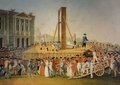
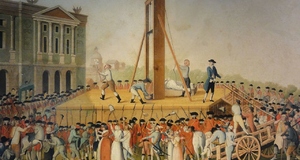
The function of caricature within the public sphere can be described as a subversive weapon.1 It can be said that caricature as a subversive medium can function as an instigator of social, political and artistic change within a social framework. Within eighteenth and nineteenth century society, particularly Revolution-era (1789-1799, beginning with the destruction of the Bastille, continuing to 18 brumaire and the Consulate of Napoleon)2 France, caricature’s primary purpose stood to attack and transgress a number of bodies, within both their own countries, and their oppositional counterparts. This essay discusses the role of caricatures and cartoons in promoting political and social change during the eighteenth and nineteenth century. The first section examines the caricature as an instrument of social change. The nexy section examines the development of caricature within France, and the subsequent attack of monarchical systems of government, leading to changing perceptions of the monarch figure and implications of censorship. The third section examines satirical caricature’s attack of the Church, and its questioning of both the role of religion in society and the differentiation between church and state. The essay concludes with a discussion of caricature and cartoons as an instigator of social and political change.In Caricature and the Revolution3, Michael Melot writes on caricature as a “subversive weapon” as such: Caricature is a subversive weapon whereby a political model is dismantled by means of an aesthetic model. The caricaturist perverts the rules of ideal representation in order to create the image of a human figure who is himself a representative of authority. Hence, in caricature there is a transgression (of an aesthetic norm) for the purpose of aggression (against a social model).4 Melot suggests that caricature’s role then is to deconstruct the political hierarchy polemically by means of an aesthetic medium for means of dissemination by a mass audience. As a destructive and reconstructive/re-structuralising medium, the caricature serves as an ideal form as an instigator of social change within a period of revolution.5 Within a period of revolution, social hierarchy experiences a process of degradation and regeneration. The hierarchical principle temporarily regresses to a point in which a situation is created where experimentation with paradigmatic forms is necessary for a return to a functioning social hierarchy. Within any one caricature, a similar model can be observed. The caricaturist strips down an established form to its bare signification, providing a construct for which experimentation, critique and commentary can occur. Building from this, a paradigmatic shift occurs as a result of the stigmatisation and problematisation of the previous established order. This structural similarity between the caricature medium and social upheaval itself lends itself to the revolutionary character of caricature, presenting itself as an ideal medium for promoting change. It is further suggested that the Freudian definition of “the joke”6 contributes highly to the caricature’s function. Due to its strongly gestural and automatist qualities, the caricature communicates more immediately to audiences through a regressive function that invokes unconscious associations. It is a medium whose primary goal is dissemination by a large audience. Within the context of eighteenth and nineteenth century society, the caricature aims not to appeal strictly to the aristocracy, yet instead addresses an emerging class—the middle class bourgeoisie. As the bourgeoisie began to emerge, so too did a new audience for artistic consumption. Prior to this, the consumption of visual culture was strictly limited to an elite aristocratic audience. Caricature’s place within the visual culture of the eighteenth and nineteenth centuries signifies not only a new audience, but also the emergence of a new set of social concerns and values. Caricature flourished primarily as a result of the rise of commercial print, the banalisation of the portrait, and the birth of the engraving of current events.7 The visual nature of the medium allowed for further consumption of caricature and cartoon by members of the lower class, a large number of whom were illiterate. Though while the visual nature of caricature did allow for wider dissemination among members of the lower classes, this does not necessarily mean that it was at all cared for or appreciated. Melot suggests that “[c]aricature was too sophisticated and perhaps suspected of a frivolity that was useless in the struggle of the lower classes.”8 The years between 1789-1799 in France mark a break in the administrative centralisation of French politics, and frame the struggle towards the democratisation of French society. Cuno suggests that during this period, the publication of caricatures were encouraged due to the fact that oppositional sides lampooned one another in debates centred around the authority of the monarchy, the position of the clergy, the role of the Third Estate, and the return of the émigrés.9 The first primary focus of caricature and graphic satire can be then seen to centre on shifting perceptions of monarchical systems of government, more specifically, the notion of the monarch as an individual, questioning monarchical authority. Through the exaggeration of an individual’s physiognomy within caricature, features that distinguish the individual are isolated and stressed, thus unmasking and revealing further perceptions of the subject’s character. Cuno further suggests then that to be the subject of such mild ridicule confirmed an individual as having attained an elevated position and could be “brought down”.10 Portrayal of the monarchy by graphic satirists then signifies a cultural attempt to question and transgress monarchical authority. In combination with physiognomic amplification, humour plays a significant role within caricature in its capacity to undermine or attack. Freud remarks on the role of the joke in this capacity as such: Where a joke is not an aim in itself—that is, where it is not an innocent one—there are only two purposes that it may serve, and these two can themselves be subsumed under a single heading. It is either a hostile joke (serving the purpose of aggressiveness, satire, or defence) or an obscene joke (serving the purpose of exposure). 11 Freud then suggests that the joke allows the individual to belittle an opponent indirectly, while presenting an opinion that otherwise could not be expressed directly. These images demonstrate how humour functions within political caricature. In The Abbé Reduced to Half Pension (fig. 1), the Abbé Maury and an aristocratic woman are shown to be fondling one another, mocking the traditional coupling of the nobility and the clergy. In The Hairdresser’s Payment (fig. 2), Marie-Antoinette is shown to be performing a sexual favour for her hairdresser as a means of payment, suggesting that the Revolution has forced the subject into a position of financial hardship, leaving the subject to use sexual favours as payment. Through ridicule, the subjects are first exposed and made vulnerable. The role and status of the monarch, clergy, and aristocracy is then diminished and attacked by placing them in intimate situations. 12 Through the implication of the abject or Unheimlich (uncanny), caricature artists sought to connect to a mass audience by means unconscious association.13 By means of Freudian psychoanalytical examination, this next section aims to discuss the prevalence of beheading, dismemberment and scatological discourse within caricature. The grotesque, it can be argued, creates an unconscious association by the responder that challenges the subject of ridicule, in turn both directly and indirectly shifting the political and social opinion of the responder. Beheading and scatological imagery served as operational mechanisms within caricature to further destabilise the role and status of the monarchy. The image of a beheaded authority figure served as an effective visual metaphor. Firstly, the rational part of the body and chief means of individual identification has been severed from the body. This has a dehumanising effect, challenging the authority of the subject. Secondly, within a “Body Politic” model, the monarch is the “head” of state. In the case of decapitation then, this “head” has been removed from power. The image of regal decapitation within caricature suggested a challenging of monarchic authority and a direct challenge through the head of state’s visually allegorical removal from power. The chief means of decapitation was machinic in nature – the guillotine. The guillotine’s use and representation in caricature was suggestive of a factory-like situation or chain of events regarding the Revolution. It was suggested that first the king is beheaded, and following this, a logical sequence of events should follow, meaning the further beheading of the queen, and so on, until nothing is left. This is demonstrated in The Executioner Guillotines Himself (fig.3), where the executioner is the last member of this chain left to execute. This comes back to the guillotines actual working, where once the mechanism’s cord has been released, there is no way to stop the blade from falling – which suggests that once the mechanism of Revolution has been put into motion, there is no means of stopping it. 14 Like the image of decapitation, scatological imagery was also commonplace within revolutionary caricature. Scatological imagery in its vulgarity provoked a direct challenge of authority through its brazen assault on refined taste. Examining Daumier’s Gargantua (fig.4) we see a grotesque portrayal of King Louis-Philippe as the obese giant Gargantua. From his mouth, a plank extends from the ground upon which the common people climb up to feed the overgrown monarch. The king sits perched upon a chaise percée, or toilet, and defecates a number of rewards upon a crowd of miniature officials. An act of provocation is intended through the aestheticized “overconsumption” of wealth and resources by the monarch. Once again, Freudian association is employed through the act of defecation. Within caricature, politicians obsessed with greed are often portrayed as taking delight in their own excrement. This links back to the Freudian notion of anal eroticism, which links adult greed with a childhood obsession with faeces. Freud suggests that a child’s sense of power and independence derives in part from the child’s manipulation of excrement. As the child matures, this anal eroticism is repressed and reattached to another symbol of power—money.15 Furthermore, the king’s throne has been transformed into a toilet and through this, Daumier challenges and negates the “seat” of power.Continued on Next Page » 
From the Inquiries Journal Blog   Monthly Newsletter SignupThe newsletter highlights recent selections from the journal and useful tips from our blog. Suggested Reading from Inquiries Journal
Inquiries Journal provides undergraduate and graduate students around the world a platform for the wide dissemination of academic work over a range of core disciplines. Representing the work of students from hundreds of institutions around the globe, Inquiries Journal's large database of academic articles is completely free. Learn more | Blog | Submit Follow IJ


Latest in History |