94 Minutes in the Badlands (1973)
By
2011, Vol. 3 No. 02 | pg. 1/1
KEYWORDS:
Martin Sheen brings a rumbling tenor and a full head of feathered hair to his role as trigger-happy Kit Carrathurs, while Sissy Spacek is convincing as girlfriend Holly Sargis. Holly’s character is all freckles and no personality, and young Spacek’s performance is unnervingly good in its portrayal of total detachment. Even after Kit shoots Holly’s father (played by Warren Oates) dead, the girl remains fairly aloof, even helping him get rid of the evidence by burning her house down. Kit is asked in one of the final scenes: “Do you like people?” “They’re okay,” he shrugs and replies. It is precisely this disconnect with the world around them that allows Kit and Holly to form their own unique bond, a relationship highlighted by the simple and organic dialogue spoken in that token Midwestern drawl. Writer-director Malick avoids the easy assumption that Kit is a soulless sociopath who has manipulated the innocent Holly, providing instead an intriguing character study. Audiences are invited to draw their own conclusions about the couple, though Malick does leave subtle hints throughout the film, including Kit’s influence over Holly’s new smoking habit. Other scenes offer small insights into the main characters’ relationship dynamic and power struggles. One scene, in which the pair is lunching in a temporary sanctuary somewhere in the badlands of Montana, Kit takes several long gulps of beer, while Holly sips from her glass of milk. Their age gap and, more importantly, difference in wants and objectives, is addressed throughout the film: more often than not, Holly, childlike, is seen sitting in the back of the getaway car as Kit drives, clearly in control. However, as their time together draws near, the power shifts in surprising and satisfying ways. For the most part, Malick does well not to romanticize the couple’s interactions, a style that has defined many partner-in-crime movies over the years, most notably 1967’s Bonnie and Clyde. If nothing else, the two seem mostly just bored.Initially the pacing is confusing, taking the plot from “boy meets girl” to “boy loves girl and vice versa” in less than five minutes of screen time. This strange escalation conflicts with the rest of the film, which is largely sparse and slow-moving (though not annoyingly so). Almost midway through, a well-handled post-sex scene allows for some chemistry between Holly and Kit and regains some of the credibility lost during the unconvincing courting period. The pattern of the killing spree becomes predictable at best and the violence forgettable and cheap. The score too leaves something to be desired, alternating between two or three pieces from Carl Orff’s Schulwerk. It’s not so much the music itself that creates a problem, but its placement within certain scenes instead of others. For instance, the tinkling bells and general bounce of Orff’s Gaussenhauer feel mismatched and even a little trite behind the scene of Holly’s house burning to the ground. Nevertheless, Badlands remains an example of exquisite simplicity, relying on natural lighting and the sunset landscapes organic to the northern Midwest. The camera only strays from the in-dialogue shot-counter shot standard to enter a wide-lens view of the flat plains of North Dakota. The set design, all dust-covered tin signs, adds to the film’s authenticity – and, just as the audience begins to wonder why on earth Kit’s character would steal an antique lamp from his girlfriend’s burning home, we are rewarded with a gorgeous shot of said lamp against the forest backdrop the murdering pair have chosen as a hiding spot. The juxtaposition of “man-made” and “natural” pops up throughout the film (nearly as often as “young versus old”), calling to question the blurred lines between such diametric opposites and what exactly it means to be “bad” or “good.” So, no, Badlands may not be your top pick for a Saturday night-in, with all the trappings of greasy takeout and some brainless staring at your nearest screen. But should you want to wonder, to learn and crave and be haunted, then it really doesn’t get any better than Badlands. Badlands. Dir. Terrence Malick. Perf. Martin Sheen, Sissy Spacek and Warren Oates. 1973. 
From the Inquiries Journal Blog   Monthly Newsletter SignupThe newsletter highlights recent selections from the journal and useful tips from our blog. Suggested Reading from Inquiries Journal
Inquiries Journal provides undergraduate and graduate students around the world a platform for the wide dissemination of academic work over a range of core disciplines. Representing the work of students from hundreds of institutions around the globe, Inquiries Journal's large database of academic articles is completely free. Learn more | Blog | Submit Follow IJ


Latest in Film & Media |

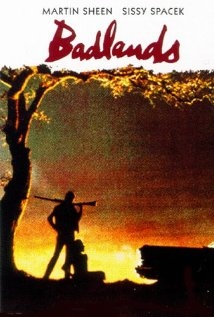 If you’re looking for another all-American cross-country love story, you’d be better off browsing movie aisles far, far away from the likes of Badlands. This 1973 title, director Terrence Malick’s debut film, turns the typical teenage romance on its head. First, predictably, boy meets girl. (He is on his way home from a day’s work of garbage-collecting; she, only fifteen, is innocently twirling a baton in her front yard.) Then: boy kills girl’s father, boy and girl run away together, driving from state to flat desert state, multiplying the body count and dodging the law the whole way. At its surface, Badlands is a quiet rendition of the real-life 1958 killing spree by Charles Starkweather and girlfriend Caril Ann Fugate. But at its core, the film offers an unassuming exploration into the lives and minds of two lonely people who are searching for something and always coming up short.