Featured Article:Defining a Nation: The Power of the Nation and its Influence on Native American 'First Nations'
By
2010, Vol. 2 No. 11 | pg. 1/1
IN THIS ARTICLE
KEYWORDS
The term ‘nation’ is notoriously hard to define, not only because it has multiple meanings, but because the prevailing definitions change in response to various social and political factors (Ozkirimli 2000). In its most basic form a nation is conceptualized as a distinctive group of people occupying a defined territory between which there is an immutable relationship (Penrose 1993; 1994). However this category has already become problematic as groups of people and territories rarely align so readily. This brings forth the question, is ‘nation’ therefore an unrealistic concept? Quite probably, however, the contemporary power of the category is derived from the way in which societies regard ‘nation’ as a naturally occurring, and therefore irrefutable, concept rather than the ideological social construction that it is. While nations are repeatedly referred to as imagined communities in academic literature (Anderson 1991; Smith 2000; Grundy-Warr and Sidaway 2005), Native American self-identification as ‘First Nations’ emphasizes the very real and powerful impact that the concept can have on social and political systems. Through an understanding of the contemporary power of ‘nation’ one can begin to examine why indigenous people may have adopted a social construction that has historically been used as a tool in their oppression and maltreatment (Dyck 1989; Berger 1990). 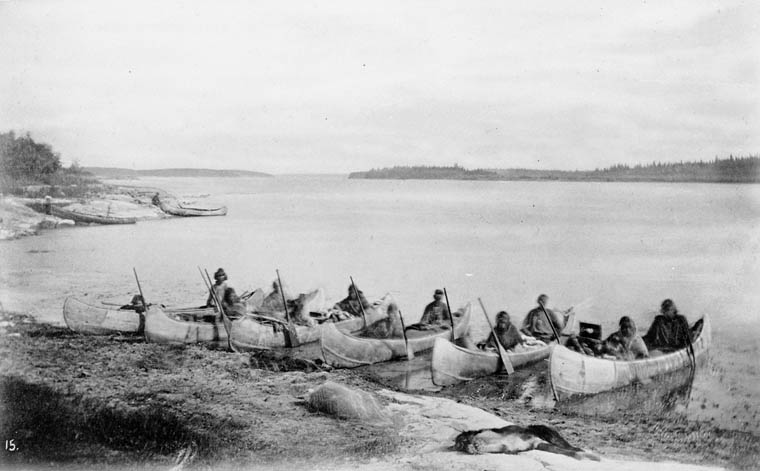
1878 photo depicting First Nations people of Manitoba, en route to hunting grounds, on the Nelson River. This article explores the contemporary power of ‘nation’ and why American Indians in Canada have assumed the title of ‘First Nations,’ though similar conclusions may be drawn for indigenous people across the world. As there are numerous representations of the word ‘nation’, there follows an initial discussion of the concept which builds into an assessment of its contemporary power. Several themes are identified from this, which aim toward explaining this self-identification. These focus on the distinctive culture associated with nations, the justification of self-governance and reparation politics. There is then a short discussion on some of the pitfalls of the phrase ‘First Nations’ before finally concluding that this particular form of self-identification is utilized as a means of advancing indigenous politics. The Nation and its Contemporary PowerA nation identifies a social, political and culturally distinct group of people and grounds them in a physical space (Jackson and Penrose 1993). Consequently the territorial boundaries are conceptualized as coinciding with the cultural boundaries of the people. This concept evolved along with the ideology of nationalism, which draws on the doctrine of self-determination where nations are considered to have the natural right to govern their own affairs (Smith 2000). When these two ideas are combined nations become tools for justifying claims to power. Notably both the concept and the ideology are social constructions which rely on the acceptance of the other as a natural phenomenon to legitimize their immutability. Although the above describes the epistemology of nations, the concept is fundamentally flawed. Cultural groups and territories rarely align, cannot be easily categorized and frequently intersect. For example, the Kurdish people have a population of over 15 million but live in an area divided between four states: Iran, Iraq, Turkey and Syria (Grundy-Warr and Sidaway 2005). Once cultures fail to align with territorial and political boundaries the ideology of nationalism begins to falter. One cannot legitimately claim power on the basis of self-determination when one’s people are undefined or already claimed by other nations (Jackson and Penrose 1993). The second flaw in the conceptualization of nations is the assumption that the people within a nation are homogenous. While this is an integral part of the ideology that governments serve the people, it is entirely unrealistic when considering the diversity of the human species; therefore minority groups naturally arise in all nations (Penrose 1994). Although the concept of ‘nation’ is fundamentally flawed it has dominated politics throughout the twentieth century (Kymlicka 2001; Grundy-Warr and Sidaway 2005). Its inability to translate to real world examples has led to the oppression of minority groups, discrimination, and its use as a tool for advantaging those in power over others (Schouls 2003). None of this would have been possible were it not for its assumption as an established category which prevents societies from seeking alternative political structures. The category ‘nation’ has heavily influenced history, dividing humanity and causing great injustices as governments have tried to apply this flawed concept irrespective of the consequences. Furthermore the assumed naturalness of nations and nationalism works to place these concepts beyond questioning. Their power and authority are therefore seldom challenged ensuring their continued acceptance (Jackson and Penrose 1993). This is the contemporary power of the ‘nation’; it is perceived as an immutable category of nature even though it is a socially constructed idea. Consequences of First Nation Self-Identification‘Nation’ is a powerful concept that American Indians have embraced to improve their position within the existing Canadian nation. To explore how and why the phrase ‘First Nations’ has been adopted, the following text will discuss three key consequences of this self-identification; these are the distinctive culture associated with nations, the justification of self-governance and reparation politics. Recognition of a distinctive cultureBy identifying themselves as ‘First Nations’ American Indians invoke the idea that they represent a distinctive and separate culture to that of the Canadian nation. This is a direct result of the way in which nations are conceptualized, as individual cultural units (Smith 1995). This status as a distinctive culture has two key benefits, firstly it prevents assimilation into the dominant nation, and secondly they may be accorded special rights in recognition of their unique culture. Throughout Canadian history indigenous people have been drawn into the process of nation building, whereby European Canadians attempted to homogenize the nation (Ryser 1984). Kymlicka and Straehle (2001: 231) argue that this amounts to ‘minority destroying’ and thus poses a significant threat to indigenous culture. Reacting to this by asserting a native identity has the effect of slowing and even preventing assimilation into the dominant nation in favor of integration. While this may sound like a small victory there is a crucial difference in the two approaches. Assimilation requires the alteration of one culture to fit another, whereas integration is a gradual process where both cultures come together with neither abandoning their core values (Penrose 2010). Therefore emphasizing cultural differences in this instance, serves to improve the chances of protecting native culture. The second consequence of asserting a distinctive culture is the attainment of special rights, such as those achieved by American Indians and the Québécois in Canada (Kymlicka 1992). This is by no means a recent notion; however the extent of these rights is still being debated across the world. Self-identification as a nation has no doubt had an impact on gaining these minority rights; it is somewhat telling that Québec also has a strong history of nationalism (Hamilton and Pinard 1976). Minority rights are not intended to preserve a static way of life but to ensure cultural protection through fair terms of interaction (Kymlicka 2001). In this respect they have several benefits. Firstly, they officially and more importantly legally acknowledge Native culture, thereby strengthening the political position of Native groups. In the past they have also disconnect indigenous people from many of the services that a nation demands of its people, such as paying taxes and being eligible to fight for the nation. This is especially important when minority groups do feel any loyalty, sense of belonging or affiliation with the nation. In many ways First Nations have always had a special status; however it had negative connotations previously. Now they have control over their self-definition there is a desire to use it to their advantage (Berger 1990). Justification of self-governanceThe ideology of nationalism implies that nations have the natural right to govern their own affairs (Smith 2000). Therefore self-identification as ‘First Nations’ can very easily be construed as an assertion of the right for self-determination. Furthermore this ideology legitimizes claims for power as the natural course of action, thereby removing the ability to question these motives. Many see Native American self-governance as the only way that their rights and needs will be accommodated (Kymlicka 2001). Native American Indians in Canada have a history of self-governance that extends back before the arrival of European settlers. The colonists imposed political systems on the indigenous population altering their existing form of organization. The new system was alien to them and Natives felt little desire to engage with it; they were consequently left powerless (Little Bear et al 1984). Gaining the right to self-determination can therefore be seen as the restoration of rights that were taken when Europeans settled in Canada. Ryser (1984) argues that this right is so inherent that permission is not within anyone’s power to grant, but simply to be acknowledged. Self-governance would allow First Nations to control aspects of their society such as education which would in turn strengthen their culture. Reparation PoliticsThe label ‘First Nations’ has two components: First and Nation. Having addressed some of the consequences of categorizing Native groups as distinct nations it is important to consider the implications of the term ‘First’. At the outset it highlights the indigenous aspect of their wishes and requirements which differ significantly from that of migrant minorities (Kymlicka 2001). Native minorities have a historical claim to the land and their connection to it, whereas migrant minorities have no such claim and must base their sense of nationalism on their current situation. ‘First’ also has the effect of reminding Canada, the dominant nation, that history did not begin with European settlement and that they are quite simply, not the original occupiers of the land (Dyck 1989). The second consequence of using the phrase ‘First Nations’ is that it serves as a reminder of past indigenous relations, by separating Native Americans as a separate and pre-existing nation. Dyck (1984: 15) refers to this as ‘embarrassment politics’ whereby history is used to shame current authorities into acting more kindly towards minorities. It is generally accepted that since the arrival of European settlers in Canada, indigenous people have been treated poorly and unfairly by the dominant nation. For instance, the Canadian government has a history of making promises and agreements with minority groups and then breaking them at will as their aims of nation-building shifted (Anderson 1987). However the hope is that by restoring self-determination and acknowledging history the government may be able to go some way towards making amends; a fact that Native American Indians are well aware of. DiscussionThe self-identification of American Indians as ‘First Nations’ seeks to use the category ‘nation’ to advance native politics. However nations are conceptualized as occupying distinct and united territories which American Indians do not do (Kymlicka 2001). They tend to be scattered across much of Canada in isolated groups (Little Bear et al 1984; Dyck 1989) and rarely form the majority in any region. This may cause difficulties when using the concept of nation as the basis for self-governance. Utilizing the category ‘nation’ has the potential to redistribute power more evenly away from large nations towards minority groups such as Native American Indians; however it only acts to reinforce the concept further (Penrose 1994). The ideologies behind nationalism and colonialism are responsible for much of the mistreatment indigenous people have suffered and are part of the problem which ‘First Nations’ are responding to. Therefore using ‘nation’ only strengthens the notion that it is an immutable category; thus the root of the problem is not dealt with and political systems will continue to be dependent on this social construct. Nations tend to try to homogenize those within its boundaries according to the ideology of nationalism. First Nations are reacting to this process with their claims for self-governance and cultural recognition that aim to exclude them from assimilation. However by suggesting that they are their own nation, they risk homogenizing their own people. For instance the phrase ‘First Nations’ merges together all indigenous populations and fails to differentiate between them, despite the fact that there are many different indigenous groups with differing cultures and traditions (Rike-Heke 1997). ConclusionNative self-identification as ‘First Nations’ employs the contemporary power of ‘nation’ to advance indigenous politics. Associating their culture with the concept of a nation can protect it against assimilation and allow it to acquire recognition of its distinctiveness. In addition nationalism justifies their claims for the restoration of self-determination, and even the assertion of this claim provides greater control over their politics, education and way of living. The phrase ‘First Nations’ also identifies the indigenous facet of their position, which accords them significantly different rights to migrant minorities, such as the recognition of their pre-existing political and social organization, and their prior occupation of the land. It also serves as a reminder of the broken promises and mistreatment that has defined their relationship with the Canadian Nation, and the hope that this will be acknowledged. The category ‘nation’ was constructed in the Western Europe in the 18th century and has since been an instrumental tool in the oppression of indigenous people along side colonization and racism (Penrose 1994). In addition, indigenous peoples were unfairly treated and discriminated against under the guise of the special ‘native’ status they were afforded. At a time when the Canadian government is trying to remove these categories it is ironic to realize that indigenous people have embraced these groupings as a means of improving their future. ReferencesAnderson, K. (1987) ‘The Idea of Chinatown; The Power of Place and Institutional Practise in the Making of a Racial Category’. Annals of the Association of American Geographers, 77(4): 580-598. Anderson, B. (1991) ‘Imagined communities: reflections and origins on the spread of nationalism’. 2nd Edition. London: Verso. Berger, T. R. (1990) ‘Native History, Native Claims, and Self-Determination’. In Francis, D. and Smith, D. B. (eds) Readings in Canadian History: Post-Confederation. 3rd Edition. Toronto: Holt, Rinehart and Winston, pp. 553-564. Dyck, N. (1989) ‘Aboriginal Peoples and Nation-States: An Introduction to the Analytical Issues’. In Dyck, N. (ed) Indigenous Peoples and the Nation-State: Fourth World Politics in Canada, Australia and Norway. Canada: ISER Books, pp. 1-26. Grundy-Warr, C. and Sidaway, J. (2005) ‘The place of the nation-state’. In Daniels, P., Bradshaw, M., Shaw, D. and Sidaway, J. (eds) An introduction to Human geography: Issues for the 21st Century. 2nd Edition. Essex: Pearson Education Limited. Hamilton, R. and Pinard, M. (1976) ‘The Bases of Parti Québécois Support in Recent Quebec Elections’. Canadian Journal of Political Science, 9(1): 3-26. Jackson, P. and Penrose, J. (1993) ‘Placing “race” and nation’. In Jackson, P. and Penrose, J. (eds) Constructions of Race, Place and Nation. London: UCL Press, pp. 1-23. Kymlicka, W. (1992) ‘The Rights of Minority Cultures: Reply to Kukathas’. Political Theory, 20(1): 140-146. Kymlicka, W. (ed) (2001) ‘Politics in the Vernacular: Nationalism, Multiculturalism, and Citizenship’. [online] Oxford: Oxford University Press. Available at http://www.oxfordscholarship.com.ezproxy.webfeat.lib.ed.ac.uk/oso/public/content/politicalscience/9780199240982/toc.html last accessed 02/03/10. Kymlicka, W. and Straehle, C. (2001) ‘Cosmopolitanism, Nation-States, and Minority Nationalism’. In Kymlicka, W. (ed) Politics in the Vernacular: Nationalism, Multiculturalism, and Citizenship, pp. 221-241. [online] Oxford: Oxford University Press. Available at http://www.oxfordscholarship.com.ezproxy.webfeat.lib.ed.ac.uk/oso/public/content/politicalscience/9780199240982/toc.html last accessed 02/03/10. Little Bear, L., Boldt, M. and Long, J. A. (eds) (1984) ‘Pathways to self-Determination: Canadian Indians and the Canadian State’. Toronto: University of Toronto Press. Ozkirili, U. (2000) ‘Theories of Nationalism: A Critical Introduction’. Hampshire: MacMillian Press. Penrose, J. (1993) ‘Reification in the name of change: the impact of nationalism on social constructions of nation, people and place in Scotland and the United Kingdom’. In Jackson, P. and Penrose, J. (eds) Constructions of Race, Place and Nation. London: UCL Press, pp. 27-49. Penrose, J. (1994) ‘”Mon Pays Ce N’est Pas Un Pays” Full Stop: The concept of nation as a challenge to the nationalist aspirations of the Parti Québécoise’. Political Geography, 13(3): 181-161. Penrose, J. (2010) ‘”Race” and Institutional Racism’. [lecture handout] 01/03/10. Rika-Heke, P. (1997) ‘Tribes or Nations? Post or Fence? What’s the Matter with self-Definition?’. In Murray, S. (ed) Not On Any Map: Essays on Postcoloniality and Cultural Nationalism. Exeter: University of Exeter Press, pp. 170-181. Ryser, R. C. (1984) ‘Nation-States, Indigenous Nations, and the Great Lie’. In Little Bear, L., Boldt, M. and Long, J. A. (eds) Pathways to self-Determination: Canadian Indians and the Canadian State. Toronto: University of Toronto Press, pp. 27-35. Schouls, T. (2003) ‘Shifting Boundaries: Aboriginal Identity, Pluralist Theory, and the Politics of Self-Government’. Vancouver: UBC Press. Smith, A. D. (1995) ‘Nations and nationalism in a global era’. Oxford: Blackwell Publishing. Smith, G. (2000) ‘Nation’. In Johnston, R. J., Gregory, D., Pratt, G. and Watts, M. (eds) The Dictionary of Human Geography. 4th Edition. Oxford: Blackwell Publishing, pp. 532. Smith, G. (2000) ‘Nationalism’. In Johnston, R. J., Gregory, D., Pratt, G. and Watts, M. (eds) The Dictionary of Human Geography. 4th Edition. Oxford: Blackwell Publishing, pp. 533-534. 
From the Inquiries Journal Blog   Related Reading Monthly Newsletter SignupThe newsletter highlights recent selections from the journal and useful tips from our blog. Suggested Reading from Inquiries Journal
Inquiries Journal provides undergraduate and graduate students around the world a platform for the wide dissemination of academic work over a range of core disciplines. Representing the work of students from hundreds of institutions around the globe, Inquiries Journal's large database of academic articles is completely free. Learn more | Blog | Submit Follow IJ


Latest in Political Science |