Featured Article:Superheroes, Superpowers, and Sexuality
By
2010, Vol. 2 No. 10 | pg. 1/3 | »
IN THIS ARTICLE
AbstractSuperheroes have a strong influence in our society, and as such we should look at the messages that they represent. To this end, I have examined the sexuality and gender roles that superheroes suggest through their appearance, the way they are written about, they way that they talk, the distribution of superpowers, and their relationships. I surveyed 63 Willamette University and Skyview Junior High students about their favorite superheroes and their reasons for liking that particular hero to begin my analysis, and branched from there to texts written by the companies who own the superheroes and other anthropologists who have examined the role of heroes in our society. Sexuality and SuperheroesFor many American children, their childhood is rife with images of supermen and superwomen defeating evil enemies and emerging victorious from many challenges. These humans and non-humans fall into a category which has earned the label of superheroes. To be a superhero, the person in question typically has a combination of certain defining characteristics: super strength, flight, telepathy, telekinesis, super speed, super intelligence, super gadgets, and, most importantly, they fight against the oppression and wrong doing of their arch-nemeses. Joseph Campbell, author of The Hero With a Thousand Faces, maintains that heroes embody “the most valued qualities of [the] society” in which they exist and also that “It is not society that is to guide and save the creative hero, but precisely the reverse” (Robbins, 2006, pg. 120; Campbell, 1968, pg. 391). This is obviously seen in American heroes and their duty to truth, justice, and the American way of life, but there are also less obvious values that are represented and promoted by our heroes. One such set of values have to do with the American views of sexuality, gender, and gender roles. With this in mind, we may ask the question, how does the American superhero reflect the American views on sexuality and gender and how does their sexuality affect out views of the hero?Sexuality and AppearanceAmericans are notoriously obsessed by physical appearance, as noted by anthropologist Horace Miner in the satirical “Body Rituals of the Nacerima” (Miner, 1956). We use physical appearance partly to verify and identify our sexuality. However, when looking at Superheroes this is taken to the extremes, an exaggerated ideal.
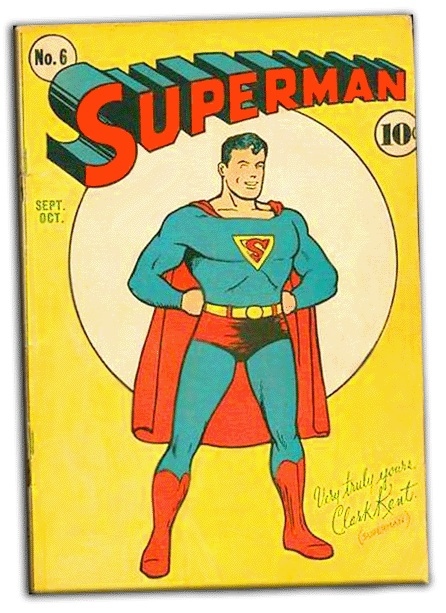
The cover of an original Superman #6, circa September 1940. Physical AppearanceThe physical appearance of superheroes does not leave much room for variation. For the men, they are at least six feet in height and are very muscular with wide shoulders and narrow hips. This body type seems to be an exaggerated ideal for American men, as many constantly go to the gym to lift weights and talk of gaining a “six-pack” of well defined abs or increase the size of their “guns” on their upper arms. Even the facial characteristics of the men promote certain ideal features. They are clean shaven and have a strong, distinct jaw line. This may be to suggest strength on the part of the man, to compliment the strong body. The men are also typically swarthy fellows, with dark hair and dark complexions. Rarely will you see a hero with pasty white skin and bleach blonde hair, though they do exist. This robust appearance seems to encourage the idea that these men are healthy, and again, strong. For the women superheroes, they are built to promote their sexuality. Nearly all of the women have hourglass figures that could rarely be accomplished in real life, like Barbie, with a small waist and large bust and hips. The breasts especially are very pronounced. These women are seen as beautiful in the American culture, and other women try to emulate the body styles. Unfortunately, some pursue this in the unhealthy manner of eating disorders while trying to achieve the pronounced waist and others resort to plastic surgery to increase their bust size. The heroines also have long hair, not too long, but falling to somewhere in the middle of their back, and worn loosely with perhaps a headband to hold it back off of the heroine’s face. The non-human superheroes follow virtually identical physical guidelines as their human counterparts with some slight differences. The non-humans are mostly bi-pedal humanoids and have similar physical characteristics as the human gender they most identify with; some of them come from planets with 8 or 9 genders, none of which are identical with our own. Several of the humanoids are trans-figured humans who have taken on a beastly appearance, such as the Hulk or the Thing from the Fantastic Four, and are larger and much more muscular than the average hero. Alien humanoids frequently have different colored skin and slightly abnormal body shapes, such as the Martian Man-Hunter whose dark green skin and more pronounced brow bones set him off from his fellow Justice League of America members. The interesting phenomenon to note is that throughout the non-human heroes, the biggest deviation from the human heroes is skin color. They may be shaped in a grotesque parody of human form or the same shape as humans, but it is the skin color which sets them apart. The non-humans with the same color skin, like Hawk Girl from the Justice League, have entirely human bodies with minor additions, such as wings. Never once is there a human-flesh colored hero who is not shaped like a human. There are no giant pinkish bears or misshapen flesh toned blobs running around and saving people. I feel that this is because for us as Americans to identify with the characters, we must be able to have a solid basis for comparison; two legs, two arms, and one head all leading off of a central trunk in a recognizable pattern, color being much less important. Instead of being designed to draw the audience closer to the hero, it is used to set the hero apart. ClothingWhile comparing the physical attributes of the superheroes is important, the clothing that the heroes don is just as equally significant. Just as Sarah Lamb mentions that different saris can indicate different ranks and importance (Lamb, 2000), so too does the garb of these titans designate them as superheroes and set them apart from the rest of humanity as people of importance. Skin tight jumpsuits seem to be the standard attire for the superhero male, with muscles showing clearly through the material. There is typically briefs or a belt of some kind drawing attention to the narrow hips, or some sort of shoulder covering designed in a triangular fashion that once again draws attention to the waist and hips. These two features of the costumes would suggest a presentation of the hero’s machismo by drawing the observer’s attention to a finely cared for body as well as the groin area. The jumpsuits also typically have an insignia of some sort emblazoned on the chest, again drawing attention to how wide and strong the chest and shoulder area is. Accenting these suits are calf boots which emphasize the leg muscles of the hero to fix our attention on the man’s strength. One optional piece of equipment is the cape. The cape is either used to draw attention or to direct attention away from the hero. Superman for instance wears a brilliant red cape which is frequently observed snapping in the wind or trailing behind him as he flies through the air. One interesting side note is that Superman rarely lets the cape obscure his muscles by swirling in front of him. His arms are always free of the cloak, openly, once more, advertising his strength. Batman however is often depicted with his cape wrapped around him avoiding detection on a dark, stormy, Gotham City night. His cloak is more a tool for stealth and representative of a bat’s wings than as an attention getter for the crowd. Non-human males take a very different route with their clothing. They wear very little, frequently only short trousers or briefs, such as the Hulk, the Thing, or the Beast from X-Men. Some like Martian Man-Hunter choose to don a cloak as well. This may be to once more highlight the fact that they are not human. It reveals their differently formed bodies and bizarrely colored or patterned skin to make sure that the observer knows they are not human. This allows the characters to affect an even more exaggerated ideal, to exhibit characteristics such as incredible strength or size that would seem comic on a human hero. It is hard to detect a definite difference in how human and non-human females dress because the costumes which they choose vary so highly to begin with. Some wear the full length body suits that their male counterparts sport while others choose a more revealing leotard or corset style ensemble. Either way, the outfits are designed to draw attention to their large breasts, narrow waist, and wide hips. They rarely have an insignia on their costume unless they are part of a team, in which case their outfit corresponds more directly with what their team members are wearing. The most baffling element of their costume however is their heeled boots or shoes. Rarely ever is there a woman hero designed wearing flat shoes, they are always in heels. This raises the question of how they run, fight, and generally exist in these shoes. The only possible reason for them to be portrayed wearing this torturous foot-ware is because we as a culture find heels attractive. They add definition to calf and leg muscles, but they are treacherous to wear. They might even be designed to raise women’s respect for the superheroes because we admire everything that they manage to accomplish in said shoes. Importance of AppearanceThe question that then remains is how important is the superhero’s looks when it comes to the attractiveness of the hero. In a survey distributed across campus about superheroes, when asked about their favorite attributes of superheroes 40% of females and 32% of males responded that some physical aspect of this hero was their favorite attribute or the reason that particular hero was their favorite. Sometimes the reason stated wasn’t even of the character itself, but of the actor which played the hero, such as Christian Bale, Batman in “Batman Begins,” or Antonio Banderas, Zorro in “The Mask of Zorro.” This theme seems to suggest that the appearance of the hero is very important in how we as a public view and accept them. The majority of superheroes exude an extremely exaggerated masculine – feminine ideal. Superheroes that do not have as pronounced physical sexuality are not as popular, such as the androgynous original Rogue from the X-Men. Through the development of the X-Men however, Rogue became steadily more feminine, with larger breasts and tighter clothing, until we are faced with the Rogue of the new X-Men movies who has a respectable sized chest, wears tight clothing, and first experiences her powers while making out with her boyfriend. We have no room for heroes who do not exaggerate the ideals we have and emulate. The pronounced physical sexuality gives us visual cues as to how a superhero should act, talk, and live their life.Continued on Next Page » 
From the Inquiries Journal Blog   Monthly Newsletter SignupThe newsletter highlights recent selections from the journal and useful tips from our blog. Suggested Reading from Inquiries Journal
Inquiries Journal provides undergraduate and graduate students around the world a platform for the wide dissemination of academic work over a range of core disciplines. Representing the work of students from hundreds of institutions around the globe, Inquiries Journal's large database of academic articles is completely free. Learn more | Blog | Submit Follow IJ


Latest in Sociology |