The Sounds of Resistance: The Role of Music in South Africa's Anti-Apartheid Movement
By
2010, Vol. 2 No. 06 | pg. 1/2 | »
IN THIS ARTICLE
Music and Resistance in South Africa
The history of South Africa under white British rule is marked by the existence of one of the most brutal systems of racial segregation that the world has ever known. A system by the name of Apartheid, literally meaning “separateness” in the Afrikaans language, made Africans of color aliens in their homeland. The laws of Apartheid forced millions to live in impoverished townships where they were denied the most basic human rights. Apartheid, under which the white minority held power over the entire population, was met with strong internal and external resistance, prompting global boycotts of sales and trade with South Africa. The most powerful form of resistance, however, was the refusal of South African blacks to remain prisoners in their own land. In the 46 years that the system of Apartheid was in place, the resistance movements evolved from loosely organized unions of non-violent protestors to powerful and armed coalitions such as the African National Congress (ANC). Throughout every stage of the struggle, the “liberation music” both fueled and united the movement. Song was a communal act of expression that shed light on the injustices of apartheid, therefore playing a major role in the eventual reform of the South African government.This paper explores the connections between music and politics as exemplified by the case of South Africa. While avoiding oversimplifications of a supposed “music revolution,” it examines the resistance to Apartheid through the lens of its music. As historian Grant Olwage notes,
By attempting to understand the role that music played in the struggle against, and eventual dismantling of the Apartheid government, we can begin to understand the power that music can hold in a political context. 300 Years of Oppression: The Foundations of ApartheidThe liberation music of the Apartheid-era was in response to a history of oppression that dates back to long before the implementation of Apartheid. The segregation of racial groups in South Africa began with the first European settlers in 1652, when a Dutch company began using the Cape of Good Hope as a base for ships travelling trade route between Europe and Asia. The Khoi people, who practiced extensive pastoral farming (animal husbandry), were driven from their land in a series of frontier wars, replaced with European settlers’ commercial farms, and used as slave labor. The British arrived 150 years later, forcing the Dutch to migrate beyond the coast and further into African lands. During the course of the 300 year Dutch and British rule in South Africa, new racial groups developed out of the intermingling of Europeans and Africans, which would later be categorized as ‘White’, ‘Black’, ‘Coloured’ and ‘Indian’. The discovery of diamonds in 1867 and gold 1886 in Southern Africa came the beginning of the economic and political structure that would greatly increase the division between white and black, British and Boer, and rich and poor. The music that would follow in the next 100 years largely reflected this widening gap, and to communicate across it. Throughout the early 1900’s the British, who had gained complete rule over South Africa after the South African Wars (1879 – 1915), enacted a series of laws that were designed to perpetuate white rule by segregating racial groups. By requiring documentation to prove authorization to be or live in “white” South Africa, the introduction of Pass Laws effectively regulated the presence of blacks in urban areas. The passing of 1913 Native Land Act restricted African land ownership to 7% of the country’s total land area, most of which was of poor quality and could not meet the needs of the African population. Under the Native Urban Areas Act of 1923, Africans were allowed to reside in the cities and townships only to “minister the needs of the white population”, and were returned to rural areas or imprisoned if they remained without work. In a report by the South African Native Affairs Commission in 1905, it was decided that “no native shall vote in the election of any member or candidate for whom a European has a right to vote” (SANAC, 1905: 35-6, 97). The central legislative, judicial, and administrative bodies were shared amongst the capitals of “white” South Africa, ensuring that only white South Africans would be involved in the government. These policies institutionalized racial segregation, and laid the foundation for Apartheid as well as for the resistance movements. The efforts to organize a resistance were consistently met with crushing, government-sanctioned attacks on non-violent protesters, inciting the sparks of a conflict whose intensity would increase in the following years. As Clark and Worger describe, after three hundred years of white settlement South Africa was “divided on nearly every conceivable level.” (Clark and Worger 31) The numerous racial groups we separated by race, language, wealth, politics, residence, jobs – in practically every aspect of daily life. Few could reap the rich benefits of life in South Africa under such a system, creating a instability and discontent amongst the different groups. The answer to this situation, reached by the ruling white leaders, was to “further entrench the existing divisions under an ironclad system of racial separation that would be known as Apartheid” (Clark and Worger 31). The General Election of 1948 and the Implementation of Apartheid
The system of Apartheid rested on a long history of racial discrimination; though many of its policies were merely elaborations on previously established frameworks, the sheer brutality of its implementation and “overarching impact” (Clark and Worger 35) on the country signaled a monumental shift. The Afrikaner (white South Africans of Dutch, German, or French descent) Nationalist Party (NP) that was voted into power by white South Africans in 1948 were known for their “‘frontier mentality” derived from years of brutal discrimination towards Africans and economic deprivation experienced by Afrikaners since the 19th century.” Without engaging in the debate over the reasons for the implementation of Apartheid, seemingly backwards in comparison to gaining of human rights elsewhere in the world, I will examine the influential figures and policies of Apartheid, and the role of music in the progressively powerful responses of the undying resistance movements. Vuyisile Mini and Hendrik Verwoerd: The Father of Protest Songs and the Architect of ApartheidHendrik Verwoerd was prime minister of South Africa from 1958 until his assassination in 1966. Often called the “Architect of Apartheid” for his role in the implementation of Apartheid during his tenure as Minister of Native Affairs, Verwoerd was the subject of a protest song composed by legendary composer Vuyisile Mini. The song, titled “Ndodemnyama we Verwoerd” (“Watch Out, Verwoerd”) became one of the most popular songs in South Africa. Mini’s soulful compositions and booming bass voice led him to emerge as one of the most powerful organizers of the resistance. In the words of poet Jeremy Cronin “Song had become an organizer, and he was the embodiment of this reality” (Hirsch 2002). The singing of Ndodemnyama was a statement of protest and a tribute to the strength of freedom fighters. “That song sounds like a fun song,” said musician Hugh Masekela, “but it’s really like ‘Watch out Verwoerd, here comes the black man, your days are over” (Hirsch 2002). Known as “the organizer of the unorganized,” Mini was actively involved with the ANC and was one of the first to be recruited into its military inception in 1961. He was arrested in 1963 for “political crimes,” including sabotage and complicity in the death of an alleged police informer; when he refused to give evidence against his comrades, he was sentenced to death. Fellow prisoner Ben Turok describes him as walking defiantly to the gallows while singing Ndodemnyama. Turok’s recollection reads:
The song was sung in South Africa for years after Mini’s death, and is still being sung today by internationally recognized voices such as Miriam Makeba and Afrika Bambaataa. The ANC: The Organized ResistanceThe formally recognized opposition to Apartheid known as the ANC began in 1912 when several hundred members of South Africa’s educated African elite gathered to establish a national organization to protest against racial discrimination. The meeting opened and closed with the singing of “Nkosi Sikelel’I Afrika”, which was adopted as the ANC’s official anthem. Changes in African attitudes to politics were articulated by the newly radical approach of the ANC. Under the leadership of Alfred Xuma (1893 -1962), they adopted a method of non-cooperation with government, and began to link their struggle with the efforts of oppressed people globally. Xuma saw no reason to expect change from “polite requests,” and as such began to mobilize what he saw as a more powerful form of resistance. In 1944 members of the ANC such as Nelson Mandela and Walter Sisulu formed the established the ANC Youth League with the aim of “invigorating the national organization and developing forceful popular protests against government segregation and discrimination” (Clark and Worger 38). Though ANC demands were met with government silence, the forced removals from thriving black communities such as Sophiatown, and the brutally violent police responses to peaceful protesters led the ANC towards armed struggle. Forced Removals, Massacres, and the New Armed Struggle
Forced removals under the Group Areas Act and Bantu Resettlement Act (1954) forced millions to migrate from their homes to live in native “townships.” The laws divided South Africa into zones, in which members of only one racial group could live. Most remarkable was the destruction Sophiatown, a community west of Johannesburg that is often compared to Harlem, New York City for its lively arts, politics, religion, and entertainments. In 1955, army trucks and armed police removed 60,000 people from Sophiatown by to an area designated for Africans. One white observer remarked:
His observation reveals the condescension with which Africans were perceived by whites, as well as the poverty which had already swept through even the most vital communities. Africans perceived the forced removals as a cleaning up of the country, erasing ‘black spots’ to make ‘the picture look white.’ Sophiatown was rebuilt as white suburb called Triomf, the Afrikaans word for triumph. The removals sparked the creation of a song called “Meadowlands”, in reference to the Meadowlands township to which many Sophiatown residents were forced relocate. The lyrics express the devastation of the evacuation: “we will move all night and day/to go stay in meadowlands/you’ll hear the white people saying/let’s go to meadowlands.” Recordings by Nancy Jacobs and Sisters, as well as famed singer Miriam Makeba popularized the song, which was composed originally by Strike Vilakezi. The international performances of the song allowed international audiences a window into South Africa, and expose the injustices suffered by oppressed racial groups. The resistance movements underwent significant changes as it began to reflect the increasingly violent struggle against white rule. The government reacted to the increasing strength (and size) of the resistance by declaring a state of emergency; they arrested approximately 18,000 demonstrators, including the leaders of the ANC and the PAC, and banned both organizations from any legal existence. Known as the Sharpville Massacre, in 1960 69 non-violent Africans were killed by government troops for protesting pass laws. This conflict became the main precursor of the transition from non-violent protest to armed struggle in 1961. Prohibited from operating in South Africa, both the PAC and the ANC established underground organizations, and he ANC began military training outside the country. The newly formed Umkhonto we Swize, translates as Spear of the Nation, and was known as the MK. The military wing targeted specific places such as police stations and power plants, but specifically avoided taking any human lives. In an explanation of the ANC’s adoption of a policy of violent resistance, Nelson Mandela says: “…we felt that without violence there would be no way open to the African people to succeed in their struggle against the principle of white supremacy. All lawful modes of expressing opposition to this principle had been closed by legislation and were placed in a position in which we had either to accept a permanent state of inferiority, or to defy the Government” (Clark and Worger 150). Mandela and other leaders were sentenced to life in prison, while Tambo managed to escape from South Africa and serve as president of the ANC in exile. It was during this transition to violent resistance that music was often talked about as a “weapon of struggle.” A song called “Sobashiy’abazali” (“We Will Leave Our Parents”) became one of the most popular songs sung at the MK training camps. The lyrics evoke the sadness of leaving home, as well as the persistence of freedom fighters:
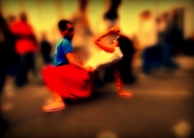
The music was more upbeat and energetic, with faster, more militaristic rhythms and accompanying marching actions as a gesture towards the marching steps of soldiers. Toyi-Toyi, thought to originate in Zimbabwe, a classic example of this shift and became a symbol of the apartheid resistance. Usually performed in a group setting, it is a dance consisting of foot stomping and spontaneous chanting. Toyi-Toyi was often invoked during the ANC’s “Amandla” chant: in call and response, the leader of a group would call out “Amandla!” (“Power”) and the group would respond with “Awethu!” (“Ours”). The power of this chant builds in intensity as it progresses, and the enormity of the sounds that erupt from the hundreds, sometimes thousands of participants was often used to intimidate government troops. As one activist puts it, “The toyi-toyi was our weapon. We did not have the technology of warfare, the tear gas and tanks, but we had this weapon” (Power to the People 2008).Continued on Next Page » 
From the Inquiries Journal Blog   Related Reading Monthly Newsletter SignupThe newsletter highlights recent selections from the journal and useful tips from our blog. Suggested Reading from Inquiries Journal
Inquiries Journal provides undergraduate and graduate students around the world a platform for the wide dissemination of academic work over a range of core disciplines. Representing the work of students from hundreds of institutions around the globe, Inquiries Journal's large database of academic articles is completely free. Learn more | Blog | Submit Follow IJ


Latest in Music |