Featured Article:Idle Youth: Using Sport to Address the Youth Bulge in Sierra Leone
By
2010, Vol. 2 No. 05 | pg. 1/5 | »
IN THIS ARTICLE
KEYWORDS
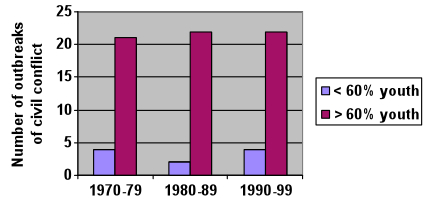
There is a growing consensus that the prevalence of a large youth population is not conducive to peace and that such a ‘youth bulge’ can even increase the risk of civil conflict and political violence.1 Richard Cincotta and Elizabeth Leahy argue that such a youth bulge within the confines of fragile or failing states where economic opportunities are few and horizontal inequalities are numerous raises the potential for violence significantly. Indeed they discovered that about eighty-six percent of all countries that experienced a new outbreak of civil conflict between 1970 and 1999 had age structures with sixty percent or more of the population younger than thirty years of age (figure 1). They also found that of the countries without recent civil conflict, twenty-four percent of all states with more than sixty percent of their population under thirty years of age experienced at least one incident of civil conflict during the following decade. Among countries with less than sixty percent under thirty years of age, just seven percent experienced civil conflict. This led Cincotta and Leahy to conclude that a quarter of all non-conflict countries with young age structures are likely to experience a new civil conflict during the next decade.2 This paper will therefore rest on the assumption that the quantifiable variable of population age structure ‘can be used to project risks of civil conflict a decade into the future.’3 Within an African context, and especially a sub-Saharan African context, this appears to be a worrying diagnosis to the conflict driven ills of many countries where youth populations can easily represent up to sixty percent of national totals.4 By 1990 more than half of all Africans were below the age of eighteen (hence classified as children) and growing up with world views that were radically different to their parents’. These children are now youths. With no experience of colonialism, their sole experience has been that of the African state itself, and as such if the youth wanted to engage in political opposition there was no foreign imperialist or exploiter to target– instead their antipathy was directed inwardly towards their own people and governments.5 Given their large numbers and prime physical state, this has led to violence with disastrous social, economic and political repercussions across the continent.Figure 1: Number of Outbreaks of Civil Conflict by Age Structure, 1970-1999
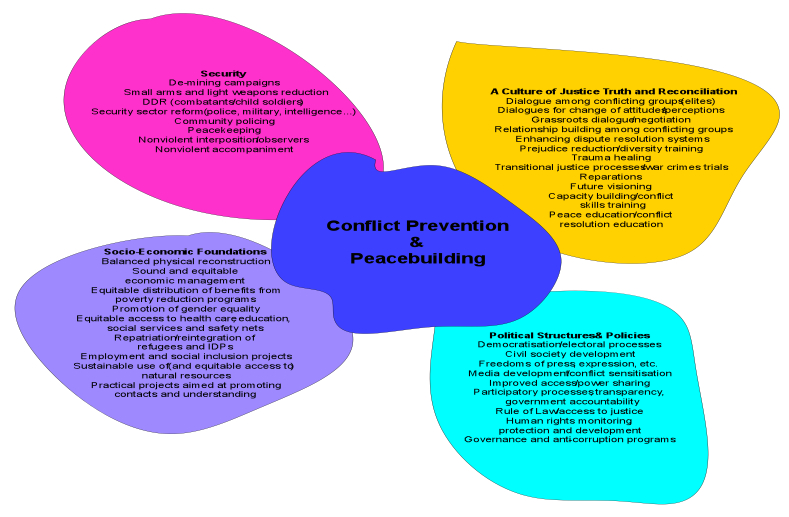
Yet to isolate this ‘youth bulge’ as something independently tangible and accountable for the violence is to fail to grasp the real breadth of the issue. The plight of youths in Sierra Leone and elsewhere in West Africa must be put within the wider context of ‘the socioeconomic and political breakdown of states in the subregion, the ensuing violent struggle over power and resources, and the spillover effects of conflicts into neighbouring states over the past decade.’6 Decades of political exclusion and conflict mismanagement has led to severe poverty, economic failure, unemployment, and the erosion of state and social structures in West Africa. As a result, many states have lost their capacity to stimulate the economy, provide welfare support, create jobs, ‘and most important, to control, discipline or rehabilitate juveniles.’7 With little or no access to education or paid employment, youths have long been excluded from their respective states in the region. In Sierra Leone the war merely exacerbated this societal disconnect and the problems at its root, and crudely exposed the youth of Sierra Leone to a kind of nefarious violence that traumatized a generation. ‘Funmi Olonisakin makes an excellent point when she notes that the ‘situation of children is all the more pathetic given their lack of skills, resources, and maturity to cope with the negative consequences of conflicts,’ adding succinctly that, ‘war has the potential of stunting the development and growth of children.’8 The most effective antidote to this disruption is to prevent conflict in the first place. This paper will attempt to show that sport for development programs in Sierra Leone are doing exactly that. In the wake of the political peace, sport has helped to provide a crucial service to the country’s youth population that has proved beneficial educationally, for their physical health and mental well-being, and for the wider goal of redeveloping civil society. To understand the key to the apparent youth propensity towards violence it is necessary to place the work of Cincotta and Leahy next to that of Frances Stewart and Paul Collier in particular. Stewart is especially influential here in her conclusion that is not simply the existence of a youth bulge that heightens the potential for violence, but more exactly it is their marginalisation.9 Horizontal inequality and the lack of a meaningful social contract between the government and significant sections of its citizenry create a climate of disillusion with one’s political elite and resentment towards one’s supposed social peers. It is this social parochialism combined with the sheer number of youths that makes a youth bulge particularly potent. Therefore the challenge is to address this bulge, to engage and include youths in decision making processes, and to empower them in positive ways that serve to dissuade them from violence driven by disaffection. This paper will look to examine how sport is doing this in Sierra Leone. It will also take into account the implications of other social and economic drivers of conflict such as growing up in ‘bad neighbourhoods’ affected by spill over of regional conflicts;10 the youth reaction to the legacy of past conflicts;11 and their propinquity to natural or primary resources whose scarcity in more fragile economies give them a significantly heightened value.12 By considering all of these together, this paper will concern itself with how sport can work towards solving Charles Tilly’s overarching conundrum: ‘how to prevent the emergence of large scale collective violence and sustain human progress.’13 To reach this problematic balance requires mediation and other operational activities, and more crucially structural changes to address the roots of conflict. However ‘there is no single proved methodology for preventing violence and building peace’14 and indeed, Given the reality of what we do not know, conflict prevention and peacebuilding evaluations in the coming years should be directed toward gathering evidence and learning from it, and on testing and challenging commonly held theories and assumptions about peace and conflict, rather than on establishing fixed universal indicators of peace/conflict. Clarity on indicators (and whether or not they can be generalised in a useful way) may emerge in the process, but the focus and approach at this time should avoid over-specification of anticipated indicators as benchmarks for evaluation. Upcoming conflict prevention and peacebuilding evaluations should focus on gathering experience and analysing it cumulatively and comparatively across contexts, to improve our collective learning. 15 As such this paper will look primarily to add some new ideas to the growing body of research into conflict prevention. However, whilst the need for originality is well understood, it would be neglectful to ignore previous studies. With this in mind, the Utstein Palette is a helpful starting point in how it shows so clearly the scope of problems that need attention. Placing Conflict Prevention and Peacebuilding in the centre, the palette consists of four overlapping sectors that require improvement in equal measure if conflict is to be averted. It calls for the provision of Security; the establishment of functioning Political Structures able to deliver effective policies; the establishment of Socio-economic Foundations for long-term peace; and the development of a Culture of Justice, Truth and Reconciliation. Within each of these four arms are more focused sub-categories, each of which demand attention (figure 2.). Figure 2. The Utstein Palette.16
The paper will therefore assess how after the protracted civil war, sport worked towards these considerable challenges. From a narrower angle it will also look into how sport for development non government organisations (NGO’s) have been integral to providing the expertise and creating the environments for men and women from varied backgrounds to interact and mend the social fabric of the nation. The importance of this repair work is evident in that it served a dual purpose. On the one hand sport for development programs in Sierra Leone have worked and continue to work towards post-conflict reconstruction by kick-starting civil society and plugging gaps in education and exercise. On the other, and of more interest to this study, they have a particularly important conflict preventative role to play in how they forge and maintain social understanding and community harmony. Given this broad scope, and in the interest of clarity, I will divide this paper into more approachable chapters. The following chapter will briefly attempt to clarify exactly the terminology, aims, and underlying assumptions of this paper. The subsequent chapters will then each look at an individual aspect of sport’s developmental role in Sierra Leone: chapter three will provide a critique of the changing nature of warfare and discuss its relevance to Sierra Leone. It will then assess the bearing this change has on sport for development programs; chapter four will demonstrate how sport positively occupies the huge youth population in Sierra Leone, and further it will inspect how sport is benefiting the wider community as a whole; chapter five will look at the need for policy coherence in sport for development policy approaches if they are to be used to their maximum potential; chapter six will evince the limitations of sports’ conflict preventative and developmental role; and the conclusion will tie all the ideas together and make some brief suggestions for better practice in Sierra Leone. Terminology, Aims, and AssumptionsTo best answer this paper first requires some clear definitions: what exactly constitutes a youth is certainly in need of further explanation. In addition there are two assumptions underlying this paper that require clarification. The first assumes that war is to a certain extent imitative of sport, and that this gives it a special applicability to conflict and post-conflict zones. This is expanded upon in chapter four. The second assumption is that the whole youth experience in Sierra Leone can be explained within Albert O. Hirschmann’s ‘Exit, Voice and Loyalty’ paradigm, the intricacies of which I will attempt to explain in this chapter. Put concisely however, this triadic concept asserts that the real challenge facing Sierra Leone and its myriad NGOs and governmental ministries is how to encourage a generation to put faith in voice as the agent of social change rather than exit and the violence associated with it. Youth is a complicated term that varies in its classification. The official UN definition of youth is someone between the ages of eighteen and thirty, whilst the Sierra Leonean government considers it to be ‘any Sierra Leonean (female and male) within the 18-35 age bracket. This does not exclude any young Sierra Leonean liable to youth related needs, concerns and influences.’17 The more flexible Sierra Leonean definition is better than the UN’s, for the latter’s tendency to regard youth as merely a demographic construct is to be guilty of reductionism. For not only does a finite age bracket disregard national fluctuations such as life expectancy– the like of which can render someone of thirty years old very much a senior member of society in some poorer states– it also fails to consider youth as a cultural as well as a numerical description. Yovex 2 is the name of a recent study carried out by the Conflict, Security and Development Group at King’s College University, London. It sought to describe how ‘Youth in Africa is a cultural construct that helps to stratify societies and to structure power relationships, and as such, it is in tension with democratic assumptions of equality before the law as well as the open access to labour embedded in liberal economic policies. This can hinder political and economic reform given the rigidities associated with hierarchical entitlements and duties based on youth/non youth status.’18 This polarisation in Sierra Leone has seen men and women of up to forty years old consider themselves youths not as a result of their demographic status, but owing to their economic and social standing. In particular, ‘those who are jobless may feel themselves as youths, regardless of age.’19 Therefore youth is a pregnant term full of weighty connotations that transcend age boundaries. Typical responses to my question of ‘what do you connect to the term youth’ were that, ‘they are idle and prone to violence and drug abuse,’20 and associated with ‘disobedience, violation of social norms, unemployment, ghettos, and crime.’21 The significance of these perceptions are that in states characterised by low capacity and resilience such as Sierra Leone, negative conceptions of youth exacerbate their exclusion from the social, political and economic order that affects them. As a result this may rouse social unease and instability if youth suddenly engage in any sort of activities as they are invariably misconstrued as working to undermine the status quo in youth/non-youth power relations.22 Therefore the challenge of addressing the youth bulge is two fold. Firstly, occupying the youth in a productive and socially responsible way that gives them a voice and fair representation in the decision making processes that affect their lives is paramount. However, secondly and equally importantly, non-youth sections of society must change the predominantly negative way they perceive youth. This paper will show that sport is helping in both of these areas. It is a visible medium through which older members of society can see youths participating in a positive and peaceful manner. Yet this must be regarded as a symbiotic relationship where not only can the youth be seen in a positive light, but also they can also use sport as a platform to make themselves seen and heard to sections of society that may not be initially looking or listening. Moses J. Johnson is the Sierra Leonean Project Manager for Right To Play, a sport for development NGO that uses sport and play to bring youths together for educational, social and health purposes, and concurrently trains local coaches who take ownership of the programs themselves. Last year the NGO worked with 48,000 children and youths and trained 6000 coaches. Speaking about the creativity and changing face of youth, Mr. Johnson commented that: Youth is increasingly associated with ingenuity and development, politics, music and sport. As a social body they are quick to undertake their own activities and form their own groups. One such example is the ’Marginalised Youth Association’ in Freetown who organise sports matches and music concerts to try to give youths a voice through which they can sensitise the population to their often ignored plight.23 Furthermore, approximately seventy-eight percent of Right To Play trained youth leaders in Makeni and seventy-nine percent in Freetown noted that sport activities provided a distraction from negative activity amongst the youth.24 This NGO opinion is reflected by those of the participants’ parents who almost unequivocally felt involvement with Right To Play programs enabled some children to interact better with their peers, and that troublesome and violent behaviour diminished.25 To complete the circle of endorsement, the participants themselves also appeared to grasp the positive outcomes of their involvement: Richmond Thorley, the Secretary and President of the Sierra Leone Teacher’s Union (SLTU) attested that from his own research in Makeni, ‘ninety percent of youths see sport as a worthwhile educational and social activity.’26 This brings me tidily to my second underlying assumption, namely that it is possible to place all of the negative and positive examples of youth activities and development priorities mentioned above within one uniting framework afforded to us by Albert Hirschmann’s broad ‘Exit, Voice, and Loyalty’ trinity. This paradigm understands youth to react to their environments in three distinct ways:
Both voice and exit are mechanisms of recuperation, and therefore the challenge for Sierra Leone is to cultivate the social conditions that afford citizens the chance to force change peacefully through the former rather than the latter. As the National Youth Policy states: The Government, through the Ministry of Youth and Sports, must create the ideal enabling environment to tackle unemployment, drug-abuse, homelessness, and create, a positive working culture in the minds of our young women and men if we are to lay to rest the rather nihilistic notion that puts premium on violence as an agent of social change.28 The preference of voice over exit is obvious on the one hand in that exit is more likely to precede or even accompany violence. Yet on the other, and in addition to this clear advantage of being more peaceful, the strength of voice above exit as an agent of change lies in its chance-like nature. Exit is binary: you are either within or without the state system and as such exit must be regarded as a mechanism for collapse if large enough numbers participate. It is as Hirschmann says, ‘a certain and dysfunctional response to declines in state performance’29 for ‘once you have exited you have lost the opportunity to use voice.’30 As such exit tends to manifest itself as conflict. Oppositely voice can overcome state fragility and put pressure on the political elite through the threat of exit. In this way it is confrontational rather than binary, chance rather than certainty, and can be seen as ‘political action par excellence’ or ‘an art, constantly evolving.’31 This evolution of voice depends upon the presence of both influential and deferential participants who are able to work together to push for change but temper the progression to violence. Within a youth context inside Sierra Leone, achieving this balance is a must, especially when one considers exit is the direct approach that will tend to be favoured over the more uncertain voice option by a restless mass. For without doubt exit is a powerful agent– by inflicting revenue or power losses on poor managements, exit beckons a quick managerial response in the way voice may not. Therefore preventing youth exit is a necessary yet neglected area of conflict prevention initiatives. Doing so rests upon a vast array of factors. Barriers in political, economic, legal and social life must be lifted and be supported with progressive taxation and pro-poor initiatives that convince the populace that the government is including them enough to encourage the use of voice to push for change rather than exit. However without either the organisations in place to safeguard social equality or the public spaces available for voices to be heard, states are unable to fulfil their minimum governmental requirements and remain susceptible to violent exit strategies. This all points to an apparent shift in the nature of warfare that has increasingly placed society itself at the centre of conflict. As a result, society must be at the centre of conflict prevention efforts too. Therefore the next chapter will show how sport for development initiatives are focussing primarily to address societal ills by providing both public spaces and interactive opportunities necessary for voice to work as a potent agent of change rooted in articulation rather than desertion.Continued on Next Page » 
From the Inquiries Journal Blog   Related ReadingMonthly Newsletter SignupThe newsletter highlights recent selections from the journal and useful tips from our blog. Suggested Reading from Inquiries Journal
Inquiries Journal provides undergraduate and graduate students around the world a platform for the wide dissemination of academic work over a range of core disciplines. Representing the work of students from hundreds of institutions around the globe, Inquiries Journal's large database of academic articles is completely free. Learn more | Blog | Submit Follow IJ


Latest in Anthropology |