Featured Article:Confusing The Wind: The Burj Khalifa, Mother Nature, and the Modern Skyscraper
By
2010, Vol. 2 No. 01 | pg. 1/2 | »
KEYWORDS:
If you happen to check in to the Grand Hyatt San Francisco on a windy day, you’ll receive a friendly note at the front desk advising you that the 35-story skyscraper may creak a bit as it moves gently back and forth in the wind. Though the hotel assures guests that this quirk is not an indication of any structural problem, the issue has nevertheless prompted complaints from visitors. “The building CREAKS!” exclaims one exasperated and sleepless customer in his review of the hotel.1 “It sounds like you’re on an old ship,” writes another.2 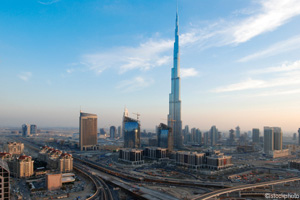 From the disconcerting to the dangerous, wind has always been an important consideration when constructing skyscrapers. Since the 10-story steel-frame Home Insurance Building, the world’s first skyscraper, opened in Chicago in 1885, architects have had to think about wind stress, or “wind loading,” as they’ve built higher and higher.3 Today, wind engineering is an integral aspect in the design of any new tall building, especially the very tallest of them all: the Burj Khalifa. From the disconcerting to the dangerous, wind has always been an important consideration when constructing skyscrapers. Since the 10-story steel-frame Home Insurance Building, the world’s first skyscraper, opened in Chicago in 1885, architects have had to think about wind stress, or “wind loading,” as they’ve built higher and higher.3 Today, wind engineering is an integral aspect in the design of any new tall building, especially the very tallest of them all: the Burj Khalifa.
At 2,717 feet, the Burj Khalifa, formerly known as the Burj Dubai, rises like a bolt of lightening into the sky, dwarfing the surrounding skyscrapers. The tower, which opened on January 4th, became the world’s tallest building, outdoing the previous record-holder, the Taipei 101, by a staggering 1,046 feet. (The Burj is about as tall as the Taipei 101 with the Chrysler building stacked on top.) Over half a mile from the base to the tip of its spire, the tower redefines the term “supertall,” a name often applied to skyscrapers over 1,000 feet. The Burj Khalifa is specially designed to conquer the wind, a goal that becomes more and more important as altitude increases. The building rises to the heavens in several separate stalks, which top out unevenly around the central spire. This somewhat odd-looking design deflects the wind around the structure and prevents it from forming organized whirlpools of air current, or vortices, that would rock the tower from side to side and could even damage the building. Even with this strategic design, the 206-story Burj Khalifa will still sway slowly back and forth by about 2 meters at the very top. The Burj Khalifa’s talent for “confusing the wind,” as chief structural engineer Bill Baker calls it, is just one of the methods used to help supertalls resist wind stress.4 Over four thousand miles away near the coast of Taiwan, stands the Taipei 101 tower, now a distant second at 1,667 feet. Inside, between the 88th and 92nd stories, a giant pendulum, known as a tuned mass damper, does quiet battle with deadly windstorms and typhoons. The gold-colored, 730-ton orb swings gently back and forth, balancing the tower against the forces of the wind and ensuring the comfort of its occupants.5 The tuned mass damper, also used in Boston’s John Hancock Building and New York City’s Citigroup Center, is a commonly employed mechanism for reducing the wind’s action on a skyscraper. The size and shape of the damper is “tuned” based on the height and mass of each particular tower. As the wind pushes the building in one direction, the damper swings or slides the other way, reducing sway similar to the way shock absorbers on a car soften bumps in the road. “You’re adding a component to the building that’s going to take the motion rather than the building itself,” explains Jason Garber, a wind-engineering specialist at RWDI, a leading wind tunnel testing firm.6 When constructing a skyscraper, consideration of the wind is paramount, says Carol Willis, director and curator of the Skyscraper Museum in New York.7 Throughout the design process, structural engineers and wind specialists work meticulously to alleviate wind stress, ensure structural stability and guarantee the comfort of occupants. Using both structural solutions, such as the Burj Khalifa’s method of “confusing the wind,” and mechanical ones, such as the tuned mass damper, designers do constant battle against the tireless wind. The Burj Khalifa, says Bill Baker, is like a Swiss watch, every part working together to “resist the forces of nature such as wind, seismic and gravity.” Yet forces like gravity are comparatively simple to deal with. Gravitational forces pull the skyscraper in only one, quite predictable, direction: down. But high-altitude winds swirl and jostle in complex and uncertain ways, whipping into eddies and vortices that put all different kinds of stress on the structure. As Garber explains it, a building is like “a giant sail” with a great deal of area that the wind can push against. “The wind is blowing on the building causing it to sway and twist,” he says. “For certain shapes, the wind can form a wake similar to what you’d see behind a boat with vortices shedding off, alternating on either side and pushing the building from side to side.”8 “This causes a regular, or periodic, force,” continues Garber, “that pushes the building side to side across from the wind flow. The frequency at which that happens will vary with wind speed and if those vortices can align with the frequency that the building wants to oscillate at then you can get some very larges forces developed.” Like a guitar string, buildings have a natural, or resonant, frequency at which they are inclined to vibrate. Wind vortices will only have a significant effect on a building when their frequency lines up just right, just as an opera singer has to hit the perfect pitch to shatter a wine glass. If by chance the vortices happen to push back and forth at the same rate as the structure’s resonant frequency, they can generate huge forces, as was the case in the Tacoma Narrows Bridge collapse in 1940. As a result of this effect, a key goal in skyscraper design is to disrupt the organized flow of wind around the building. “What they’ve done on the Burj Khalifa deliberately,” explains Garber, “is keep introducing changes to the shape of the building with height so that the flow pattern can’t organize itself. It’s almost like you have several different buildings with height and each one of them has different vortices shedding at different winds speeds. All of those things can’t happen at the same time so what you’re left with is very little vortex shedding.” If not properly addressed, wind stress from vortex shedding could theoretically cause major structural damage or even collapse. No need for queasiness though, as today’s skyscrapers are strong enough to withstand the most extreme winds speeds, making true structural failure a near impossibility. Skyscrapers are engineered according to a 50- or 100-year return rule, meaning that, on average, engineers expect winds to reach structurally dangerous speeds only once in a half century or more. Just to be safe, designers then increase the strength of the structure by an additional 60% or so to account for uncertainty in their measurements. When all this is taken into account, says Garber, “you’re talking about something along the lines of a 500- or 1000-year event.” The bottom line, he says, is that these buildings aren’t in any risk of falling over.9 Still, wind stress can still cause all kinds of problems in tall buildings. It can break windowpanes, damage the outer façade, stress building joints, cause leaking, crack walls and create myriad other issues. In addition, it can result in unnerving, even nauseating, swaying.10 “If the building’s moving too much, sometimes you can hear it creaking,” says Garber. However, “the most common concerns are of excessive motions. You might get people complaining that they feel the building moving or they might even feel sick.” Such was the case in the former Gulf & Western building in New York City. As a result of wind stress, the 44-story building developed cracks in stairwells and interior walls. In addition, office workers on the upper floors frequently complained of motion sickness on windy days. To fix these problems, owners invested over $10 million to add a massive steel brace to steady the structure.11 Indeed, measures to counteract the wind are undertaken as much for comfort as for safety. The happiness of occupants is an especially important issue to structural engineers, says Willis. “People are more sensitized than structures are to wind. Tuned mass dampers, for example, are used to address acceleration and peoples’ queasiness and response to the sway of buildings.” Wind stresses grow dramatically the higher you build. Not only do wind speeds increase with height, but the force of the wind also increases with the square of its velocity. That means rapidly growing wind stress as the height of the building increases, which can cause even the most rigid skyscrapers to sway slowly back and forth. “In any building,” says Garber, “the amount of motion you’d expect is on the order of 1/200 to 1/500 times its height.” For the Burj Khalifa, this translates into about two to four meters. “It’s not much, but certainly enough to make residents queasy if they can sense this motion. That’s why one of the chief concerns of architects and engineers is acceleration, which can result in perceptible forces on the human body.” In carnival rides, cars and planes, physicists often think about forces in terms of “g’s,” multiples of the force of gravity. “When we are looking at buildings,” explains Garber, “we’re talking about milli-g’s of force.” As long as the occupants can’t feel the building moving, a certain degree of sway is acceptable and even expected. Humans can sense acceleration as small as about 5 to 25 milli-g’s, far less than what the structure can actually withstand.12 In most cases, such as the John Hancock building and Taipei 101, tuned mass dampers are installed not to ensure structural stability but to prevent queasiness. Skyscrapers undergo rigorous wind tunnel testing during the initial design phase. Rowan Williams Davis & Irwin Inc. (RWDI), one of the world’s leading wind engineering consulting firm, has handled the testing for numerous projects around the world including the Burj Khalifa and Taipei 101. At RWDI, wind-engineering experts collaborate with the building’s structural engineers early on. Prior to construction, wind-engineering specialists are given complete architectural drawings of the building and the team at RWDI then gets to work constructing a complex, rigid scale model for testing. These models are covered in small holes, called pressure taps, used to measure the effects of the wind. The 1:500 scale model of the Burj Khalifa, for example, contains 1,140 separate pressure taps for collecting wind data.13 These elaborate replicas go through several rounds of testing in a specialized wind tunnel. Unlike the tunnels used to test airplane wings, sporting equipment and other small projects, these boundary layer wind tunnels are designed to simulate changes in the wind speed with height and can replicate the variable wind environments in which the buildings will ultimately be constructed. Inside the tunnel, the model is rotated at all different angles and wind effects are sometimes visualized using smoke. All of this data is then fed into computer models in order to perform additional analysis. In the case of the Burj Khalifa, wind tunnel testing led to a dramatic design change: the entire building was rotated 120º to reduce wind loading. Ultimately, this process of wind testing, provides structural engineers with a nuanced understanding of wind loads.Continued on Next Page » 
From the Inquiries Journal Blog   Related ReadingMonthly Newsletter SignupThe newsletter highlights recent selections from the journal and useful tips from our blog. Suggested Reading from Inquiries Journal
Inquiries Journal provides undergraduate and graduate students around the world a platform for the wide dissemination of academic work over a range of core disciplines. Representing the work of students from hundreds of institutions around the globe, Inquiries Journal's large database of academic articles is completely free. Learn more | Blog | Submit Follow IJ


Latest in Architecture |