Featured Article:Confusing The Wind: The Burj Khalifa, Mother Nature, and the Modern Skyscraper
By
2010, Vol. 2 No. 01 | pg. 2/2 | «
“Usually,” says Jan Klerks, Research & Communications Manager at the Council on Tall Buildings and Urban Habitat, skyscrapers “have to fight the wind but this type of building is trying to grab the wind.”15 Around the world, other skyscraper projects are beginning to take advantage of the wind to save and even generate energy. One of them is the Pearl River Tower, a 71-story supertall set to open in 2010 in Guangzhou, China. Originally conceived as a “zero-energy skyscraper,” one that uses zero or even negative energy, the Pearl River Tower has been designed both to reduce energy consumption and generate some of its own power. The building employs a wide variety of strategies, including four integrated wind turbines, to accomplish these goals.16“The building is actually positioned on the site to be directly facing into the prevailing wind,” says Russell Gilchrist, designer of the Pearl River Building and practice leader at Skidmore, Owings, & Merrill, the architecture firm that also designed the Burj Khalifa. “It’s slightly counterintuitive on one level to place the broad face into the wind because it attracts quite a lot of wind load. In this case, we choose to ignore that and tried to tap into the wind potential.”17 The Pearl River Tower has four integrated wind turbines placed inside separate three-by-four meter holes, or apertures, one-third and two-thirds of the way up the building. Unlike normal wind turbines, these vertical axis turbines can capture wind blowing in almost any direction. The apertures themselves serve to increase wind speed, making the turbines more efficient. Because of the prevailing winds, pressure builds up on one side of the tower. The pressure difference between the two faces causes air currents to be sucked through the apertures. The power potential of the turbines, Gilchrist explains, is related to the cube of the wind speed blowing against the tower. As a result, faster winds through the apertures result in a sizeable increase in the energy generated by the turbines. These four integrated turbines, Gilchrist claims, will ultimately produce as much energy as sixty-four freestanding ones placed on the roof of the building.18 The apertures also serve a dual function as a pressure release valve, alleviating some of the wind loads on the building, says Gilchrist. This not only decreases structural stress but also reduced the amount of steel and concrete needed to reinforce the building. Ultimately, the integrated turbines will generate a modest amount of the building’s electricity, around 3%. However, Gilchrist says, when combined with a number of other strategies such as a high-performance façade, specialized cooling systems, and integrated solar panels, the wind turbines will help the Pearl River Tower consume 58% less energy than local building codes require.19 Though he cautions that wind turbines are not the only or even the best path to energy efficiency, Gilchrist looks forward to trying out other designs in future projects. “Next time around, I think we’ll look at other ways we could harness or optimize the use of wind in buildings of that height. What we are trying to do is open a door to other architects and designers to see that there is the possibility of building integrated wind turbines within buildings of this type and size.”20 Wind can also provide skyscrapers with natural ventilation, which along with lighting, heating and cooling systems, represents a major energy expenditure in most buildings. “It’s basically like what you do in your home, you open windows on both sides of the building,” says MIT Professor Leon Glicksman, an expert in green architecture. According to Glicksman, some advanced building facades have a system for regulating natural airflow into the building. Vents in the building’s “skin” are used to provide energy-efficient ventilation, powered by prevailing winds outside.21 When it comes to using wind turbines especially, Glicksman is a little suspicious. “Architects always love to put wind turbines, green roofs or photovoltaic panels on just because they are visual and give the image of a super-green building.” But these sustainable technologies, he says, are not always particularly effective.22 Energy reduction is just as important. “The idea of a true zero-energy high rise is far in the future,” says Glicksman. “It just isn’t going to happen until you substantially reduce the amount of energy consumption for these buildings.”23 The proposed Dynamic Tower in Dubai represents one such example of wind-based sustainability that may be too good to be true. At least on paper, it’s one of the most ambitious projects ever. Named one of TIME magazine’s Inventions of the Year in 2008, it will consist of eighty independently rotating floors with horizontal wind turbines between each one.24 The project sounds quite impressive, yet the design has drawn the ire of skyscraper experts, especially over the claim that the turbines will power the entire building with extra energy to spare. “It’s fascinating nonsense really,” says Jan Klerks. “It’s pure marketing, it’s got nothing to do with really wanting to be sustainable.” The amount of energy used to power the rotating floors will be so high, he says, that it would be almost impossible to offset it by installing wind turbines or solar panels.25 Whether the wind turbines in the Dynamic Tower will ultimately live up to designers’ grandiose claims remains to be seen. What is clear, however, is that the project is yet another sign of a growing fascination with harnessing the wind. “I would like to think that Pearl River is just the start of what is possible,” says Gilchrist. “And I’d like to think in our future work that we could do as well if not improve upon the performance that we’ve got in Pearl River. I hope other architects and engineers do the same too.”26 Ultimately, says Klerks, the iconic value of these wind-powered skyscrapers and the message they represent are more important than literal energy savings. These highly visible buildings embody an ideal and put forth a leading example to the world, taking what, in many cases, is simply an architectural obstacle and turning it into an opportunity for sustainable energy. ReferencesInterviews Garber, Jason. Rowan Williams Davies and Irwin Inc. – Senior Wind Engineering Specialist. Phone interview. November 12, 2009. Gilchrist, Russel. Skidmore, Owings & Merrill LLP – Practice Leader. Phone Interview. November 9, 2009. Glicksman, Leon. MIT – Professor of Building Technology & Mechanical Engineering. Phone Interview. November 10, 2009. Klerks, Jan. Council on Tall Buildings and Urban Habitat – Research & Communications Manager. Phone Interview. November 4, 2009. Klerks, Jan (2nd Interview). Council on Tall Buildings and Urban Habitat – Research & Communications Manager. Phone Interview. November 13, 2009. Toukan, Abdelfattah. Council on Tall Buildings and Urban Habitat – Country Representative (United Arab Emirates). Phone Interview. November 4, 2009. Willis, Carol. Skyscraper Museum – Curator & Director. Phone Interview. November 5, 2009. Pictures “Bahrain WTC.” Wikimediacommons.org. http://commons.wikimedia.org/wiki/File:Bahrain_WTC_day.JPG. Accessed November 17, 2009. “Burj Khalifa.” Wikimediacommons.org. http://commons.wikimedia.org/wiki/File:BurjDubai.01.vm.jpg. Accessed November 18, 2009. Other Sources CTBUH.org. Council On Tall Buildings and Urban Habitat. “Tallest Buildings Database.” http://www.ctbuh.org/HighRiseInfo/TallestDatabase/tabid/123/language/en-US/Default.aspx. Accessed November 12, 2009. 1.) TripAdvisor.com. “Grand Hyatt San Francisco: Traveler Reviews.” http://www.tripadvisor.com/ShowUserReviews-g60713-d80999-r4715960-Grand_Hyatt_San_Francisco-San_Francisco_California.html. Accessed November 17, 2009. 2.) TripAdvisor.com. “Grand Hyatt San Francisco: Traveler Reviews.” http://www.tripadvisor.com/ShowUserReviews-g60713-d80999-r2481265-Grand_Hyatt_San_Francisco-San_Francisco_California.html. Accessed November 17, 2009. 3.) Moffett, Marian, Michael Fazio & Lawrence Wodehouse. A World History of Architecture. London: Lawrence King Publishing Ltd., 2004. Pg. 446. 4.) The Skyscraper Museum. Skyscraper.org. “World’s Tallest Building: Burj Khalifa.” http://www.skyscraper.org/EXHIBITIONS/BURJ_DUBAI/index.htm. Accessed November 4, 2009. 5.) Eddy, Nathan. “Taipei 101’s 730-Ton Tuned Mass Damper.” Popular Mechanics. May 2005. http://www.popularmechanics.com/technology/industry/1612252.html. Accessed November 15, 2009. 6.) Garber, Jason. Rowan Williams Davies and Irwin Inc. – Senior Wind Engineering Specialist. Phone interview. November 12, 2009. 7.) Willis, Carol. Skyscraper Museum – Curator & Director. Phone Interview. November 5, 2009. 8.) Garber, Jason. 9.) Ibid. 10.) The Skyscraper Museum. “World’s Tallest Building: Burj Khalifa.” 11.) Greer, William. “Rx For Swaying Skyscrapers.” New York Times. October 24, 1982. http://www.nytimes.com/1982/10/24/realestate/rx-for-swaying-skyscrapers.html. Accessed December 1, 2009. 12.) Boggs, Daryl. “Acceleration Indexes for Human Comfort in Tall Buildings – Peak or RMS?” CTBUH Monograph Chpt. 13: Motion Perception Tolerance and Mitigation. Counsel on Tall Buildings and Urban Habitat, 1997. 13.) RWDI.com. “Burj Khalifa.” http://www.rwdi.com/project/burj_dubai. Accessed November 17, 2009. 14.) “Bahrain World Trade Center.” Popular Science. http://www.popsci.com/bown/2008/product/bahrain-world-trade-center. Accessed November 10, 2009. 15.) Klerks, Jan. Council on Tall Buildings and Urban Habitat – Research & Communications Manager. Phone Interview. November 4, 2009. 16.) Gilchrist, Russell. “Towards Zero Energy: The Pearl River Tower.” Intelligent Glass Solutions. Intelligent Publications, Ltd. 17.) Ibid. 18.) Frechette, Roger E & Russell Gilchrist. “‘Towards Zero Energy’: A Case Study of the Pearl River Tower, Guangzhou, China.” Presented at The Proceedings of the Council On Tall Buildings and Urban Habitat’s 8th World Congress. Dubai, United Arab Emirates. 19.) Gilchrist, Russell. “Towards Zero Energy: The Pearl River Tower.” Intelligent Glass Solutions. Intelligent Publications, Ltd. 20.) Gilchrist, Russell. 21.) Glicksman, Leon. 22.) Ibid. 23.) Glicksman, Leon. 24.) TIME.com. “Time’s Best Inventions of 2008: 16. Dynamic Tower.” http://www.time.com/time/specials/packages/article/0,28804,1852747_1854195_1854134,00.html. Accessed November 13, 2009. 25.) Klerks, Jan (2nd Interview). 26.) Gilchrist, Russell.
KEYWORDS:

From the Inquiries Journal Blog   Related ReadingMonthly Newsletter SignupThe newsletter highlights recent selections from the journal and useful tips from our blog. Suggested Reading from Inquiries Journal
Inquiries Journal provides undergraduate and graduate students around the world a platform for the wide dissemination of academic work over a range of core disciplines. Representing the work of students from hundreds of institutions around the globe, Inquiries Journal's large database of academic articles is completely free. Learn more | Blog | Submit Follow IJ


Latest in Architecture |

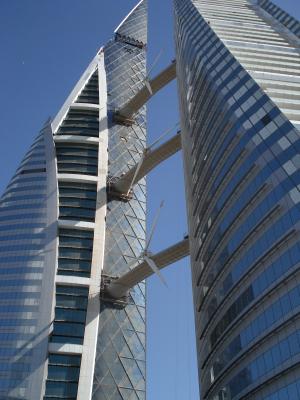 Just a few hundred miles away from the towering Burj Khalifa stands the slightly less imposing 50-story Bahrain World Trade Center in the center of Manama. In this structure, wind is not just treated as an obstacle to be overcome, but as a source of energy to be harnessed. It’s the first skyscraper to integrate large wind turbines into its design. Three 225-kilowatt, 95-foot diameter wind turbines hang from separate walkways connecting the identical, sail-shaped towers. Together, these turbines supply about 15 percent of the towers’ electricity, the equivalent, designers say, of the energy needed to power over 300 homes. The unique shape of the buildings directs wind gusts towards the turbines, increasing wind speeds and creating an artificial wind tunnel between the two towers.