Featured Article:Invasion of the Invaded: NAFTA and the Rise of Illegal Immigration
By
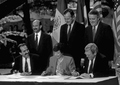
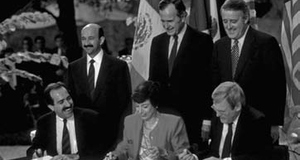
2009, Vol. 1 No. 10 | pg. 1/1 On January 1, 1994, the day the North American Free Trade Agreement, the great neoliberal experiment that tested the economic waters of the post-cold war world went into effect, the southern Mexican state of Chiapas was under siege. They came from everywhere and nowhere, wearing ski masks and red, yellow and black bandanas (the colors of the campesinos, or subsistence farmers) and they took the world by surprise. They moved quickly, taking control of six towns, including the traditional capital of Chiapas, San Cristobal de las Casas, using their rag tag array of weapons, an AK-47 there, an old shotgun here, plenty of machetes worn from years of cutting whatever plant life was in the way of the campesinos and their livelihood. Now that same urge to destroy obstacles between the family and his livelihood was turned toward the very government that they lived under. There are women and children among them. They have no military dress, but the clothes they work and sweat in. They called themselves the “Ejército Zapatista de Liberación Nacional” (EZLN). Translated into English, they were the Zapatista Army of National Liberation. The world quickly knew them as the Zapatista’s, a name they took after the Mexican Revolution’s famed freedom fighter, Emiliano Zapata. As they marched through the streets they chanted “NAFTA is death!”1 By the time the government declared a cease fire on January 12, one hundred and forty five people had been killed as the Mexican Army clashed with insurgents.2 Why the revolt? Why did the Zapatista’s declare NAFTA, the controversial and widely publicized free trade agreement between Canada, Mexico and the U.S, a death sentence? The night the Zapatistas took San Cristobal, they burned the financial records and land titles.3 The next morning they read their declaration of war from the balcony of the Palacio Municipal, declaring “Ya Basta!” (“enough is enough!). “We are a product of 500 years of struggle,” they declared. “[…] We have been denied the most elemental preparation so they can use us as cannon fodder and pillage the wealth of our country […] Nor are we able to freely and democratically elect our political representatives, nor is there independence from foreigners, nor is there peace or justice for ourselves or our children. But today we say ENOUGH IS ENOUGH.”4 They didn’t talk about proletariats or the evils of capitalism. They put their rebellion squarely within context Mexican political system, citing Article 39 of the Mexican constitution, which states that “the people have, at all times, the inalienable right to alter or modify their form of government.” Calling the Presidency of Carlos Salinas “illegitimate” and called on Mexicans to “restore legitamcy and the stability of the nation by overthrowing the dictator.”Chiapas had been one of the poorest parts of Mexico for years. Inhabited by a mostly indigenous population, the region had also been flooded by refugees fleeing the civil war in nearby Guatemala in the 1980’s. The population grew in the years leading up to the uprising by six percent, while the land continued to be practically useless for farming.5 Yet, the population preserved, in spite of a huge slump in coffee prices and other free market adjustments that made life harder.6 The EZLN formed in 1983, but it was NAFTA that drove the group public, it was NAFTA that forced the local campesinos to decide between armed insurrection and quiet death. Specifically, it was the Salinas administration’s cancellation of Article 27 of the constitution, which protected communal land holdings from sale or privatization. Article 27 was considered the centerpiece of Zapata’s 1910-1919 revolution. Now it was considered just another barrier to foreign investment.7 As Andrew Kopkind points out, the campesinos, already struggling to survive, could not compete with high-tech government subsidized corn from “Bob Dole’s Kansas or Tom Harkin’s Iowa.”8 So instead they declared war on the undemocratic one-party government that had remained in power for over seventy years, and had negotiated and implemented NAFTA. This dissatisfaction with NAFTA did not only manifest itself in the ski-masked rebels in Chiapas. Although the benefits of NAFTA can be shown, as will be done later in this paper, both economically and politically (the reign of the PRI, the one party system that ruled Mexico, ended in 2000 with the election of opposition candidate Vicente Fox to the presidency) the poorest of the poor saw few gains. While a minority took arms, others fled to America, taking advantage of the new open borders that NAFTA produced. The effects of NAFTA on Mexican and US relations are vast and complex, even now, twelve years after the agreement was implemented, no consensus has been reached on whether NAFTA has improved the lives of the citizens of the U.S. and Mexico. But NAFTA has had an effect on Mexican immigration to the U.S. While illegal migration from Mexico has been matter of much public debate starting in the early to mid-eighties (which was legislated first in the 1986 Immigration and Reform and Control Act) it was in the post NAFTA years that immigration exploded. The 2000 census showed that the U.S. had the largest population of non-native born residents in its history (a figure not that shocking given that the whole population is also the highest in the nation’s history). More startling, and more indicative of NAFTA’s influence, was the fact that the 2000 census now counted 31.3 million foreign born people living in the U.S.—compared to only 11.3 million in 1990 (a fifty-seven percent increase). Mexicans were the nationality represented most among that immigrant pool. In 1970, there were 800,000 native Mexicans living within the U.S. In 2000, there were 10 million. That same year 2000 census also found that the Hispanics were now the nation’s largest racial minority.9 While NAFTA might not have been the reason for this in immigration, it is part of a longer process of economic liberalization that encouraged Mexican workers to move to the U.S. and made it financially advantageous for U.S. companies to hire immigrant workers. In many ways NAFTA is the final step in the opening of the Mexican economy to U.S. companies that started when the neoliberal economic policies of U.S. President Ronald Reagan were used to confront the Mexican debt crisis of the early 1980’s. In 1976 geologists found oil reserves in southern Mexico and the Bay of Campeche. The result was an economic boom that resulted in one million new jobs and an eight percent growth rate in the economy between 1978 and 1981. As Mexico became the world’s fourth largest oil producer, foreign investment flooded into the Mexican economy, increasing 500 percent between 1978 and 1980.10 Unfortunately, with such massive foreign investment also came massive foreign debt. President Lopez Portillo presided over the entirety of the economic boom (1976-1982) and was criticized by many for his reckless spending and development projects, which required huge amounts of foreign loans all based on the strength of oil prices. By 1982 Mexico’s foreign debt had tripled since the oil discovery, reaching $87 billion.11 Oil prices declined sharply in 1981, and as a result “commercial banks turned their backs on Mexico.”12 Mexican government officials had predicted oil profits would generate $20 billion in 1982, when the real number turned out to be $15 billion Mexican officials were forced to announce in August of 1982 that the Mexican treasury was suspending its foreign debt payments as it had run out of foreign exchange reserves.13 The Reagan administration, fearful of the consequences of the third largest debtor country in the world no longer able to pay its debts, decided to construct a bailout package organized under the leadership of Treasury Department and Federal Reserve Board Chairman Paul Volker.14 Out of the $2 billion loan that the U.S. treasury granted Mexico, $1 billion was lent against future oil purchases, and U.S. negotiators also succeeded in setting the price of Mexican oil five dollars a barrel below market prices.15 While $9.85 billion was loaned to Mexico from international banking organizations and private banks, the U.S. loan had an implicit interest rate of thirty-eight percent.16 The deal, although saving the Mexican economy, was a victory for the U.S. in securing cheaper oil and actually increasing the amount of debt it could collect on. With the inauguration of economically disciplined President de la Madrid at the end of 1982, the U.S. now had an opportunity to use its collector status to open the closed Mexican economy to U.S. interests. As it became clear that one bailout was not going to save the Mexican economy, the U.S. government and the International Monetary Fund (IMF) continued to support the De La Madrid government on the condition that he embark on an economic recovery program based on a liberalization of the economy.17 Beginning with the Baker Plan (1986) and continuing with the Brady Plan (1990), the U.S. sought to open the previously closed and state structured Mexican economy. The De La Madrid administration followed the U.S. lead in supporting free trade, and implemented many liberal policies, including adopting a more realistic exchange policy, abolishing price controls, selling and closing many state owned enterprises, eliminated quantitative restrictions on imports in favor of a tariff based system, reducing tariffs, and scheduling the phasing out of most remaining non-tariff import barriers.18 In 1986 Mexico joined the General Agreement on Tariffs and Trade (GATT) which was another major step toward free trade. While De La Madrid was receptive to liberal and free trade economic policies advocated by the U.S. treasury and IMF, these policies did not always work in real terms. Jorge Dominguez and Rafael Fernandez de Castro note the costs of the economic restructuring: “the social impact of the austerity was draconian; during President de la Madrid’s term, real wages fell 41.5 percent.”19 De la Madrid’s term lasted from 1982 until 1988, when he was replaced by Carlos Salinas, the former’s Budget Minister and fellow free-trade reformer, in a controversial election that many believed to be rigged, since Salinas, the ruling PRI party’s candidate, won only after a computer crash that delayed vote counting for weeks. Salinas’ ascension to the Presidency corresponded with George Bush’s inauguration to the north. As the Cold War was suddenly and rapidly ending as a result of the break up of the USSR, President Bush pursued to construct what he called a “new world order” based on free trade and democracy. Jacqueline Mazza writes that when the two newly elected Presidents met in Washington in October of 1989, “it was reported that President Salinas had largely dismissed the idea of a free trade agreement with the United States, saying the unevenness of the two economies made the idea unrealistic.”20 In February, Salinas returned to sign a debt reduction deal based in the Brady Plan which actually reduced Mexico’s $48 billion dollar debt instead of just rolling it over and lowered debt payments in real terms. After a high profile tour through Europe to promote investment failed, Salinas realized he best way to attract foreign capital was to show potential investors that economic policies would continue to be geared toward opening markets and gaining permanent access to the U.S. market. Knowing the only way to gain that kind of investor confidence was through a permanent agreement with the U.S., Salinas met with President Bush on June 10, 1990 and proposed that the two governments begin talks to create a free trade area. Ambassador John Negroponte stated that “Salinas concluded he needed something dramatic. He wanted something to consolidate domestic economic reforms.”21 Another factor for Salinas’s change of heart is the cycle of economic downturn that has occurred at the end of every Mexican presidential term since the Peso was devalued at the end of the Echeverria administration in 1976. Not only that, but Mexico’s pro-democracy forces, no longer easily labeled and discredited as communists, were becoming louder then ever. Looking ahead to 1994, and himself having won by the Presidency by the slightest margin in the PRI’s seventy year history in an election that drew international criticism for its not so subtle subversion of the democratic process, Salinas may have seen the need to do something “big” to secure foreign investment and keep the economy afloat to guarantee victory for his handpicked successor in the next election to keep the PRI dynasty in power. Salinas’s personal ambition may have been a factor as well: it was widely reported that Salinas wanted to use his new reputation as an economic reformer to become the head of the new World Trade Organization22. Either way, Salinas had, in the words of Jorge Castaneda, “bet the store on NAFTA.” It was the keystone of [the Salinas] administration, the achievement or failure that would determine the fate of his government, and his own. If approved on time by the U.S. Congress, it would allow the Mexican economy to grow again, in time for the 1994 Presidential elections, which then the PRI could win cleanly; if rejected on Capitol Hill, disaster would follow: capital flight, a devaluation of the currency, disenchantment with the free-market reforms, possible institutional breakdown.23 Although Congress granted Bush fast track negotiating authority (allowing Bush to bring the final NAFTA agreement to the Congress for a simple “yes” or “no” vote) by a vote of 231 to 192 in the house and 59 to 36 in the Senate, the debate over NAFTA heated on many fronts. Mexico’s democratic institutions or lack thereof, was an area of much debate. “We are for the first time being asked to consider a free-trade agreement with a country that is not free,” declared fast-track opponent Sen. Moynihan (D-NY).24 The 1991 Mexican mid-term elections offered a test of Mexican democracy, and the widespread fraud in two of the governor’s elections drew criticism from many U.S. media outlets, which watched Mexico with greater interest due to the NAFTA debate. Salinas, operating in damage control mode for the benefit of NAFTA, forced the resignation of the PRI governor’s elect, but replaced one with another PRI member and the other with a member of the opposition PAN party, but not the one who had lost25 (Vicente Fox, who would end the PRI’s nearly century long control of the Presidency in 2000). As would be expected with any trade agreement as large in scope and influence as NAFTA, many different interests had stakes in how the agreement was made and implemented. A major source of pressure on the NAFTA negotiations came from traditional pillars of the left: labor and environmental groups. These two groups made up the base of the Democratic Party that saw its candidate elected president in 1992. With the election of Bill Clinton, who declared his support of NAFTA contingent on environmental and labor safeguards during his campaign, these issues came to the forefront of the NAFTA debate. President Clinton followed up on his campaign promise by implementing of the North American Agreements on Environmental and Labor Negotiation (NAALC and NAAEC). However, many commentators have noted that these agreements have very little potential for enforcement. Jorge Dominguez and Rafael Fernandez de Castro observe that “the agreements have some ‘teeth’ but not very sharp or effective ones.” “There are provisions to impose trade penalties for consistent violations of each of the three nations’ own standards. But the procedures for imposing penalties are so long and cumbersome that it is almost impossible to impose sanctions under either agreement.”26 John Cavanagh and Sarah Anderson agree: “The agency set up under the NAFTA labor side agreement has proved incapable of holding governments or corporations accountable for workers rights violations,” they write. “More than 20 complaints have been filed regarding alleged violations in all three NAFTA countries, but in not a single case has the process yielded more than a bit of public exposure to the problem.”27 Immigration, specifically Mexican immigration, which had been a major policy issue starting with the debate over the IRCA in 1986 was a matter that came to the forefront of the NAFTA debate. All three Presidents, Salinas, Bush and Clinton, pronounced that the passage of NAFTA would increase investment in Mexico, thereby revitalizing the economy and creating more jobs, giving Mexican’s less motivation to migrate to the U.S. During the NAFTA debate, Salinas argued that to not pass NAFTA after so much debate would “bring about an economic collapse in Mexico, which would unleash a wave of undocumented immigration to the north.”28 The Washington Post sums up the sales pitch the U.S. political elite made in regards to NAFTA’s effect on immigration: “NAFTA was supposed to be more than a trade deal. One of the big selling points before it was approved -- emphasized in a White House launch featuring then-President Bill Clinton and three of his predecessors, Republicans George H.W. Bush and Gerald Ford and Democrat Jimmy Carter -- was that the pact could stem illegal immigration. Mexican President Carlos Salinas de Gortari made the same pitch.29 While reducing Mexican immigration into the U.S. might have been part of the case made for NAFTA, the treaty itself did not address the issue. Except for a small provision allowing for movement of corporate executives and certain professionals, the agreement did not touch the subject of large-scale migration of labor.30 Immigration, both administrations seemed to be suggesting, would simply take care of itself when Mexico began to prosper. Not everyone, however, thought this: there were plenty of experts who differed greatly from the politicians in their view of NAFTA’s effect on immigration. “Most immigration scholars in both countries expect NAFTA and the economic policies it will encourage in Mexico to stimulate migratory flows in the short run,” Castaneda wrote in 1995. “Displaced peasants and laid-off employees [will] take advantage of large wage differentials and head north.”31 The faith in the free market to cure all ills that Bush, Clinton, and Salinas embraced was and is typical of the then new “Washington Consensus.” Championed by Ronald Reagan and British Prime Minister Margaret Thatcher, as well as Economists like Nobel Prize Winner Milton Friedman, neo-liberal economic policies (a belief in free-trade, deregulation and privatization) had taken hold at the end of the cold war, and the old Keynesian economic models had been all but abandoned in Washington, hence the “consensus.” Stephen Morris and John Passe-Smith put forth five key components of this new economic vision in regards to Mexico, which include maintaining cheap labor to attract foreign investment, creating new financial opportunities for global capital, reorienting the state away from social needs toward protection of private property, opening peripheral economies to U.S. products and accepting a rise in social inequity, at least in the “short term.”32 This belief in the power of free markets does, however, have a dangerous habit of becoming an ideological faith in the hands of overzealous leaders. NAFTA was implemented with a little too much blind trust in the equalizing effect of free markets, and as the above priorities demonstrate, perhaps a little indifference toward the plight of the lower socio-economic classes. As a result certain safeguards necessary to ensure a smooth transition to an interconnected economy were ignored, as the 1995 Peso Crisis demonstrated (more on that later). NAFTA was unique, and in many ways a new experiment in economic integration, because it brought together a major economic power and a developing economy, as well as Canada’s midsized, but developed, economy.33 It also, unlike the European Union (the only comparable economic integration scheme up until that point), rejected the notion of any kind of executive branch, and intentionally stayed away from any institution building. Thus, NAFTA’s organizations remain “skeletal” when compared to the EU’s.34 As a result, NAFTA “either ignores […] problems or leaves them to the market” Castaneda writes. “The trade pact presupposes the amount of money needed to bring together economies and societies […] is not overwhelming and that market forces alone will provide it.”35 It is not as if decisions to leave many of the details of the agreement to the free market was a deliberate act of malfeasance. This kind of free trade area had never been tried before, and as such it was very much an experimental process testing the possibilities of the free market approach. NAFTA was passed by Congress in November of 1993 and implemented on January 1, 1994. PRI candidate Ernesto Zedillo won the 1994 Mexican presidential elections in August, and according toe Jacqueline Mazza, begged Salinas to devalue the peso before the former took office. Salinas refused and Zedillo was forced to deal with the overvalued peso at the beginning of his term. In early 1995, just three weeks after the new administration had taken office; Zedillo announced that devaluation of the peso by fifteen percent. Within a few weeks the peso fell to fifty percent of its worth before devaluation, and a financial crisis was born.36 Foreign investment, so dearly needed and finely obtained through NAFTA, dried up. The Clinton Administration, having risked far too much politically to let NAFTA fail so early, organized a multilateral package of nearly $50 billion in aid, including $20 billion from the U.S. government in late January. Overall, the Mexican GDP declined by six percent in 1995 as crime rose. The economy did eventually stabilize, thanks to gains in U.S.-bound exports. In 1996 the Mexican GDP grew by 5.5 percent; in 1997 it grew by seven percent, the largest growth in nearly twenty years.37 The Mexican economy has grown substantially under NAFTA, especially when measured by foreign direct investment (FDI). In the eight years before NAFTA was implemented, the average annual FDI in Mexico was $3.47 billion. From 1994 to 2002, the average FDI topped $13 billion annually.38 Mexican exports have tripled since 1994, from $52 billion to $161 billion, and Mexico now has the world’s ninth largest economy (it was the fifteenth largest in 1991).39 There is no doubt that NAFTA has helped the Mexican economy grow. So why then has migration from Mexico to the U.S. continued to grow during the same period? As was mentioned earlier, Presidents Salinas, Bush and Clinton all championed NAFTA’s potential in stemming the flow of immigrants north. Not only has immigration not been slowed, it has increased under NAFTA. NAFTA has opened the border for capital and commerce. Naturally, when a border is opened for these reasons, other “undesirable” elements of economic integration cross the border as well, namely illegal drugs and illegal aliens. Tony Payan notes that under NAFTA, “truck traffic on the border has increased exponentially. Five to six million trucks cross the border in a given year.”40 While the flow of shipping might be more fluid and less restricted, creating opportunities for smuggling, this alone can not account for a rise in immigration since a variety of border security plans and initiatives have been tested since NAFTA, and none have been very successful. On duty border patrol agents increased from 3965 in 1993 to 9212 in 2000, yet immigration continued to rise.41 Yet, border crossing continued, even to the point where in 2005 the “Minutemen” of Arizona, a civilian organization, grabbed headlines when they announced their intention to use militias to patrol the border. Operation Hold the Line, launched by the Clinton Administration in 1994 under head of the Border Patrol Silvestre Reyes was an increase in military and police forces on the border around El Paso, Texas. Operation Hold the Line was soon duplicated in the form of Operation Gatekeeper in San Diego and Operation Safeguard in Arizona. It was seen by many as an attempt to mitigate the new openness of the border for illegals, and perhaps more central to the plan, to give the Democrats the edge on the growing immigration issue heading into the mid-term elections.42 In his book on Operation Gatekeeper, Joseph Nevins observes that the program “has had a significant impact in limiting unauthorized crossings of the boundary in the most urbanized seciotns of the San Diego sector. But overall, it has merely pushed the great bulk of extralegal crossers to more rural areas along the U.S.-Mexico boundary.” Nevins argues that more rural crossings succeed politically in making in rendering “the ‘illegal’ less visible.”43 He also quotes scholar Michael Huspek in noting that pushing illegal crossing into more rural areas, and often much more dangerous areas in the deserts of the Southwest helps to create “the perfect workers.” “It is young, fit males who are most apt to make a successful entry…This shift in the type of worker gaining entry into the U.S. amounts to a strengthening of the labor pool available to U.S. employers while at the same time restricting access to those who in the past have been the likeliest to draw upon the states social relief programs.”44 The effect of limiting the access to those who are more likely to draw upon social services (the young, elderly and pregnant), whether intentional or not, is particularly interesting considering that in 1994 (when Gatekeeper was implemented) the issue of social spending on undocumented immigrants was at the forefront of the immigration debate, as can be seen by the widespread controversy over California’s proposition 187, which denied social services to those “illegals.” Still, analyzing border security and its strengths and weaknesses is not the same as analyzing immigration. To ask how undocumented workers get into the country is not the same as asking why they want to get into the country. Crossing the border, especially in rural areas, is oftentimes a dangerous endeavor. In 2004 the Border Patrol reported that 464 undocumented workers died in the harsh deserts of southern Arizona and New Mexico.45 So why do so many undocumented workers attempt to enter the U.S.? It’s a simple matter of economics: Mexican workers need jobs, U.S. businesses need cheap labor. NAFTA, and the neo-liberal economic policies it represents, has only increased the motivation for Mexican workers to move north by making life harder for the most impoverished Mexicans. Mexican immigration to the U.S. exploded in the mid-eighties, well before NAFTA. “Between 1965 and 1985, the pace of Mexican undocumented migration on the U.S.-Mexico border grew steadily albeit slowly,” writes Tony Payan, who goes onto declare 1986 “the breaking point.”46 The mid-eighties, when immigration patterns broke the steady rise model from the 1960’s and 70’s was also the time when income disparities in Mexico grew. Carbacho and Schwartz observed “following several decades in which [Mexico] moved toward a more even distribution of income, Mexico’s income disparities have generally widened since the 1980’s.”47 The 1980’s was the time of Mexico’s economic liberalization, and as was noted earlier, during the De la Madrid Presidency (1982-88) real wages fell 41.5 percent. The relationship between the economic liberalization of Mexico, the fall in wages, and the rise in immigration is, I believe, a causal one. NAFTA represents the final step the economic liberalization of Mexico, and it is during the NAFTA years that immigration has risen the sharpest. “One report noted that detentions of illegals were up 26 percent in the first quarter of 1995 compared with the same time during the previous year,” Morris and Passe-Smith declare. “In 1996 1.6 million Mexicans were deported, the largest number in seven years.”48 A review of the economic data during the NAFTA years will illustrate this point further. Although NAFTA did grow the economy in absolute terms, as was discussed earlier, the growth did not, “trickle down” (a favorite phrase of Reagan economists) to the lower classes. Agriculture was hit hardest. In addition to the end of communal land holdings that the Zapatistas claimed was a death sentence for the campesinos of Chiapas, cheap American subsidized corn flooded Mexico under NAFTA, making it harder for rural farmers to sell their staple crop. Between 1993 and 2000 the amount of corn imported to Mexico rose eighteen fold, and rural poverty rose from 79 percent in 1993 to 82 percent in 1998.49 Even more disheartening is the fact that tariffs still exist on corn imported from the U.S. to Mexico, but will be phased out by 2008, making the situation even worse. The Salinas administration promised to launch government programs to help Mexico’s 20 million campesinos to transition from growing corn to export crops. These programs never materialized, and a Washington think tank has estimated that 1.3 million farm jobs have disappeared since 1993.50 These losses in the agriculture sector, as disheartening as they are, might be considered a cost of adjustment to a modern economy if manufacturing jobs were created as farming jobs were lost. Unfortunately, this is not the case. Employment is down more than twenty percent from its post-NAFTA peak of 1.3 million workers.51 Real wages for manufacturing jobs remain lower now then when NAFTA was implemented.52 The industry that showed major growth in terms of job creation under NAFTA was the maquiladora export industry, which assembles American export products at the border. The maquiladora industry cushioned the impact of the economic depression of the 1980’s, and under NAFTA the number of maquiladora jobs nearly doubled between 1993 and 1998, to over one million employed.53 And while maquiladora wages fell 0.7 percent from 1993 to 1998, wages in Mexico as a whole fell 1.4 percent. However, maquiladora wages still remained lower on average then Mexican manufacturing wages as a whole.54 The creation of jobs in the maquiladora industry has pulled more Mexican seeking employment closer to the border, which helps explain the increase of the border population in recent years. Although, even moving to the border, jobs are hard to find. “Mexico creates over a half a million jobs a year,” Tony Payan notes. “But over 1 million of its young people enter the job market every year.”55 With such a job shortage, it is no surprise that many Mexican migrate north in search of work. However, even though the border region is growing faster then the rest of Mexico, it is not growing fast enough to employ all those seeking work. If one can not find work after moving north, then the next logical step is to move just a little further north and try and hop the border to the U.S. In the U.S. there is sure to be work, and as much as politicians and anti-immigrant groups like to decry the loss of jobs to undocumented workers, the statistics show that the U.S. economy is able to absorb somewhere between 300,000 and 400,000 undocumented workers every year. A study in The Economist showed that even with the influx of undocumented workers, the U.S. market continues to have a shortage of labor, with 161 million employments in the U.S. and 156 million workers.56 A better argument against undocumented workers might not be that they are taking jobs away from American workers, but sending their dollars away from American businesses: it is currently estimated that $14 billion is sent from workers in the U.S. to their families in Mexico, compared to $2.4 billion in 1993.57 NAFTA has only served to exacerbate the conditions that push Mexican workers away from the Mexico and toward the U.S. The poor have not been helped by NAFTA, on the contrary, their plight has become worse. They have no other choice but to move north in search of economic opportunities that will allow them to feed their families. But in terms of measures like gross domestic product (GDP) and FDI NAFTA is a success for the Mexican economy. These measurements, which neo-liberal economists obsessively point at for proof of their wisdom, fail to address the biggest problem facing globalization: the widening gap between the rich and poor. While Mexico’s rich are rich than ever, the poor are slipping even further into poverty, a fact that is not reflected in overarching economic statistics. Mexico is now the world’s number one exporter of people. The U.S. remains the world’s number one importer. As economic and military hegemony allows the U.S. to influence and dictate economic policy for its own gain it is no surprise that the people affected by these policies want to become part of the U.S. Eduardo Galeano calls this “the invasion of the invaded.” “They come from lands where conquering colonial troops and punishing military expeditions have disembarked 1,001 times. Now this voyage in reverse isn’t made by soldiers obligated to sell themselves in Europe or North America at whatever price they get. They come from Africa, Asia and Latin America, and, since the burial of bureaucratic power from Eastern Europe as well. “In the years of the great European and North American economic expansion, growing prosperity required more and more labor, and it didn’t matter that those hands were foreign, as long as they worked hard and charged little. In years of stagnation and or weak growth they became undesirable interlopers: they smell bad, they make a lot of noise, they take away jobs. Scapegoats of unemployment and every other misfortune, they are condemned to live with several swords hanging over their heads: the always imminent threat of deportation back to the grueling life they’ve fled and the always possible explosion of racism with its bloody warnings, its punishments: Turks set on fire, Arabs stabbed, Africans shot, Mexicans beaten. Poor immigrants do the hardest, poorest-paid work in the fields and on the streets. After work comes the danger.”58 1 Hayden, Tom. “Introduction.” The Zapatista Reader. Ed. Tom Hayden. New York: Nation Books, 2002. p. vi. 
From the Inquiries Journal Blog   Monthly Newsletter SignupThe newsletter highlights recent selections from the journal and useful tips from our blog. Suggested Reading from Inquiries Journal
Inquiries Journal provides undergraduate and graduate students around the world a platform for the wide dissemination of academic work over a range of core disciplines. Representing the work of students from hundreds of institutions around the globe, Inquiries Journal's large database of academic articles is completely free. Learn more | Blog | Submit Follow IJ


Latest in Political Science |