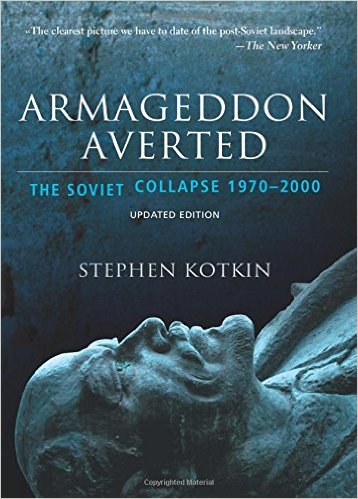
Book Review: Stephen Kotkin's Armageddon Averted
By
2010, Vol. 2 No. 01 | pg. 1/1
KEYWORDS:
As the world's first real Marxist experiment, the Soviet Union, by virtue of lasting seventy odd years, proved Western intelligentsia wrong. The latter had long thought it was doomed to fail. When the Berlin Wall fell in 1989 and the Soviet Union disintegrated two years later, Western conservatives and liberals alike felt vindicated. United States conservatives would point to Reagan's military arms buildup which the Soviet Union could not keep pace with, while liberal capitalists believed in the inherent unfeasibility of a nonmarket system. Contrary to these suppositions, Stephen Kotkin's Armageddon Averted: The Soviet Collape 1970-2000, paints a picture of a behemoth, bureaucratic state resting atop a superannuated industrial infrastructure. Yet he maintains that if the Soviet elite had so chosen, they could have sustained it decades longer.
Kotkin offers a refreshing view of pre-Soviet collapse and post-Soviet Russia that is not seen through an obvious American lens. Generally, Americans like to see themselves as the world hegemon and thus all significant world events must be the consequence of American action or inaction. This inevitably clutters the typical view of Soviet collapse. Kotkin hardly subscribes to this view. Nevertheless, he asserts infectious Western consumer culture did affect Soviet Union in the late 1960's. During the Brezhnev era, the people employed in the black market economy were an estimated 20 million people, while the official labor force throughout the 1970's was calculated at 17.8 million (Freeze, 375, 376). As the government ownership of the economy could not provide goods that were necessary and desired, people purchased products through a shadow economy. Consequently, rock n' roll records, washing machines, typewriters, refrigerators and other goods became part of Soviet life. Kotkin writes that during the Brezhnev era, “Soviet public spaces were decorated not just with official slogans but also with graffiti about sports teams, rock music, sex, and the merits of punk music versus heavy metal. Schoolchildren „ranked' each other by their jeans, with Western brands being the highest (43).” The Western world had set an example painting a picture of ready access to consumer goods; this was the Soviet people's first glimpse into an alternate life in the West. The Soviet Union had the Arab-Israeli War of 1973 to thank for continuing the status quo and not dabbling into much needed Khrushchev-style reforms. With the Soviet Union being a major oil exporter, skyrocketing oil prices put money in the pockets of elites, helping bankroll the war in Afghanistan at the end of the decade and a massive military buildup that put the Soviets on the same level with the United States. This gargantuan oil revenue helped the Soviet Union to perpetuate without much change in the years preceding the rise of Gorbachov to General Secretary in 1985. Yet underneath the oil money; military might; and planned economy, consumerism had infected the Soviet people – a kind of satori, or awakening, one has when introduced to a new material good that solves the problem of menial work (like a washing machine); a realization that most people in other Western countries had these helpful products made one grow a bit dubious of one's own system. Later, when Gorbachov opened the Russian people to other potential political systems during perestroika, the people would often correlate wealth and higher standards of living with Western countries and to his dismay, would chose a democratic system over communism. In the early 1980's, General Secretary Leonid Brezhnev had turned into a walking corpse and all his potential successors were hardly in better conditions. “The average age of Politburo members rose from 55 to 68 between 1966 and 1981” (Freeze, 373). The Soviet elite was decaying and needed new blood. After brief reigns of Yuri Andropov and Konstantin Chernenko, both whom died of natural causes associated with old age within a few years, Gorbachov became General Secretary of the Soviet Union. His leadership, Kotkin argues, was indispensable to a change that was one of the most profound yet at the same time almost entirely peaceful, as the top elite of an empire decapitated itself. Instead of taking the world down with it by giving destructive orders to the largest military in the world and unleashing their enormous nuclear arsenal, the Soviet Union succumbed to its own death rattles with little more than a mild cough. Gorbachov entered the office of General Secretary of the Soviet Union with the belief that change was needed. Oil revenues dropping, an obsolete industrial infrastructure, and an inflated state bureaucracy were just some of the problems he faced. The latter problem manifested itself in such a way that the organs of state – the party - were redundant to every managerial position, thus greatly inhibiting efficiency. At 47 upon entering office, Gorbachov began reforms that brought unintended consequences; consequences that would spiral out of control and eventually lead to the dismantling of the Soviet Union. Gorbachov's reforms were as wide-ranging as: economically painful legislation that aimed at reducing alcoholism, cutting back on military spending and rivalry with the United States, reducing censorship, and allowing organizations to burgeon outside of the official party. In the economic sphere there was a shift towards more competitive practices such as “joint ventures” and a greater autonomy for industry. Gorbachov's belief in Communist ideals had led him to venture beyond Khrushchev's reforms and he had the cunning to not get ousted in the process; all the while believing that the Soviet people would opt for a “humane socialism” over a democratic capitalist model. Kotkin's concise analysis (66) of the situation in which a system is suddenly opened to the world is telling: “Prior to 1985, the planned economy – greased with extensive black marketeering, choked by phenomenal waste, and increasingly dependent on key foreign imports – had stagnated, but it had functioned. Compared with their parents and grandparents, the Soviet population was better fed, better clothed, and better educated. Comparisons, however, were made not with the Soviet past, or developing countries, but with the richest nations of the world, and both the leadership and population expressed increasing impatience. To compete withadvanced capitalism the only recourse seemed to be going beyond partial reforms and introducing the very mechanism, private property and the market, whose suppression constituted the essence of socialism – in short, undoing the revolution and the regime's identity.” What Kotkin is essentially saying is within an insulated system all one can compare to is one's immediate neighbor and one's own past. But, with the risk of using an over-the-top analogy, when a prison is opened after seventy years and prisoners are allowed to comment on the prison system, criticize it and eventually elect their own wardon, the prison collapses. When the most visible aspect of Soviet power and the entire system was taken down in November 1989, the fall of the Berlin Wall, Gorbachov did nothing to stop it; this set a peaceful precedent to civil disobedience that would, at its core, tatter the Soviet Union. Throughout the late 1980's and in 1990 Gorbachov sometimes grew wary of some of the unintended effects that his earth shaking reforms were having. For instance, after urging satellite states to become more politically open, he tried to regain control of the Soviet republics that he had essentially federalized, giving them de facto autonomy. In 1990 he reneged on this reform somewhat and gave the republics limited control over their resources and made Russian be their official language. But when republics bristled he refused to clampdown as would have nearly any other Soviet ruler; instead, he shifted to the left only months later and in April 1991 opened direct negotiations with nine republics that were willing to have some relationship with Moscow (91-92). By the early 1990's Gorbachov had promised a market economy and in 1989 had already paved the way for competitive elections for a New Congress of People's Deputies. In May of 1990 Boris Yeltsin, a populist “crowd bather” was elected to the Supreme Soviet of the Congress. A year later, what had been the Soviet Union was on the very edge of a precipice with two presidents – one elected by parliament, Gorbachov, and one by the people, Yeltsin – and a Union Treaty whose “working text dropping the word „socialist'” (96) and made Union membership voluntary. This standing on the brink of collapse made conservatives bristle. In August 1991 hardliners trying to restore the Soviet Union declared martial law, invoked “emergency power” and confined Gorbachov to his dacha on the Crimean Sea. Intrepid Yeltsin ignored the KGB troops surrounding his dacha, drove to the Russian White House and stood on top of a hostile tank to address a crowd. Though hardliners trying to restore the Union had “the nuclear suitcase with the codes for launching the Soviet doomsday arsenal” (102), when faced with protest they simply called off the troops and the coup was over. Despite the overwhelming military force at its disposal, the Soviet Union's raison d'etat had lost all its potency. If George Orwell's “Animal Farm” was a satire for the period leading up to the Stalinist era in Soviet history then Golding's “Lord of the Flies” may be an accurate analogy to Russia in the 1990's. In Armageddon Averted, Kotkin argues that the devolution of the Soviet Union, or perhaps more precisely stated its complete and utter collapse, would be an arduous process that consumed over a decade and still had ramifications even in the Putin era at the beginning of the 21st century. Contrary to Western media reports that Russia was going through a gradual period of “liberalizing”, this period was an anarchic period of instability with corruption several times worst than during Soviet times. When privatization began the winners were largely the same winners under the Soviet system. The top political elites and industrial managers were the immediate beneficiaries of state owned companies being changed into private hands; because, essentially, they were the closest private and readily available hands to pilfer new ownership. Kotkin explains that though before Soviet collapse much of the elites and Communist upper class enjoyed “de facto ownership of state-owned property and mocked its slogans about the proletariat and social justice” (114-115), they still largely believed a Leninist system was for the good of the people. But after the system crumbled: “The KGB and the army began wheeling and dealing commodities, from arms to computers” and “the Central Committee, still railing against the market, also established private business. Individually, officials signed over to themselves deeds for state dachas, vehicles, anything under their watch, at bargain prices, if they paid at all (115).” Despite Yeltsin's heroic actions against disgruntled hardliners trying to salvage the Soviet Union from collapse in 1991, he proved to be a relatively weak leader. The Russia state had indeed become a democracy (though certainly not a liberal democracy) but lacked adherence to law. Yeltsin's reluctance and clear inability to reign in former organs of the Soviet state benefiting from privatization paved way for a Russia in the nineties that was economically bleeding to death. Nevertheless, despite the fact that full private ownership of land and the industrial sector had yet to go into full effect, the Soviet system was indeed dismantled. By 2000, Russia was one of a kind: it was “democratic but not liberal”, had a “boisterous parliament”, “a federation without federal buildings in its regions”, and a gargantuan KGB that far outweighed the size of its judicial system (165). But without its former ideology giving it a raison d'etre, the KGB had a dangerous penchant to sell information to the highest bidder. Still one must take heed of the fact that despite the 40,000 metric tons of chemical weapons, between 150 to 200 tons of enriched plutonium and 1,300 of enriched uranium, it appears – though perhaps in 2009 it may still be too early to say with categorical certainty – that Russian nuclear experts did not sell their material to the highest bidder. After Vladimir Putin entered office in 2000, he greatly halted the collapse of the Soviet system perpetuating throughout the 1990's by clamping down on corruption, reasserting Russian military power and influence under republics once in the Union, and consequently “re- establishing the sovereignty of Russia vis-à-vis international organizations” (195). Kotkin posits that Putin's leadership style resembled that of a tsar than a Soviet era general secretary. Because under his rule, Russia middle class expanded rapidly and a collapsing economy was abruptly halted and turned around – Russian stock value shifted from $60 billion in 1999 to $1.7 trillion in 2007 – Putin became a very popular figure in post-Soviet Russia. Kotkin offers the reader a perspective of the years of and preceding the collapse of the Soviet Union that they would not likely find in Western media sources and perhaps not even astute foreign policy journals. As someone who has read John Lewis Gaddis's The Cold War: A New History, the author of this paper has largely been flooded with accounts of the Soviet Union from either a Cold War perspective as in Gaddis' book or from an acutely Western vantage point in the media. Yet, the author has read much of Trotsky's The Revolution Betrayed and has gotten an idea of the problems during the early days of the Soviet state when collectivization had just been put into effect and an incipient bureaucracy that was burgeoning rapaciously. Again, Trotsky was a Marxist believer and a Stalinist Russia was not the Communist utopia he had envisioned; in short, he had an axe to grind. On the contrary, Stephen Kotkin's Armagedon Averted offers a concise yet in-depth look at the last twenty years of the Soviet polity and its subsequent collapse from a non ideological lens. He describes the problems that agglomerated throughout the late Soviet years: an elite that was the country's de facto upper class (in a supposed egalitarian society!), the obsolete nature of the country's industrial infrastructure, and attempts at reform resulting in sometimes ousting from power (as with Khrushchev and Interior Minster Beria) and counter-reform. Interestingly Kotkin writes of the influx of Western consumer goods and the Russian youth's fascination with Western culture – from blue jeans to rock n' roll. Kotkin lays such a firm foundation for Soviet collapse but he seemingly gives all the credit to one man: Mikhail Gorbachov and the Soviet elite who could not and then simply would not stop him. Kotkin describes him as a crafty Machiavellian politician who was too cunning a tactician to let Ligachev or any other anti- reformers high up in government take him down as had been done to Khrushchev. It was surely true as Kotkin posits that Gorbachov's reforms had the unintended consequences of ultimately bringing to the Soviet Union. Also, he cites how the lack of will power of those trying to save the Union when they briefly took over in a coup. Though Kotkin hints at the answer, as he describes the coup orchestrators with their access to the world's largest military and an enormous nuclear arsenal, he does not explicitly say why they did not order the troops to forcibly arrest Yelstin as he impudently gave a speech atop a hostile tank. The fall of the Soviet Union, which Kotkin accurately argues was collapsing throughout the 1990's, was something that was ready to occur. The de facto ownership of state property by Soviet elites, the people basically imprisoned in a poorly realized utopia, failure to compete with the West economically after World War II, an obsolete industrial sector, dated technology with a fraction of the computers Western countries had....all these factors added up. After Gorbachov set the polity's windows ajar and people stared out into the world, jaw hanging open, the Soviet structure was doomed. When Gorbachov allowed a choice and thought everyone would return to the belief in “humane socialism” out of their own volition, he poorly underestimated his people's desire for freedom, a higher standard of living and access to consumer goods. Kotkin is certainly correct in his assertion that the Soviet Union could have perpetuated for decades longer, using similar methods of KGB or military intimidation and additionally had a new drive towards industrialization so as not to completely fall behind the rest of the developed world with its superannuated machinery. Yet the Soviet military and the coup leaders didn't act more forcefully because Soviet communism had lost its reason to exist. Why save a corpse? At least have some decency and not create other corpses in the process! Ever since Western consumer goods and culture started pouring into the USSR en masse in the late sixties, the communist dream was shattered. The atheist, Marx, had wanted to create a Heaven on earth – not mere delusional opium to be smoked after an intolerable day working endless hours like a machine for a capitalist owner! Yet the consumer goods and culture that poured in, in contrast to the simple, difficult life most Soviet citizens led, surely made these same citizens wonder who was living closer to a Heaven on earth. Kotkin's Armagedeon Averted offers the reader an eye-opening experience unavailable in most other literature regarding the Soviet Union. Yet the author of this paper, while finding Kotkin’s thesis outwardly correct, finds Kotkin's implicit belief that “great men” create history flawed. The top tier of Soviet elites orchestrated the USSR collapse, yet Kotkin neglects to connect the orchestrators, Gorbachov and Yeltsin, to the vast members of the orchestra: the people and every aspect of stringent Soviet life that could barely function. Armagedeon Averted, while illuminating, relies heavily on this idea of “great men” creating history rather than the entirety of the orchestra creating the music. ReferencesFreeze, George L. “From Stalinism to Stagnation.” Russia: A History. Ed. George L. Freeze. 2nd Edition. New York, NY: Oxford University Press, 1997. 347-383. Kotkin, Stephen. Armageddon Averted: The Soviet Collapse 1970-2000. New York, NY: Oxford University Press, 2001. 
From the Inquiries Journal Blog   Related ReadingMonthly Newsletter SignupThe newsletter highlights recent selections from the journal and useful tips from our blog. Suggested Reading from Inquiries Journal
Inquiries Journal provides undergraduate and graduate students around the world a platform for the wide dissemination of academic work over a range of core disciplines. Representing the work of students from hundreds of institutions around the globe, Inquiries Journal's large database of academic articles is completely free. Learn more | Blog | Submit Follow IJ


Latest in Book Reviews |