Featured Article:The Hero We Create: 9/11 & The Reinvention of Batman
By
2009, Vol. 1 No. 12 | pg. 1/1
IN THIS ARTICLE
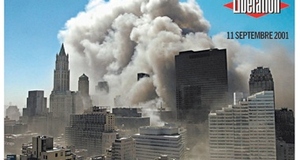
A giant hole is ripped in the side of a skyscraper. Smoke and flames pour out and debris tumbles into the street. Clouds of smoke billow upwards and burning embers rain down. Plumes of dust and smoke blot out the sun, darkening the city skyline. In the foreground, a figure stands defiantly, his confrontational gaze burning with dark intensity. This imagery is hauntingly familiar. The flaming wing-shaped hole in the side of the building, the smoke-darkened sky, and flaming debris all conjure up painful memories. “Welcome to a World Without Rules,” the caption reads dramatically. Yet this striking image does not come from any news report, documentary or amateur video clip. The disturbing scene captured in this picture exists only in the realm of imagination - on a promotional poster for the most recent Batman film, The Dark Knight (2008). The parallels between this poster and the events of 9/11 are so striking and visceral that they prompted the London Times to ask, “Has the new Batman plundered its plot from 9/11?” The Times, which calls Gotham City “New York’s alter ego,”1 draws abundant parallels between the film and the real world concerns of a post-9/11 American society:The imagery here is blatant: firefighters framed in tableau against the smouldering rubble of Downtown; politicians cashing in on the paranoia; bound hostages used to relay demands on television; the extraordinary rendition of a foreign suspect; a crusade against an “evildoer” that turns more personal vendetta than reasoned response.2 According to the Times, the film’s violent imagery, its tacit political commentary and even its characterization of Batman all evoke the traumas, struggles and moral quandaries central to 9/11 and the War on Terror. Likewise, the previous Batman film, Batman Begins (2005), displays an overt preoccupation with terrorism. From the use of fear as a weapon, to the plot to destroy Gotham’s most iconic skyscraper, the film allegorizes 9/11 in a way that is jarring in its bluntness. These films, both co-written and directed by Christopher Nolan, are not alone in their engagement with modern-day anxieties about terrorism. In the seven years following September 11th, 2001, numerous novels, films, poems, plays, paintings and photographs have engaged the events in an attempt to transmute emotional responses and historical fact into a cohesive narrative. Some, such as Oliver Stone’s World Trade Center, have celebrated heroes of the tragedy. Others, such as Don DeLillo’s Falling Man, have endeavored to extract cultural meaning from these traumatic events. While creative interpretations of September 11th have taken on numerous and varied forms, no genre deals more transparently and explicitly with the themes of 9/11 than the superhero narrative. For decades, figures such as Superman, Batman, and Spiderman have been fighting evil and criminality in fictional worlds that re-imagine American society and offer clear and unequivocal ideas of justice. The fantastical stories of these superheroes generate frameworks within which endlessly complex social issues can be disentangled to reveal pure and didactic cultural ideals, collapsing moral shades of gray into a black and white duality. The genre’s engagement with concepts of justice, evil and terror uniquely positions the superhero to comment on the events of 9/11. Superhero narratives allegorizing 9/11 possess the power to create analytical spaces in which reworked conceptions of terrorism, justice, and “good and evil” can be examined and tested. The superhero film genre has grown explosively in the post-9/11 world. According to the Internet Movie Database, there were 39 superhero films released during the entire 1990’s.3 In contrast, there have been 45 superhero films released in the last five years, and there are a staggering 42 films planned for the next three.4,5 Of the all-time top-grossing films in the US, eleven of the Top 100 are superhero movies released after 9/11.6 As Peter Coogan, author of Superhero: The Secret Origin of a Genre, puts it, we are truly in the midst of a “superhero renaissance.”7 Furthermore, it would appear that 9/11 has something to do with this revival. Through analysis of Christopher Nolan’s Batman Begins (2005) and The Dark Knight (2008), I intend to prove that this renaissance and the events of 9/11 are indeed related and that these films represent both a reassertion of and reflexive commentary on a cultural mythology that forms the foundation of the superhero genre and the American response to 9/11. Both Batman Begins and The Dark Knight, I argue, seek to explore and mitigate the trauma and anxiety associated with the terrorist attacks of September 11, 2001. The films work to establish the terrorist as the supreme form of evil, incorporating the events of 9/11 both thematically and allegorically to demonstrate the continued ascendance of Good over Evil. In the first film, Batman Begins, the worldview of the terrorist is explored through the character of Ra’s al Ghul, and a fantasy of conquering fear and preventing the attacks is enacted. In the second film, The Dark Knight, the terrorist is embodied by the Joker, who is dismissed as a nihilist and agent of chaos. Yet this film also explores the moral ambivalence about questionable tactics such as spying and torture that characterized the American reaction to 9/11. Batman Begins (2005) and The Dark Knight (2008) reveal a latent desire to prove the ascendency of the terrorist model only to subsequently defeat it, thus demonstrating the moral supremacy of American society. Yet these are also deeply self-conscious and reflexive works, critical of the American response to 9/11 and of the very process of cultural mythmaking itself. Despite the exploration and defeat of terrorism that occurs within these films, they reveal a deep-seated cultural anxiety about the nature of the American response and a fear that fighting terrorism necessitates a fundamental compromise of American ideals. Trauma & the SuperheroIn order to make sense of the current Great Superheroic Reawakening, the genre itself must first be deconstructed and rigorously defined. According to Peter Coogan, the superhero genre emerged in 1938 with the creation of Superman and has since been a stable if mutable aspect of American popular culture.8 Over the course of the 20th century, the superhero genre (in comic books, television and film) has experienced sporadic cycles of celebrity and disrepute. Batman himself has enjoyed periods of great success (as with the enduring popularity of the comic series), mixed reception (as with the campy 1960’s television show that was both popular and widely ridiculed), and outright failure (as with the generally reviled box-office flops Batman Forever and Batman & Robin of the 1990’s).9 Batman, like the superhero genre itself, has indeed led a varied existence and is now in the midst of an intense revitalization. Given the highly referential themes of the new Batman films and the genre’s current renaissance, it would be naïve to treat these works and the superhero genre in general as distinctly divorced from historical events. As Ann Keniston and Jeanne Follansbee Quinn argue in Literature After 9/11, much of post-9/11 literature insists… on the space between the real and imagined, between image and trope, and between the private realm of memory and the public realm of history. 9/11 literature impels us to see these spaces even as it forces them together; it consistently uses the literal to deconstruct the symbolic and the reverse. It thus offers a kind of partial, awkward bridge between life and language.”10 There thus exists, according to Quinn and Keniston, a profound and meaningful interplay between fact and interpretation, between the factual trauma of the attacks and the symbolic interpretations that have resulted. Instead of factual reality simply giving rise to creative interpretation, the factual reality of 9/11 and creative interpretations of 9/11 can be viewed as having a reciprocal relationship. Not only do historical events influence creative works but creative works also come to influence popular perception and interpretation of those same historical events. As Keniston and Quinn point out, literature (especially, but not uniquely, the literature of 9/11) serves both as a symbolic interpretation of events and a method of understanding the literal events themselves. Interpreting the attacks of September 11, 2001 in a literary context thus serves both a palliative and instructive function; fictional portrayals of the events possess the power to simultaneously explain 9/11 and redefine it. The notion that there exists a “space between the real and imagined,” an exchange between the literal and symbolic, is one that is not new in the post-9/11 world. Trauma theorists have argued that the echoes of traumatic events continue to give rise to what is thought of as “history” even after such events have occurred. In Unclaimed Experience, Cathy Caruth explores the complex way that history arises out of incidents of trauma: The recurring image of the accident… seems to be especially compelling… not only because it depicts what we can know about traumatizing events, but also… because it tells us of what it is, in traumatic events, that is not precisely grasped. The accident, that is… does not simply represent the violence of a collision but also conveys the impact of its very incomprehensibility. What returns to haunt the victim… is not only the reality of the violent event but also the reality of the way that its violence has not yet been fully known.11 Here Caruth argues that traumatic events echo across time because they are not “fully known,” not fully accessible to the individual (or collective) until later on in flashbacks and memories. History, Caruth contends, is as much a function of these traumatic echoes as are the real events. Efforts to interpret and understand a traumatic event become a permanent aspect of a cultural history that is not confined merely to factual occurrences. This elusive and complex relationship between real and imagined, between fact and interpretation, is also apparent in the fundamental nature of the superhero narrative. Superheroes occupy a uniquely composite narrative space that traverses this same boundary between reality and fiction. Despite the fantastical attributes of characters such as Superman, Batman and Spiderman, their cities are amalgamations of real-life modern metropolises, their motives a reflection of cultural ideals and their struggles a manifestation of contemporaneous anxieties. Superheroes thus occupy a distinct moral plane, and recognition of this complex status allows for an examination of how and why 9/11 and the superhero renaissance are linked. Why does society need superheroes and how is their image a reflection of collective fears, aspirations, or subconscious anxieties? Furthermore, how does the idealized but representative world of the superhero evolve in response to very real and traumatic historical events such as the attacks of September 11, 2001? The fictional character Batman is especially central to any discussion of superheroes in a post-9/11 world. The dramatic success of Batman Begins and The Dark Knight indicates that Batman (or a reinvented Batman) has special appeal within a post-9/11 society preoccupied with generating new definitions of terror, evil, and justice. The Dark Knight is the second-highest grossing film of all-time in the US and fourth in the world while Batman Begins, though notably lower on this list, is well within the Top 100.12 In addition, The Dark Knight has grossed just short of $1 billion worldwide and recently won two Oscar after being nominated for eight.1314 Though the current superhero renaissance and incredible success of these films are readily apparent, the reason for this success is not. It is my intention to demonstrate that these films have drawn strength and popularity specifically from their engagement with 9/11. If it is the case that Batman has emerged anew in the aftermath of September 11th, is the renewed success of the character connected to this historical trauma? Moreover, how and why might these seemingly disparate areas of culture be linked to one another? The Problem with “Authenticity”In order to analyze Batman in the context of 9/11, it is vitally important to first understand the diverse iterations of the character that have been produced over the years. Since his creation in 1939, Batman has been shown to possess a remarkable degree of mutability and, unlike many superheroes, has enjoyed iconic status throughout the comic’s existence. In addition to the original Batman and Detective Comics series, which have gone through 684 and 852 issues respectively, Batman has appeared in diverse array of major motion pictures, film serials, live-action television shows, cartoons, graphic novels, video games, and newspaper comics. Despite this diverse history, there is a prevailing a sense that the post-9/11 Batman is somehow distinct from his historical counterparts. There exists, in addition, a profound tension in how this difference is defined. Some scholars, like film critic Daniel Kimmel, contend that new Batman represents a profound and dramatic reinvention of the character. Speaking of the lampooned Batman film franchise of the 1990s, Kimmel argues, “It would be years before the caped Crusader appeared on the screen – outside of animation – and it would be a reinvention that scraped away nearly everything that had come before.15 Additionally, according to Mark Cotta Vaz, author of The Art of ‘Batman Begins’, Christian Bale joined the cast in part because of “the knowledge that what was being aimed for was a reinvention of Batman lore (emphasis added).”16 Yet in another article from Batman Unauthorized, writer and film scholar Lou Anders makes an opposing claim. He argues that the films were successful not because they reinvented the character but because of a meticulous attention to tradition that produced a truly “authentic” Batman. In the success of the film – which had the daunting task of relaunching a dead and lampooned franchise and did so triumphantly – was testament to the validity of this interpretation of the character. Simply put, by crafting what is the most faithful-to-the-comics adaptation of Batman to date on film, Nolan and Goyer created in Batman Begins what has emerged as the new definitive rendition of the Batman, as well as raise the bar for comic book adaptations henceforth.17 These two interpretations seem to be wholly at odds with one another. Is the new Batman “authentic” or “reinvented”? Furthermore, what implications do these conflicting definitions have for the interpretation of the new character? In order to understand the meaning behind these films, the conflicting ideas of reinvention and authenticity must first be reconciled. Given the heterogeneous history of the character, it is difficult if not wholly impossible to talk about the “authentic” Batman. Though Batman does have definitive origins, emerging in the context of WWII as a crime-fighting hybrid between detective and scientist, he is far from being a stable character. In the 1940’s he was a placid, invulnerable crime fighter; in the 1960’s, he was a campy pop culture icon; and in the 1990’s he was a dark, quasi-Gothic figure (under the direction of Tim Burton) as well as a self-caricature of dubious sexual orientation (under the direction of Joel Schumacher).18,19 The character of Batman truly contains multitudes. The resonance of the modern Batman thus derives not from the character’s “authenticity” but from his mutability. As William Brooker, author of Batman Unmasked, writes, “Batman’s survival as a cultural icon over sixty years can be attributed to his ability to adapt and change with the period.”20 Batman’s persistent popularity lies in the ability of his story to be told and retold in endless and varied iterations. His ability to be continuously transformed and reconstructed extends the potency and variety of his narrative and allows him to conform to the demands of his audience. Indeed, this is one aspect of what drew director Christopher Nolan to the project. “The fact that Batman could encompass both the gaudy goings-on of the pop TV show and the dark weirdness of a Tim Burton movie, that he could be both groovy and Gothic, spoke to the character’s inherent mythic strength.”21 This distinction is an especially important one: Batman is far more than a simple character of fiction, he is a mythic figure. It is this quality that explains both his mutability and enduring presence and is what makes him such as a powerful diagnostic tool for evaluating the creative impact of 9/11. Yet this in itself is a term that requires a broader understanding of the cultural mythology from which superheroes originate. The Cultural Mythology of SuperheroesThe classification of Batman as a mythic figure reveals how various reincarnations of the character can seem “authentic” even when they sometimes contradict one another. The mythology of Batman can be placed in a broader context of American cultural mythology, a mythology that some contend stems from the frontier history of America and binds American culture together. In The Terror Dream, Susan Faludi outlines an underlying cultural mythology that she argues has dictated the American response to 9/11. This mythology, she claims, is centered on a myth of male dominance and female vulnerability that has its origins in the history of the American frontier. In her discussion of this frontier mythology, Faludi describes the archetypal male hero that dominates frontier narratives: The American masculine archetype that emerged by the end of the 19th century was a detached figure of the frontier, with no wife or children, no companions beyond a subordinate Indian sidekick, and no possessions besides his gun… the hero of these interchangeable plots was a loner who could handle torture and, when necessary, deliver it. He had one calling above all others: to shield helpless girls from the monster grown-up male sexuality.22 This conception of a male archetype resonates with the basic attributes of the superhero. Batman, for example, is a tortured loner, living on the outskirts of Gotham and seeking only the company of his trusted butler Alfred (and intermittently his side-kick Robin). He is strong, powerful, and capable of resisting torture and of engaging in morally questionable tactics when it suits him. He has no family to speak of, and experiences only fleeting and unfulfilling romantic relationships. Yet he also is centrally concerned with the well being of female characters, with rescue dramas featuring prominently in many narratives, including the most recent films. Faludi further claims that such “rescue fantasies” constitute a dominant aspect of American cultural mythology as well as a significant part of the American response to 9/11. These rescue fantasies, Faludi argues, represent a kind of “redemptive myth” that glosses over the complexities and failures of a troubled national past. Peter Coogan makes similar observations with respect to the origins of the superhero genre itself: Mythological and legendary heroes provide the deep background, roots, and prototypes for the superhero. Sometimes they offer immediate inspiration to the creators… other times they merely serve as a version of the collective “cultural unconsciousness” – the background we all carry with us because of the way characters, motives, and plot dynamics provide the models of characters and narrative that authors drawn intentionally and unintentionally.23 This “cultural unconsciousness” that Coogan describes is the essence of Batman’s mutability. Because of the character’s adaptability around a fixed framework, Batman is positioned to comment upon his own cultural context and become a reflection of his audience’s desires and anxieties while still maintaining continuity with previous incarnations. New narratives, as both Faludi and Coogan claim, grow out of the narrative structures that preceded them. Moreover, Batman’s consonance with Faludi’s “cultural mythology” indicates that his revival as a character may be symptomatic of this cultural myth being reawakened by the trauma of 9/11. If Batman is considered as a mythic figure, then his resurgence can be viewed as an indication of a cultural consciousness that demands this type of mythic redemption. The notion of mythic redemption is an enduring feature of the superhero genre. In The Myth of the American Superhero, John Shelton Lawrence and Robert Jewett explore the employment of such mythology. Superhero narratives, they argue, originate from a “cultural monomyth,” which constructs America as a mythic Eden. “The belief in America’s millennial destiny, optimism about human progress, and an increasing hope in the perfectibility of man,” they write, “contributed to the idea of America as ‘the Garden of the world.’”24 Like Faludi, they contend that this cultural mythology stems from the cultural memories of frontier America. The idealized dream of an isolated Edenic frontier community forms the foundation of the superhero genre; Eden’s disruption then necessitates the intervention of a savoir, a superhuman hero: “When evil is ascendant,” they argue, “Eden becomes a wilderness in which only a superhero can redeem the captives.”25 Furthermore, Lawrence and Jewett posit the existence of a superhero archetype that is derived from this redemptive mythology: The modern mythic superhero is distinguished by disguised origins, sure motivations, a redemptive task, and extraordinary powers. He originated outside the community is called to save, and in those exceptional instances when he resides therein, the superhero plays the role of the idealistic loner. His identity a secret… his motivation is a selfless zeal for justice. By elaborate conventions of restraint, his desire for revenge is purified…When he is threatened by violent adversaries, he finds an answer in vigilantism, restoring justice and thus lifting the siege of paradise. In order to accomplish this mission without incurring blame or causing undue injury to others, he requires superhuman powers.”26 These essential qualities form the core attributes of the mythic superhero, whose mission is to rescue the disrupted Eden from the invading “other,” thus “lifting the siege on paradise.” It is a definition that provides the outline of a “pure superhero” against which Batman can be contrasted. Lawrence and Jewett recognize the cultural monomyth as inherently divorced from reality, a distinction that is vitally important in the analysis of Batman: In denying the ambivalence and complexity of real life, where the moral landscape offers choices in various shades of gray rather than black and white, where ordinary people muddle through life and learn to live with the many poor choices they have made, and where the heroes that do exist have feet of clay, the monomyth pictures a world in which no humans really live.27 By recognizing this rift between the superhero and moral reality, Lawrence and Jewett assume a pure moral superhero that defines the cultural monomyth, an assumption which does not fully apply to a multifaceted character like Batman. In a number of ways, Batman appears to conform to these basic definitions. He comes from “disguised origins,” growing up separated from society by wealth and burdened by great trauma (the violent death of his parents). He seeks to complete a redemptive task: to defeat evil and criminality and redeem the city of Gotham from degradation and moral depravity. He “plays the role of the idealistic loner,” shunning healthy relationships and a normal lifestyle in favor of his vigilante pursuit of justice. Yet Batman also deviates substantially from this definition. Most obviously and importantly, he lacks super powers. As Kristine Kathyrn Rusch argues, this is an extremely significant distinction: “Superman might stand for truth, justice and the American Way, but he’s an alien… Superman works hard at maintaining all the best traits of Americans… But he’s not us and he never has been…. Batman is.”28 This difference makes Batman a glaring exception to the superhero rule and brings him far closer to reality than any other superheroic figure. In addition, Batman deviates from the definition in other ways. His motivations are not “sure:” though he seeks justice, he does so also out of a desire for personal vengeance (over the death of his parents). Thus, he is not motivated purely by a selfless zeal for justice; in fact, his motives are often selfish ones. As Chuck Tate argues in “An Appetite for Destruction,” “Batman is not focused on helping people at all; instead, helping is simply a consequence of his self-indulgently aggressive behavior.”29 Thus, according to Tate, the fact that Batman’s quest for personal vengeance benefits Gotham is incidental. Lastly, unlike most superheroes, Batman’s characterization implicitly recognizes the fantastical nature of the monomyth. His deeply rooted emotional struggles, his morally questionable tactics and his conflicting motives all bring him closer to reality, closer to a world of “ambivalence and complexity” in which the “moral landscape offers choices in various shades of gray.” For these reasons, Batman represents a midpoint between monomyth and reality. Batman & 9/11
This intermediate status, in combination with his mutable nature, allows Batman to take on the qualities that his audience dictates and to become a potent signifier in the post-9/11 world. According to Lawrence and Jewett, the attacks of September 11, 2001, “gave the lie to every modern mythic expectation.”30 Batman, midway between cultural myth and reality, possesses a unique ability to reconcile this breach. In the final pages of The Myth of the American Superhero, Lawrence and Jewett predict the changing role of superheroes in the aftermath of 9/11.“The hope to restore Eden through superheroic violence must now give way to sober honesty in the face of the ghastly smoldering ruins at the foot of Wall Street. Such hope must now be recognized as inappropriate for a Democratic Society, indeed as a threat to civilized life anywhere on the planet.”31 In the following chapters, I will explain how these films represent a limited reassertion of this cultural monomyth, simultaneously bold and self-conscious about the act of myth making. As I have discussed, the superhero genre itself emerged from a brand of cultural mythology centered on lone heroism, rescue fantasies and idealistic redemption. As a result, The Dark Knight (2008) and Batman Begins (2005) struggle to reconcile the trauma of 9/11 with the dictates of superhero narrative. The assimilation of terrorism into the superhero genre becomes, in effect a ritualistic practice, meant to offer mythic redemption. Yet these are also highly self-conscious works, aware of the complexities and moral quandaries of such cultural myth-making. Embedded in these narratives is a profound and deeply rooted anxiety about the nature and threat of modern-day terrorism. Batman Begins and Dark Knight thus represent self-conscious renderings of the monomythic ideal, staged as the result of deeply rooted anxiety that American society is guilty of its own moral transgressions. At heart, these films grapple with the challenge of trying to categorize 9/11 in terms of previously existing cultural constructs and thus engage the uncomfortable friction that exists at the boundary between reality and cultural mythology. Chapter 1 - ‘That’s the Power of Fear:’ Terror and the New SupervillainSome men just want to watch the world burn. This is good versus evil. These are evildoers. They have no justification for their actions. Of Terrorists and Evildoers In the immediate aftermath of September 11th, President George W. Bush characterized the struggle against terrorism as a monumental battle of “good versus evil,” and extremist terrorists as those motivated purely by evil. This type of rhetoric, abundant in the immediate aftermath of the attacks, drew the ire of many who deemed it a cartoonish, moralizing and dangerous oversimplification of global conflict. In her infamous op-ed in the New Yorker, Susan Sontag branded this rhetoric “sanctimonious” and “reality-concealing,” “the self-righteous drivel and outright deceptions being peddled by public figures and TV commentators.”33 Likewise, this rhetoric was met with suspicion and hostility aboard. “The necessary fight against international terrorism” the French paper Le Monde argued, “is not a monumental battle between Good and Evil, contrary to what George W. Bush has declared.”34 Despite these examples of condemnation, others celebrated Bush’s quasi-superheroic stance against “evil-doers.” As Susan Faludi, author of The Terror Dream, observes, “The president’s vow to get the ‘evildoers’ won him media praise because it sounded cartoonish.”35 As an example of this, Faludi cites Wall Street Journal columnist Peggy Noonan who, in the aftermath of 9/11, commented (without sarcasm or irony) that she half expected Bush to “tear open his shirt and reveal the big ‘S’ on his chest.”36 This idea that a politician might aspire to be like a comic book character implies the attractiveness of the superhero’s moral universe. How and why did politicians and leaders adopt the language of the comic book in the aftermath of the attacks? Conversely, how and why did the trauma of these attacks come to be represented in the modern superhero narrative? The interplay between comics and real-world issues is not new to the post-9/11 world. For example, the cover of Superman Issue #17 depicts a triumphant Superman holding both Adolf Hitler and the Japanese Emperor by the scruff of their necks and Issue #18 contains imagery of Superman riding bombs towards the “Japanazi” army.37 Just as the Nazis and Japanese became the villains-in-vogue in WWII-era comic books, the terrorist model has been taken up by today’s superhero genre. The Joker and Ra’s al Ghul of The Dark Knight (2008) and Batman Begins (2005) are, in many ways, symbolic manifestations of contemporary anxieties. Beneath a few layers of theatrical and artistic manipulation lies a depiction of evil that intertwines both real and imagined aspects of modern-day Islamic extremism. Like their real-life counterparts, these villain-terrorists use fear as their primary weapon and lack the typical desires for wealth and power that fuel more traditional comic book criminals. On a superficial level, both villains are reflections of contemporary terrorist imagery. During a dramatic chase scene, the Joker wields a shoulder missile launcher, and, in a confrontation with the Gotham mob, he threatens to blow himself up like a suicide bomber. Likewise, Ra’s al Ghul is a shadowy, bearded figure with an Arabic name who hides out in the mountains of Asia.38 However, this basic thematic and visual appropriation is not a phenomenon specific to the post-9/11 world. Early Batman comics adopted and glorified contemporaneous images of conflict as well: the first issue of Batman to be released following the attack on Pearl Harbor featured a gun battle between biplanes as well as prominent imagery of ships and submarines.39 This process of generating a fashionable and familiar villainy is not even unique to the superhero genre. For example, James Bond has, for decades, fought a veritable parade of Nazis, Japanese, Russians, North Koreans and terrorists. Thus, it is not their cultural topicality that distinguishes Batman’s new nemeses as unique villains. The commonalities between evildoer and extremist run deeper than the simple borrowing of terroristic mannerisms. The parallels between the modern supervillain and the terrorist represent an attempt to explore the terrorist mindset and assert that these individuals deviate inherently and irreversibly from society. The villains of The Dark Knight and Batman Begins are manifestations of a desire to understand, to deconstruct, and ultimately to triumph over terrorists by proving their status as others. The characters of Ra’s al Ghul and the Joker, though highly dissimilar, both indicate efforts 1) to assimilate terrorist ideology into the superhero genre and 2) to frame this ideology as the supreme form of evil. In Superhero: The Secret Origins of a Genre, Peter Coogan argues, “The supervillain seeks something – typically wealth or power, but often fame or infamy in addition – that will serve his interests and not those of others or the larger culture.”40 Though this basic definition adequately describes the vast majority of supervillains, it does not hold with regards to the post-9/11 incarnations of the Joker and Ra’s al Ghul. Ra’s seeks destruction, but not for power or to serve his own interests. Meanwhile, the Joker scorns wealth and seems to act simply upon a love of chaos and terror. Both villains appear to aggressively shun the typical goals of the supervillain, breaking even with the individual history of their characters. What then can we make of these post-9/11 supervillains? Do they, in fact, represent a new brand of evil, one that these films begin to explore and define? Or do they simply reinforce the dualistic moral universe in which superheroes reside? And ultimately, how does the trauma of 9/11 force the reinvention or reassertion of the supervillain model? The Power Of Fear At its most basic level, terrorism is defined by the systematic use of fear as a method of control and coercion.41 In Terrorism: How the West Can Win, former Israeli Prime Minister Benjamin Netanyahu defines international terrorism as “the deliberate and systematic murder, maiming, and menacing of the innocent to inspire fear for political ends.”42 In his analysis of definitions of terrorism, Israeli scholar Boaz Ganor found that the majority of surveyed definitions contained reference to the use of fear and terror as weapons.43 As Bruce Bonger writes in Psychology of Terrorism, Terrorism is not about war in any traditional sense of destroying the material resources of an enemy nation and taking over that country; instead, terrorism is fundamentally about psychology. Terrorist acts are designed strategically to incite terror and fright in civilian populations.44 Fear, then, is commonly identified as a central aspect of the practice of terrorism. At heart, terrorism is aimed more at producing fear than causing literal destruction. Issues of fear and trauma play an integral role in the first film, forming a central preoccupation of all of the villains - Carmine Falcone, the Scarecrow and Ra’s al Ghul. Even at the lowest levels of criminality, fear signifies power. “Look around you,” Falcone says to a distraught and angry Bruce Wayne, “There's two councilmen, a union official, a couple of off-duty cops and a judge. Now, I wouldn't have a second's hesitation blowing your head off right here in front of them. That's power you can't buy. That's the power of fear.” This incident makes Bruce realize his impotence in confronting criminals and serves in part as inspiration for his decision to become Batman. Likewise, the Scarecrow is described by Nolan and others as “a figure consumed by a morbid fascination with fear and a sadistic desire to trigger terror in others.”45 Throughout Batman Begins, fear serves as a potent tool and weapon for each villain. Fear serves as a powerful factor not only for the villains in Batman Begins but also for the movie’s hero. In Nolan’s treatment, fear drives and defines the course of Batman’s development from child to superhero. Bruce Wayne’s choice of symbology is grounded in childhood trauma: as a young boy he falls down an old well into a pitch-black cave filled with bats. As a result of this incident, Bruce develops a terrible chiroptophobia (fear of bats), which later causes him to become deeply distraught while attending a performance of Mefistofele, an opera which features demonic figures reminiscent of bats. Wayne’s fear results in his family leaving the performance early and indirectly contributes to the mugging and murder of his parents. Even in the face of death, Thomas Wayne’s last words to his son are not “I love you” or “goodbye” but simply “don’t be afraid.”46 These details, though present to some degree in the corpus of Batman mythology, have no parallel in the original origin story and are never explored as fully as they are in Batman Begins. In Issue #1 of Batman, Bruce Wayne casually chooses the bat as a symbol because it will frighten criminals. The symbol of the bat is originally chosen as a means of cultivating a terrifying public persona. “Criminals are superstitious cowardly lot,” Bruce muses, “so my disguise must be able to strike terror into their hearts. I must be a creature of the night black, terrible…a… a… bat! That’s it!.”47 Although the image of the bat was chosen explicitly to induce fear, it has little meaning to Bruce Wayne other than its generally dark and terrifying nature. “In the original Batman story,” Cotta Vaz writes, “it’s a clear-cut path from young Bruce’s vow of vengeance to that defining moment when a black bat inspires him to become a ‘weird figure of the dark.’ “The intervening years of physical preparation are symbolized in one panel with Wayne single-handedly thrusting a barbell overhead.”48 Only in Batman Begins is the fear of bats turned inward, rooted in childhood trauma and tragedy, and constructed as a central aspect of Batman’s training. Fear then becomes a key element of Wayne’s travel and soul-searching; in the words of Henri Ducard, Wayne has “traveled the world to understand the criminal mind and conquer [his] fears.”49 Bruce Wayne’s extensive training with Ducard is based primarily upon the goal of conquering fear and learning to instill fear in the hearts of criminals. During his final training exercise, Wayne ingests a hallucinogenic flower that heightens feelings of fear. When prompted by Ducard, Wayne elucidates his overall goal: “I seek the means to fight injustice, to turn fear against those who prey on the fearful.”50 Batman’s struggle is as much about his own fear as it is about a broader sense of justice; it is for him an inward struggle to a degree far greater than for any version of Batman that has preceded him. The thematic obsession with fear that pervades these films echoes the terrorist’s primary apparatus of control and emphasizes the importance of conquering fear. This preoccupation implies the potency of the intangible emotions of fear and terror; unlike their predecessors, these villains seek to spread terror through symbolic action and use literal destruction only in support of this goal. Villains such as Ra’s al Ghul utilize fear as a means of control; no large-scale destruction is required to achieve his ends. Indeed, his ultimate goal is to spread a weaponized, fear-inducing chemical throughout the city.51 In Batman Begins, a microwave emitter, which has only the power to vaporize water, takes the place of the bomb as the weapon of the supervillain. The planned destruction of Wayne Tower, though spectacular, serves only the larger goal of spreading panic throughout the city (in the form of the weaponized chemical). This central objective bears an eerie resemblance to the attacks of September 11th and recognizes that fear is more potent than literal destruction. The Criminal Elements In addition to this intense preoccupation with fear, a clearly delineated criminal hierarchy serves to bolster the ascendency of the terrorist-villain. Through the emphasis on fear, these films assert the power of terrorism to coerce and control and in turn, the criminal hierarchy establishes the villain-terrorist as the pinnacle of evil. In both Dark Knight and Batman Begins, criminals are arranged in a hierarchical power structure that endeavors to demonstrate the supremacy of the terrorist. Unlike their original counterparts, the post 9/11 Ra’s al Ghul and Joker do not operate in a vacuum but are perched atop a complex and interwoven network of criminality. Both films posit the existence of a criminal hierarchy with discrete tiers. Ultimately, it is the assertion of this hierarchy that establishes the “otherness” of Ra’s al Ghul and the Joker and solidifies the primacy of the terrorist mode of evil. Gotham is, and always has been, a city rife with criminality and human depravity. For nearly 70 years, this fictional blend of American metropolises has generated an endless stream of evildoers for Batman to battle. In Batman Begins and The Dark Knight, this veritable cornucopia of villains is organized into three distinct categories that supersede one another throughout the course of the films. These three levels, which reinforce the terrorist’s ascendency, might be categorized as follows: 1) the blue-collar mobster, 2) the white-collar criminal, and 3) the terrorist. On the lowest tier in the Gotham power structure is the mobster, who is interested in the same goals as most of Batman’s nemeses: wealth and power. These goals, derived from a wholly capitalist worldview, appear as a common thread across most of the early Batman comics. No matter how complex the plot, no matter how evil or nuanced the evil genius’ plan, villains are almost always most interested in robbing a bank or seizing power for themselves.52 In Batman Begins, Carmine Falcone represents this simplistic yet still terrifying layer of Gotham’s underworld. Falcone does not understand the full implications of his criminal activity. His conversation with Dr. Jonathan Crane reveals his role as an ignorant subordinate: despite having garnered some information regarding Dr. Crane’s criminal activities, he still knows little about the drugs he has been smuggling and nothing of the central terrorist plot to destroy Gotham. His ruthless yet simplistic nature serves as an example of the most basic criminal element. In contrast, the Scarecrow represents a different sort of criminality that is based upon a bizarre combination of mental instability and scientific curiosity. The Scarecrow takes sadistic delight in the torment of others, and this is his motivation for promoting the cause of the terrorist Ra’s al Ghul. However, the defeat of the Scarecrow again highlights the dominance of the third level of criminality: terrorism. Although the Scarecrow is the most iconic villain in the film (he appeared as early as 1941 in Batman comics, while Falcone and Ra’s al Ghul did not emerge until 1987 and 1971 respectively), his defeat is perhaps the most anticlimactic moment in Batman Begins.53,54 After the release of the chemical weapon in the Narrows, the Scarecrow, riding a horse, terrorizes that part of the city. Yet, in what would seem to be a key moment of the film, Rachel Dawes, cowering in fear along with a young child, thwarts the Scarecrow’s attack using only a Taser. Batman himself is conspicuously and meaningfully absent in this scene. The gendered implications are clear: the fact that a vulnerable female character protecting a child can defeat this villain with a simple weapon of self-defense is meant to suggest the Scarecrow’s impotence. The rapid, unceremonious, and anticlimactic defeat of this character effectively diminishes the power of the “criminally insane” archetype that dominates the plots of so many superhero films. In other words, the moment of the Scarecrow’s defeat is designed to be anticlimactic, and the purpose of the anticlimax is to reveal his subordinate role. The ignominious defeat of the Scarecrow and the simplistic ignorance of Carmine Falcone both testify to the primacy of the terrorist as the highest level of evil. Ra’s al Ghul manipulates these two layers of the criminal underworld and takes his place as the supreme villain of the film. A similar criminal hierarchy can be observed in The Dark Knight. Both mobsters and white-collar criminals are once again at the mercy of a far more powerful force: the terrorist, embodied here by the Joker as played by Health Ledger. The film opens as the Joker carries out a brazen robbery, stealing bags of cash from a bank controlled by the Gotham mob and killing off the petty criminals that assist him. Likewise, the sinister Chinese banker Lau, who initially steals from the mob, is later burned alive atop a mountain of cash by the Joker. Both layers of criminal activity are supplanted and manipulated by the terroristic Joker. In addition to providing complexity to each film’s plot, this hierarchical arrangement of criminal elements demonstrate the supremacy of the terrorist as supervillain. Ra’s al Ghul Of the two villain-terrorists of Batman Begins and Dark Knight, Ra’s al Ghul is the more blunt personification of terrorist ideology. The dominance and influence of Ra’s al Ghul’s organization establishes terrorism as a supreme evil that subordinates and controls lesser forms of criminality. In Batman Begins, this shadowy figure orchestrates the plot to destroy Gotham City and save the world from Gotham’s corruption and moral depravity. Ra’s is the leader of the secretive League of Shadows, a reclusive group dedicated to correcting perceived injustice in the world. Despite the presence of other criminal elements, Ra’s al Ghul is given the most primacy in the film by far. It is clear by the film’s end that he is the orchestrator of events and that the secondary criminals are simply pawns in his larger game. The League of Shadows is an organization that works literally “in the shadows” to manipulate history and “correct” wayward civilizations by facilitating their destruction. Ra’s al Ghul goes so far as to claim that it was the League that sacked Rome, spread the Black plague, and burned down London.55 The worldview of the League has much in common with modern day Islamic extremism. The League of Shadows attempts to “restore the balance” of civilization by destroying societies mired in greed, excess, and immorality. This is highly similar to the purported motives of Islamic extremists, who scorn Western culture and immorality and hope to upend Western hegemony in favor of a new (and moral) world order. Sayyid Qutb, an Islamic fundamentalist author upon whose writings much of Osama bin Laden’s worldview is based, claims that the world is “beset with barbarism, licentiousness and unbelief” that represents a danger to Islam. Additionally, according to the 9/11 Commission Report, one of bin Laden’s primary goals is to make the US “end the immorality and godlessness of its society and culture.”56 Thus, with respect to their goals, modern-day Islamic terrorists have much in common with the fictional Ra’s al Ghul. Even Ra’s al Ghul’s name itself has significance in the context of 9/11. The name comes from Arabic and means literally “The Demon’s Head.”57 Although Ra’s al Ghul originated in a Batman comic from 1971, the choice to use him as Batman’s primary nemesis in the 2003 film is a telling one. Passing over numerous iconic villains including the Joker, the Riddler, and the Penguin, the creators of the film choose instead to appropriate an obscure character of Islamic origin for use as the central villain.58 Neither Henri Ducard nor the original Ra’s al Ghul (the two characters that were fused to create the post-9/11 Ra’s) had substantial recurring roles in the comic book series. Despite this, Ra’s is instrumental in the birth of the new Batman. The creators of Batman Begins depict Ra’s al Ghul as a sinister and highly intelligent villain who subscribes to his own conception of unequivocal justice and morality. “If someone stands in the way of true justice,” Ra’s states plainly, “you simply walk up behind them and stab them in the heart.” This dramatic statement has many drastic implications. It blends justice with violence and also implies the existence of an objective and unequivocal form of morality. In addition, Ra’s philosophy condones outright murder. The phrase “walk up behind them” is an especially telling indication of how Ra’s and the League view the world. The inclusion of this phrase implies the ruthless nature of the League’s members and also frames the victim of their “justice” as defenseless. It is one thing to fight against an enemy to achieve a goal; however, it is quite another to murder an unsuspecting victim. In addition, the word “simply” as well as the idea that the victim “stands in the way of true justice” implies a dichotomy of right and wrong and an idea of unequivocal and universal “justice.” The ruthlessness of stabbing someone in the heart also suggests a degree of violence and swiftness that transcends any idea of a struggle. This worldview is quite similar to Netanyahu’s conception of terrorism as including the “systematic murder, mayhem and menacing of the innocent.” The rejection of human compassion is an issue of central importance in the philosophy of Ra’s al Ghul. When Ra’s al Ghul returns later in the film, he mocks Bruce for unwittingly saving him. “I warned you about compassion,” he says gravely, implying that Bruce should have killed him when he had the chance. In addition, Ra’s warns Bruce earlier in the film, “Your compassion is a weakness your enemies will not share.” His message is clear: no enemy can be defeated if compassion imposes rules and limitations on the pursuit of justice. In his words, Bruce “lacks the courage to do what is necessary.” What is “necessary” in the mind of the terrorist Ra’s al Ghul is the pursuit of justice with utter indifference towards those who stand in the way, whether they are innocent or guilty, adversaries or bystanders. Compassion for those who are killed in the pursuit of justice is, in the mind of Ra’s a Ghul, a “weakness.” Finally, Ra’s al Ghul’s sinister plot to destroy Gotham bears a chilling resemblance to the events of September 11, 2001. These parallels are captured most succinctly by film critic Michael Marano who, in his essay “Ra’s al Ghul: Terrorist as Father Figure,” describes the apparent allegory that exists within the film. Speaking of Batman’s primary foe, Marano writes: Ra’s again plays on modern anxieties. He’s the head of a shadowy international organization hidden in the mountains of central Asia who, at the climax of the film, seeks to overthrow established social order by driving a multi-passenger transportation device into a skyscraper in the heart in a major American city. Sound familiar?59 The only way these parallels between Batman Begins and 9/11 could be stronger would be if the film dared to migrate from the realm of analogy to the grotesque by using a plane or dual Wayne Towers as part of the central plot. Along with the clear terroristic elements of Ra’s’ moral philosophy, this readily apparent allegory establishes Ra’s as closely allied with the real extremist terrorists of the modern era. Thus, Ra’s al Ghul is characterized as a villain who possesses a strong sense of justice but one that is extremist in nature and ultimately flawed due to its reliance on violence. What separates Ra’s al Ghul from Batman is his willingness to destroy innocent lives in order to achieve his larger goal of justice. Through Batman is closely allied with Ra’s al Ghul early in the film, Batman’s training ultimately reveals his unwillingness to kill in the name of justice. The continuous differentiation between the worldview of Ra’s al Ghul and Batman’s supposed moral “weakness” of compassion serves to elucidate the essential characteristic that differentiates Ra’s as a terrorist. Though Ra’s al Ghul’s motives are based on notions of justice and balance, they are ultimately depicted as being founded upon a faulty and extremist moral logic. In the ultimate redemptive fantasy, Ra’s al Ghul and Batman fight for the fate of Gotham in a dramatic final scene eerily reminiscent of September 11th. A raised monorail races across the city skyline towards Gotham’s tallest skyscraper; Ra’s al Ghul and Batman struggle for the controls of the vehicle. In the end, Batman predictably triumphs and the train plunges to the earth in a ball of fire; Gotham is spared both the destruction of the skyscraper and the terrifying repercussions that destruction would bring. Batman refuses the opportunity to kill Ra’s al Ghul, allowing him instead to perish in the crash. Batman, throughout the film, refuses to let go of his compassion and to actively kill even in the name of justice (though he also fails to save Ra’s, a subtle but vitally important distinction to be explored later). Thus, Batman’s moral superiority is proven, the terrorist is defeated and Gotham is spared the reign of fear and chaos. The Joker In the second post-9/11 Batman film, The Dark Knight, the archetype of terrorism that Ra’s Al Ghul personifies is supplanted by a far more terrifying and unpredictable conception of terrorism in the form of the new Joker. The Joker, played by the late Health Ledger who won an Oscar for the role, is a crazed, identity-less, lover of chaos. His face is smeared with clown makeup and disfigured by hideous scars, his dyed hair hangs limp and unwashed and his mannerisms are animal-like and unpredictable. His tag line “Why so serious?” implies his imbalanced nature and the delight he takes in creating anarchy and destruction. This post-9/11 Joker is explicitly identified as a terrorist: “Should we give in to this terrorist's demands?” Gotham District Attorney Harvey Dent asks his audience at a crowded press conference. Likewise, Alfred muses the Batman stands for something more important than the “whims of a terrorist.”60 The original Joker, who debuted in the first issue of Batman in 1941, is, in many ways, just as depraved and criminally insane as his reinvented counterpart, but he is no terrorist. The Joker of the original Batman comic series, beneath the maniacal schemes, chemical concoctions, and ghoulish grin, is simply a jewel thief. Behind his most complex and twisted machinations is an obsessive desire for riches in the form of rubies, diamonds, and emeralds.61 For all his depravity, the early Joker is still a man beholden by Western-capitalist desires for wealth and power. Later on in the history of Batman, a different sort of Joker was unveiled. In Tim Burton’s 1989 Batman, the Joker is awarded an identity, and his motivation, instead of riches, is one of revenge. Jack Napier, played by Jack Nicholson, becomes the Joker after a fight with Batman results in his permanent disfigurement. In addition, it is revealed later on that Napier was responsible for the death of Batman’s parents. The Joker of Burton’s Batman, though terrifying and certainly evil, is without mystery. His motives and identity are known, and thus the primary emphasis is on defeating him (rather than on understanding him).62 Contrary to the original Joker and the Joker of Burton’s Batman, Nolan’s Joker lacks both a motivation and an identity. This radically enigmatic presentation of the Joker deprives the audience of a locus of control; with no comprehensible motivations or identity, the character is an impenetrable riddle, desiring only terror and mayhem. The post-9/11 Joker is interested in neither wealth nor power nor revenge. In the ultimate repudiation of the original Joker’s motives, Nolan’s Joker, after returning the mob’s money, immediately sets fire to a pile of several hundred million dollars. This act confirms to the most explicit degree possible that the Joker has no interests in the hallmarks of Western criminality: money and the power it buys. As the Joker himself says, “I’m a guy of simple tastes. I enjoy dynamite, gunpowder and gasoline. And you know the thing that they have in common? They’re cheap.”63 Just as the Joker appears to be without comprehensible motive, financial or otherwise, he is also depicted as “unknowable” with respect to his identity. When Batman craftily unearths the Joker’s fingerprint in an attempt to identify him, it leads only to a trap laid by the Joker himself. Even when the Joker is captured later in the film, police are wholly unable to identify and thus to understand him. Gordon’s frustration is evident as he reports his lack of findings to the mayor: “No matches on prints, DNA, dental, clothing is custom, no labels, nothing in his pockets but knives and lint, no name, no other alias.”64 The new Joker has no identity, no residence, and no origin. He is, in effect, a character adrift, one who defies understanding through his lack of identity. Like his identity, the Joker’s motives are also characterized as indefinable and unknowable. What makes the new Joker terrifying is not that his plans are despicable but the fact that his motivations are beyond comprehension. As Alfred puts it, “some men aren’t looking for anything logical, like money. They can’t be bought, bullied, reasoned or negotiated with. Some men just want to watch the world burn.”65 Thus, the Joker’s power is derived not from the evil of his acts but from the absence of logical motivation. The Joker describes himself as a lover of chaos with no “plans” or motivations: Do I really look like a guy with a plan? …The mob has plans. The cops have plans. Gordon's got plans. You know…they're schemers. Schemers trying to control their little worlds. I'm not a schemer. I try to show the schemers how pathetic their attempts to control things really are… Introduce a little anarchy. Upset the established order, then everything becomes…chaos. I'm an agent of chaos.66 Paradoxically, to define the Joker as an indefinable “agent of chaos” represents a simplification that enables the preservation of a dualistic moral universe. To write off the Joker as a nihilist deprives him of nuance. Framing the Joker as an “other,” outside of understanding and society’s moral constructions, the creators of The Dark Knight partially absolve Gotham of complicity. If his motives are unknowable, his moral philosophy based only on the love of chaos and destruction, then no fault lies with the city. His impenetrable nature enables the viewer to dismiss his motivations. This generates a comforting circumscription of the superhero’s moral universe and precludes a nuanced exploration of his character. The construction of the Joker as a nihilistic character is reinforced by the stories he tells regarding his scars. The Joker delights in recounting the origins of his hideous facial scars, yet his stories, though terrifying, are wholly inconsistent with one another. In the first story, his scars come from an abusive father; in the second, they are self-inflicted. In one version, the disfigurement is done to him and in the other he does it to himself out of a desire to alleviate the suffering of his wife. The fact that these two stories are so divergent casts doubt on their authenticity. While the first seems to initially provide some motivation for his insanity, the second undermines these established motivations. The existence of these two conflicting narratives strips away any understanding the viewer may have gained and reasserts the Joker’s role as a force of nihilistic evil. The stories are thus emptied of meaning, becoming only vehicles of terror that the Joker employs. In characterizing the Joker as a nihilistic and unpredictable “agent of chaos,” Nolan makes the Joker terrifying by virtue of his inexplicable nature. Yet the unknowable identity and motivations of the Joker distance the audience from the audience just as the known motives and identity of Ra’s al Ghul do so in Batman Begins. Both conceptions of terror posit that the terrorist is intrinsically “other,” intrinsically separate from “us” in a fundamental way. Ra’s al Ghul and Batman are so closely allied at times that it underscores the compassion and refusal to kill that separates Batman from his enemy. The rift between Batman and the Joker is much wider, yet it serves the same purpose. Though it forcefully challenges Batman’s morality, the Joker’s amoral love of chaos only serves to underscore Batman’s powerful (if complex) zeal for justice. * * * * * * * The new, post-9/11 Batman re-evaluates and restructures evil within the superhero genre. Yet the representation of terrorism through the characters of the Joker and Ra’s al Ghuls stop short of a true exploration of the mind of a terrorist, one that might consider the terrorists true motives, conceptions of justice, and social context. These villains appropriate both machinations and mannerisms of a modern Islamic extremist. However, the end result is effectively to circumscribe the world of the terrorist, fitting this world into the superhero narrative rather than adapting the superhero narrative to fit it. The terrorist reigns supreme yet his motives are dismissed: Ra’s al Ghul is depicted as an ideologue while the Joker becomes an unpredictable nihilist. By his own account, Osama bin Laden is neither “a nihilist nor a millenarian.”67 Though he believes in using violence to achieve his ends, he does not believe in an imminent return to a harmonious world order like Ra’s nor does he advocate chaos or anarchy like the Joker. The films offer an opportunity for profound and complex exploration of what motivates a terrorist. Nolan casts these villains as others, outsiders, whose motives can be dismissed because they are either too extreme or too unknowable and thus offers a comforting reassertion of the dialectical struggle between Good vs. Evil that characterizes the superhero genre. The effect of Nolan’s approach is to assert the essential differences between Batman and his nemeses, between the “good guy” and the terrorist. By elevating the terrorist model, positing it as a distinct and potent form of evil and ultimately fantasizing about its defeat, Nolan offers a form of redemptive cultural mythology that celebrates society’s supposed moral superiority and reassures viewers as that Good will triumph over Evil as usual. Chapter 2: White Knight, Dark Knight Failed Rescue, Troubled Morals and Myth-MakingYou’re the symbol of hope I can never be. Sometimes, the truth isn't good enough. Ra’s al Ghul and the Joker embody the superhero genre’s incorporation of the terrorist model. Yet this process of assimilating terrorism into the genre yields further questions about the role of the superhero in the post-9/11 world. What becomes of the hero in the face of such terrifying and redefined villains? What superheroic strategies have been brought to bear against these supervillains in order to demonstrate the continued superiority of Good over Evil? Batman has always occupied a troubled, intermediate space on this continuum; yet this moral ambivalence makes him all the more suited to an era in which this Manichean narrative has been both called into question and aggressively reasserted. As George W. Bush said in the aftermath of 9/11, "My administration has a job to do and we're going to do it. We will rid the world of the evil-doers."69 Yet subsequent events proved to be plagued with moral ambiguity and political challenges. Issues surrounding the war in Iraq, Abu Ghraib, Guantanamo Bay, domestic wiretapping, “enemy combatants,” and torture all bear witness to this troubled aftermath. By occupying an ambiguous moral terrain, Batman symbolizes these modern-day anxieties about the American response to terrorism. In Chapter One, I discussed the thematic use of fear and the dominance of the terrorist model in both Batman Begins and The Dark Knight. Ultimately, both films employ a similar strategy aimed at: 1) demonstrating the power of fear as a means of control, 2) asserting the ascendancy of the villain-terrorist, and 3) proving the intrinsic differences in worldview that separate Batman, as well as the citizens he protects, from the terrorists Ra’s al Ghul and the Joker. In light of this revised characterization of villains, the central question then becomes: Why do these two films construct the terrorist as the purest and most potent form of evil? Moreover, why do they go to such complex lengths to demonstrate the terrorist as alien and innately dissimilar from the hero and those he protects? Both films construct terrorism as a force that is alien, potent and dangerous yet also conquerable. The terrorist model is carefully rewritten into the cultural mythology of Batman with the goal of reasserting the “cultural monomyth” that gives rise to the superhero genre. The cultural monomyth, as Lawrence and Jewett define it, entails the superheroic redemption of captives in a disrupted American Eden. In both The Dark Knight and Batman Begins, Good continues to triumph over Evil, as the monomyth dictates, disruption by an “other” yields to a return to order imposed by the superhero. Yet these films do not simply reassert existing cultural mythology. In fact, the enacted fantasy of vanquishing this “new evil” is borne out of insecurity and anxiety. Batman’s troubled morality, his failures and his conflicting motives all serve as an embodiment of this anxiety, a self-conscious fear that something, in fact, has changed irrevocably, that 9/11 truly does represent a point of historical rupture and the apogee of American moral and political hegemony. Failed Rescue On a broad scale, the type of cultural myth-making present in Batman Begins and Dark Knight stems from an anxiety that 9/11 represents a historical singularity, a point of rupture that has thrust American society into a “world without rules.” As French cultural theorist Jean Baudrillard writes, “The whole play of history and power is disrupted by this event [9/11].”70 Indeed, Baudrillard identifies this sense of interruption as intrinsic to the attacks and accuses American hegemonic power of being complicit in the rise of terrorism: “It was the system itself which created the objective conditions for this brutal retaliation. By seizing all the cards for itself, it [the US] forced the other to change the rules.”71 “We have to face facts,” he continues, “and accept that a new terrorism has come into being, a new form of action which plays the game, and lays hold of the rules of the game, solely with the aim of disrupting it.”72 This other, the terrorist, occupies a unique position of power because hegemony, which by definition seeks dominance, need only be interrupted in its pursuit of perfection to achieve the terrorist’s ends. This is what Ra’s al Ghul and the Joker both seek to accomplish: to destabilize society through fear and subsequently to realign the social order. This sense of rupture, of entering a new era without rules, is symbolically captured in the failed rescue attempt staged in Dark Knight. In The Terror Dream, Susan Faludi identifies the “rescue fantasy” as a central aspect of our cultural mythology that resurfaced in the aftermath of 9/11. “The specter of the white maiden taken against her will by dark ‘savages’ became our recurring trope,” she argues, “That maiden’s rescue, fantasized or real, became our reigning redemption tale.”73 This device has become a central aspect of the superhero narrative; in comics and superhero films, maidens-in-distress are almost constantly menaced, kidnapped, and dropped from buildings only to have the superhero swoop in for the rescue. In both Batman Begins and The Dark Knight, Batman must rescue his childhood friend and love interest, Rachel Dawes, from the clutches of his terrifying foes. In Batman Begins, he saves her from the Scarecrow’s poison, bringing her to the safe haven of the Bat Cave after a dramatic chase scene. Likewise, in Dark Knight, he saves her after the Joker drops her from a skyscraper. Despite the inherent irrationality, Batman in both instances abandons the matter at hand to save Rachel. In one instance, he passes up the opportunity to interrogate the Scarecrow and in the other he leaves a group of hostages to the whims of the Joker. For all her independence and bravery, Rachel exists to be rescued, a maiden-in-distress dependent on her Dark Knight. By the time of the final rescue scene, these facts have been established as the audience’s collective expectation: 1) Batman will choose Rachel over other priorities, and 2) Batman will save her. It is because of these established expectations that Rachel’s final failed rescue is so jarring. In a revealing and deeply disturbing moment in the film, Batman is forced by the Joker to choose between saving the life of Harvey Dent and that of his love interest and childhood friend, Rachel Dawes. The Joker sets up a sadistic either-or rescue scenario in which both Dent and Dawes are bound and gagged in separate buildings filled with drums of gasoline wired to explode. (The Joker delights in creating these zero-sum scenarios, ones in which it is seemingly impossible to accomplish a rescue of all parties involved. The climax of the film revolves around a similar scenario in which two ferries are wired to explode and the passengers of each boat are given the detonator for the other.) Batman predictably chooses to go after Rachel but the Joker switches the locations of Rachel and Dent; ultimately, Rachel, the established maiden-in-distress, dies in a spectacular explosion, deprived even of the dignity of last words, final utterance cut off by the violent blast. In order to understand the breach this situation represents, it’s valuable to compare it with an analogous rescue scenario. In Joel Schumacher’s Batman Forever (1995), the Riddler, who is similar to the Joker in his role as the twisted, insane trickster, sets up a similar scheme.74 Both Robin (Batman’s sidekick) and Dr. Chase Meridian (Batman’s love interest) are captured and suspended above a deep pit with jagged rocks at the bottom. As in the Joker’s scenario in The Dark Knight, Batman must chose one person to save. “Not enough time to save them both,” the Riddler says mockingly: “Which will it be, Batman? Bruce's love or the Dark Knight's junior partner?”75 Confronted with this horrific choice, the pre-9/11 Batman naturally goes right ahead and saves them both. In juxtaposition with the post-9/11 Joker’s scheme, this ending seems almost grotesque in its optimism. The Batman Forever rescue scenario is predicated on the assumption that Batman remains in control. The Riddler turns the scenario into a twisted game and it is Batman who refuses to play by the rules. The Riddler presents Batman with the choice and Batman subsequently refuses to acknowledge this choice, deftly saving both Robin and Dr. Meridian. In contrast with Schumacher’s Batman Forever, Nolan’s Dark Knight deprives Batman of control. The Joker’s twisted scenario as well as his willful misdirection thwarts Batman’s ability to “save the day” and forces him to play by the Joker’s rules. He is deprived of the ability to save both Dent and Rachel; moreover, he is deprived even of the choice of who to save. The power dynamic has shifted: Batman no longer dictates the “rules of the game” but is instead manipulated by the Joker’s terms. He is prevented from saving Rachel and arguably fails to save Dent as well (as I will show later on in this chapter). Batman, for all his power and strength, is rendered impotent by this impossible rescue scenario. “You have nothing – nothing to threaten me with!” the Joker taunts, “Nothing to do, with all your strength!”76 Challenged by an enemy that does not fear his threats of violence, Batman must abide by the Joker’s plan and only learns the location of Dent and Rachel when it is too late. In effect, a contract that existed between hero and villain, established through narrative expectations, is breached. The Joker fails to offer Batman the requisite opportunity to foil his evil plot and thus, like the real-life terrorist, has suspended the rules of war. The Joker deprives Batman of agency, as the Riddler does not, and makes a mockery of the notion that there exists a set of rules of engagement that governs their antagonism. As a result of the Joker’s duplicity, Batman cannot control the situation and cannot make the choice he wants most: the choice to save Rachel. This profound deviation from narrative expectations is symptomatic of the rupture or breach that the 9/11 terrorist has produced in the Manichean narrative. Batman’s Troubled Morality This violent breach of expectations stems from an anxiety that society has in fact entered a “world without rules,” that, in the aftermath of 9/11, the predictable triumph of Good over Evil dictated by the cultural monomyth is no longer assured. Batman resonates with contemporary audiences because he embodies this concern. The complexity of Batman as well as the reason for this resonance can be reduced to a simple question: What is Batman’s quest truly about? Is his essential purpose to seek vengeance for his parents’ deaths or to promote justice? A similar question might be asked about our own response to 9/11: was the American response founded on a desire to spread democracy and root out terrorism or was it a matter of seeking vengeance on those who carried out the attacks? It is this unresolved anxiety that pervades the two films and is reflected in Batman’s troubled morality. For all his commitment to justice, Batman is a character beholden to conflicting motives. Deeply scarred by the death of his parents, his pursuit of justice has always been inextricably bound to his desire for vengeance. “It’s important to understand,” Lou Anders, a columnist and science fiction writer, argues, “that the Batman has something to prove… Batman does what he does for himself, for his needs. That society gains from his actions is incidental, an added value… but not the primary reason for his activities.”77 Batman’s motivation stems primarily from a desire to avenge his parents’ deaths. His actions are thus always tinged with anger, his goals framed in the context of the smoldering rage that burns within him. Yet his overall goal is noble: he seeks justice and endeavors to improve society through his actions. This fore-grounded tension between revenge and justice is what fuels the character’s complexity in the modern Batman franchise. Due to his anger, Batman engages frequently in morally questionable tactics in the name of achieving his professed goal of defending justice. From torture to spying, Batman continually undermines his own moral authority and, consequentially, calls into question the nature of his purpose. The most troubling aspect of this behavior is that Batman condemns others for actions that he is willing to commit himself. As Chuck Tate notes in The Psychology of Superheroes, “The Batman resorted to intimidation, other fear-inducing tactics, and physical violence to rouse, confuse, and ultimately subdue criminals and continues these practices to the present.”78 These specific moral ambiguities make Batman uniquely resonant, especially in the years after the start of the War in Iraq when many analogous transgressions came to light. In 2008, it was this type of conduct that prompted Kristine Kathryn Rusch to assert “President George Walker Bush is the closest thing we’ve had to Batman in a long time.” Bush, she claims, in his attitudes and moral conduct, resembles the Dark Knight to a disquieting degree. In a manner similar to how Faludi defines the mythic hero of the frontier, Rusch argues that “we believe in the lone wolf. We believe in the man who, for moral reasons, will act in a solitary and often violent manner. We believe in him – if he’s always right. And therein lies the rub.”79 This compelling and somewhat unsettling analogy ultimately points to an explanation for why Batman behaves in this way and why his audience tolerates such moral ambivalence.80 Examples of morally dubious behavior abound in both Batman Begins and The Dark Knight. Moreover, these examples draw heavily on contemporary moral quandaries such as warrantless wiretapping, forcible extradition, and issues surrounding torture and interrogation. In one explicit reference to contemporary anxieties, the creators of The Dark Knight explore the morality of spying on the citizens of Gotham. By tapping into Gotham city’s cell phone network, Batman creates sonar that allows him to spy on the entire city. While Batman is in awe of his own creation, Lucius Fox, Bruce Wayne’s trusted adviser, immediately recognizes the dangerous and morally questionable function of the machine. The following exchange takes place between Batman and Fox, when Batman unveils this powerful and dangerous tool: Batman: Beautiful, isn't it? Lucius: Beautiful. Unethical. Dangerous. You've turned every cell phone in the city into a microphone. Batman: And a high-frequency generator/receiver. Lucius: You took my sonar concept and applied it to every phone in the city. With half the city feeding you sonar you can image all of Gotham! This is wrong. Batman: I've got to find this man, Lucius. Lucius: But at what cost? Batman: The database is null key encrypted. It can only be accessed by one person. Lucius: This is too much power for one person. Batman: That's why I gave it to you. Only you can use it. Lucius: Spying on thirty million people isn't part of my job description. Batman: This is an audio signal. If he talks within range of any phone in the city, you can triangulate his position. Lucius: I'll help you this one time. But consider this my resignation. As long as this machine is at Wayne Enterprises…I won't be. Batman: When you're finished, type in your name.81 Fox calls the machine “unethical,” “dangerous,” “wrong,” and “too much power for one person.” Yet Batman seems immune to Fox’s moral condemnation, saying simple “I’ve got to find this man, Lucius.” Batman accepts that this instance of ethical transgression is worth it if it means catching the Joker. He sees himself, in this moment, as somehow excused from moral responsibility. In his or Fox’s hands, Batman considers the machine a tolerable exception to moral conduct. That Batman designs the machine to ultimately self-destruct only reinforces the implication that he knew its use was immoral in the first place. Other examples of moral transgressions are numerous. In both films, Batman tortures crooks in order to gain information: in Batman Begins, he dangles a corrupt police detective off of a building and in Dark Knight he tosses the mob boss Salvatore Maroni from a fire escape, breaking both of the crook’s legs. Likewise, in Dark Knight, Batman resorts to violence while interrogating the Joker. Pushed to the brink by the Joker’s sinister rescue scenario, Batman’s anger takes control of him; he blocks the door to the interrogation room with a chair and begins violently beating the Joker to extract information. Earlier in the film, he facilitates the extraordinary and illegal extradition of a foreign national, the corrupt banker Lau. “We need Lau back,” Dent argues, “but the Chinese won’t extradite a national under any circumstances.” “If I get him to you,” Batman replies, “can you get him to talk?” The subsequent action sequence involves a covert break-in and kidnapping, followed by a dramatic forced-extradition by plane. All these examples only serve to affirm Batman’s moral flexibility. In addition, they engage the same moral questions of torture, unilateral action, spying and interrogation that have plagued the American response to 9/11. It is Batman’s moral ambiguity that makes the Joker such a compelling foe. The Joker delights in proving the moral depravity of individuals, especially Batman. In the final dramatic sequence of The Dark Knight, the Joker sets up a scenario in which two ferryboats, one filled with average citizens and the other with prisoners, are wired to explode. Each boat’s passengers receive the detonator for the other boat and are given a deadline to decide whether they will blow up the other ferry or die themselves. The Joker’s goal is to demonstrate that all people are amoral in the right situations; specifically, the Joker has always hoped to prove that he and Batman are alike in their moral conduct: “without rules.” This has been a burning question in the history of Batman; “Why doesn’t Batman Kill the Joker,” as Mark White asks in Batman and Philosophy.82 This is Batman’s one rule, the “one rule” that the Joker insists he will have to break to achieve his ends. The Joker, past and present, has tempted Batman to break this rule, to kill in the name of justice and Batman has invariably refrained. Despite this, Batman’s vigilantism allows him a degree of moral flexibility that manifests itself in other ways, such as spying on the citizens of Gotham. Though he takes the moral high ground against the Joker, he continually struggles with the questionable tactics he employs in all other instances. Despite his refusal to kill, Batman’s conception of ethical conduct seems to allow for significant exceptions when the need arises. From spying to torture to other moral transgressions, Batman is revealed to be a character beholden to his anger and beset by conflicted morals. In Batman Unauthorized, Kristine Katheryn Rusch argues that Batman’s troubled moral conduct mirrors that of the United States as a whole: In short, America’s national character is self-righteous, violent, and powerful. On the surface, we seem to be frivolous and fun-loving… but only if everyone stays out of our face. When someone pushes us, we get mean. And behind that meanness is an incredible national darkness-tolerant of all sorts of nastiness so long as the ultimate goal is noble. Or maybe, so long as we believe the ultimate goal is noble.83 While this is an oversimplification, it points to an anxiety underlying both films. Batman pursues an overall goal of justice yet he does so in part out of a desire for revenge; this is a defining characteristic that distinguishes Batman from other superheroes. He believes that his motives are noble and yet he exhibits many examples of moral “darkness” that betray an underlying tolerance for evil. Indeed, Chuck Tate identifies this as the reason that Superman and Batman have never gotten along: Superman knows that the Batman is closer in behavior and motivations to the villains and is wary of him because of that association… Likewise, the Batman appears to detest Superman for his ethics – only using violence when it’s the last resort and never taking pleasure from it.84 Superman is far more representative of the pure superhero that Lawrence and Jewett described in their definition of the cultural monomyth; Batman, in contrast represents an intermediate figure in that he strives for pure morality and does not always succeed in achieving it. Batman is thus a fitting figure for an era of moral ambiguity. His own questionable tactics and the ambivalence he feels regarding them resonate with an audience preoccupied by similar issues such as warrantless wiretapping, torture and unilateral military action. Unlike moral exemplars such as Superman, Batman occupies a grey area between Good and Evil and frequently engages in murky moral tactics in order to achieve virtuous ends. Two-Faced Presented as a counterpoint to Batman’s moral plasticity is Harvey Dent, the apparently virtuous District Attorney who promises to be the public face of an uplifted city. “The night is darkest just before the dawn,” he says to the citizens of Gotham in the midst of the Joker’s reign of terror, “And I promise you, the dawn is coming.”85 This interplay between light and dark, between dawn and night, is one that dominates the film and is symbolically captured in the relationship between Batman and Dent. The optimism and supposed purity of the “white knight” Harvey Dent represents a countervailing force against Batman’s secrecy and dark motives. Both before and after his transformation into the villain Two-Face, Dent appears to rely on far less ambiguous moral constructs than those of Batman. Prior to the traumatic event that precipitates his downfall, Dent is celebrated by the citizens of Gotham. “I Believe in Harvey Dent” is the political slogan that papers the city and becomes symbolic of moral and social uplift. Dent is held up a “hero with a face” who unlike Batman will work to improve Gotham publicly and within the limits of the law. Yet this idealistic outlook also draws criticism: “I don’t get political points for being an idealist,” Detective Gordon says to Dent, “I have to do the best I can with what I have.”86 Like Batman, Gordon is much more of a realist, ascribing to an ends-justify-the-means morality that is reflected in his alliance with the vigilante Batman and his pragmatic approach to reducing crime in Gotham. Despite Dent’s idealism, the Joker’s depravity pushes Dent to the edge. After the Joker “kills” Detective Gordon, Dent kidnaps one of the Joker’s associates (a schizophrenic) and menaces him with a revolver.87 Concerned for Dent’s reputation as much as the captive’s safety, Batman quickly intervenes, preventing Dent from harming him. Yet a juxtaposition of scenes reveals the inherent hypocrisy of Batman’s actions and the moral rift between Dent and Batman. In a cross-cutting sequence that precedes the scene, Batman is seen violently gaining entrance to a dance club run by the mob and then torturing Salvatore Maroni for information, dropping him off a building in order to learn the whereabouts of the Joker. The juxtaposition of these two scenes reveals the dissimilar moral roles that Dent and Batman take on. Dent, the moral exemplar, can never be seen menacing someone with a weapon. “If anyone saw this,” Batman says to him, “Everything would be undone.”88 Batman, in contrast, does not believe he needs to occupy a similar moral high ground. He sees no hypocrisy in his actions against Maroni simply because he and Dent occupy separate and divergent moral roles in Gotham. Though Batman and Dent appear to operate on different moral planes and are characterized in opposition to one another as “white knight” and “dark knight,” Dent nevertheless engages in morally questionable tactics of his own. In addition to menacing the Joker’s hired hand, Dent lies to protect Batman’s identity. When the Joker threatens to kill hostages if Batman does not turn himself in, Dent proclaims “I am the Batman!” during a press conference and is promptly taken into custody, thereby protecting Batman’s secret identity and enabling Batman to continue pursuing the Joker. Dent also relies on Batman’s moral flexibility to assist him in accomplishing his own goals. After all, it is Dent who asks Batman to forcibly extradite Lau and deliver him into the custody of the Gotham police. Despite his status as a morally pure hero, Dent believes in tolerating certain moral transgressions if the overall goal is noble. Dent, already suffering from the same moral quandaries as Batman, is then transformed (both physically and emotionally) by Rachel’s death and his disfigurement, both of which occur as the result of the Joker’s maniacal rescue scenario. As a result of the trauma, Dent loses faith in his ideals. As the Joker puts it, “I took Gotham's white knight and I brought him down to our level. It wasn't hard. You see, madness, as you know, is like gravity. All it takes is a little push!”89 As Two-Face, Dent becomes a literal embodiment of the Manichean narrative. Dent, once the moral exemplar of Gotham, is transformed into the amoral Two-Face, his dual nature reflected in his horrific disfigurement. Two-Face then goes on a citywide killing spree, doling out justice to those he could never defeat as an upstanding moral attorney, choosing whether or not to kill them by the flip of a coin. The Joker’s thesis is that everyone has the potential to become like Dent with the right impetus. “Their morals, their code… it’s a bad joke,” he says, “Dropped at the first sign of trouble. They’re only as good as the world allows them to be.”90 This is the point that the Joker attempts to prove about Batman, about Dent and about the people of Gotham in general. The Joker believes that morality is a social construct, the temporary façade of a civilized society. In many ways, the films bear this anxiety out. Batman, as I have already discussed, is a man of great moral flexibility, ascribing to an ends-justify-the-means, vigilante style of justice. Likewise, Dent seems to be a perfect personification of the Joker’s credo: after Batman’s failed rescue, Dent, a previously virtuous civic leader, becomes an amoral monster. “You thought we could be decent men in an indecent time. But you were wrong. The world is cruel and the only morality in a cruel world,” Two-Face says to Batman and Gordon, “is chance. Unbiased. Unprejudiced. Fair.”91 This notion of being “decent” in an “indecent time” reveals the fundamental anxiety that is present both in Batman’s ambivalence and Dent’s fall from grace. It reflects a contemporary concern that if pushed hard enough, as Dent was, American society will “drop” the moral code and ideals that distinguish it. The trauma of 9/11 represents one such impetus and the preoccupations with idealism, pragmatism, and the fragility of morality all underscore a fear that terrorism is generative of moral challenges within American society. Truth & Mythology Both Batman and Harvey Dent, the “good guys” of the narrative, are ultimately represented in a way that underscores their flaws and dramatizes their moral struggle. They demonstrate quite clearly the complexity of the Manichean monomyth that usually characterizes the superhero genre, the gray areas and moral ambivalence that characterize true ideological struggles. In Literature After 9/11, Anne Keniston and Jeanne Follansbee Quinn discuss how this narrative is disrupted and revised in literary interpretations of 9/11: In the years after the attacks of September 11, 2001, with early national unity dissipated and global sympathy foundering in the wake of the US invasion of Iraq, American perspective on the attacks has continued to evolve. Suspicion about the Bush administration’s attempts to link Iraq, Al Qaeda, and September 11 – coupled with an enduring sense of mourning for the losses of that day – have led to political and historical frameworks for 9/11 that go beyond the initially articulated binary of ‘us’ and ‘them.’92 Batman’s engagement with this narrative represents a vacillation between myth and reality. At times he is burdened by his moral struggles, yet at others he has no qualms about reasserting this mythology and even lying to make events conform to the pure struggle between Good and Evil. In the final moments of The Dark Knight, Batman decides that he will take the blame for Dent’s crimes. He says to Detective Gordon “Sometimes, the truth isn’t good enough. Sometimes people deserve more. Sometimes people deserve to have their faith rewarded.”93 This sentiment, as powerful as it is paradoxical, strikes at the heart of the idea of cultural mythology. If the superhero genre is, as Lawrence and Jewett argue, a manifestation of a “cultural monomyth,” then The Dark Knight and Batman Begins are actively engaged in promoting a long-standing American cultural mythology. This statement thus serves as a reflexive commentary upon the function of the films themselves. In exploring American society’s own apprehensions about the morally questionable conduct that characterized the US government’s response to 9/11, Batman Begins and The Dark Knight offer a sense of qualified reassurance to their audience. The idea that truth is sometimes insufficient and that faith can be a more effective catalyst for social change is one that encapsulates the intrinsic tension between historical reality and cultural myth making. Can faith in ideals be more valuable than a painful, introspective examination of the truth? This is the fundamental question that is asked in the final moments of the film and this is the very same question that has been posed in the aftermath of 9/11. Through Batman’s moral pliancy and Dent’s self-destruction, The Dark Knight admits the necessity of moral “shades of gray” while also worrying over their employment. Batman may lie to the people of Gotham and protect Dent’s good name, but the audience knows that this moment lacks moral clarity and subordinates the truth to an ideal. Batman, “not a hero” but a “dark knight, a watchful protector,” speeds off as the credits roll, and the audience is left to measure the weight of his moral transgressions against the power of his ideals. The mutability of his character once again allows him to be what the citizens of Gotham need, a mythic knight, embodying social realities as he fights to preserve ideals. Epilogue: Battle Not With MonstersYou either die a hero or live long enough to see yourself become the villain.
As Robert Pinsky wrote in his memorial poem “9/11,” Whence is our courage? Is what holds us together A gluttonous dreamy thriving? Whence our being? In the dark roots of our music, impudent and profound? – Or in the Eighteenth Century clarities And mystic Masonic totems of the Founders The Eye of the Pyramid watching over us, Hexagram of Stars protecting the Eagle's head From terror of pox, from plague and radiation.94 Pinsky’s poem, written for the first anniversary of 9/11, suggests that more than ideology, history, culture or geography, American society is bound together by its symbols, symbols that evolve to reflect the evolution of the nation. Among these myriad symbols is the complex and mutable figure of Batman, sometimes underappreciated and cast into obscurity but consistently present over the last 70 years. Batman, due both to an enduring character framework that resonates with modern concerns and a mutability of character that allows him to be continually redefined, has come to represent modern anxieties that remain, as yet, unresolved. Arguably, he is, at present, the personification of a collective American psyche. Yes, Batman, is a privileged individual, granted the advantages of extreme wealth, physical prowess and refined intellect. Yet he is also uniquely resonant with his audiences. He is mortal, not blessed with the fantastical powers of Superman or Spiderman, and he is flawed. Batman struggles to define his own motives, reconcile his tactics with his morals, and navigate an ambiguous and often ill-defined struggle between Good and Evil. Batman’s essential cultural role is not reductive; instead, he offers a degree of moral complexity that reflects fundamental social realities. Batman personifies the concerns and fears of a society unsettled by shared trauma. In The Spirit of Terrorism, Jean Baudillard suggests that this anxiety stems from “an unconscious form of potential, but failed, carefully repressed criminality, which is always capable, if not of resurfacing at least of thrilling secretly at the spectacle of evil.”95 Yet through analysis of The Dark Knight (2008) and Batman Begins (2005), it can be shown that this is not the case. It is instead a fundamental anxiety about preserving cherished American ideals, an attempt both to prove American moral ascendency and analyze American society’s troubled response. Can ends truly justify means in the quest to vanquish terrorism or is something fundamental lost or misplaced in the process? As Friedrich Nietzsche wrote, “Battle not with monsters, lest ye become a monster, and if you gaze into the abyss, the abyss gazes also into you.”96 Just as these films struggle to incorporate the “monster” of terrorism into the superhero genre, they are also self-conscious about the problems of doing so and anxious about the process of cultural myth-making itself. Ultimately, Batman is neither “the hero we deserve” nor “the hero we need”: he is the hero we have recreated for ourselves in an attempt to palliate fear, explore anxiety and discover greater meaning in the events of September 11th, 2001. 1.) Nolan himself refers to Gotham as “New York on steroids.” Cotta Vaz, Mark. The Art of Batman Begins: Shadows of the Dark Knight. San Francisco, CA: Chronicle Books, 2005, pg. 58. 2.) Dawson, Jeff. “Has the New Batman Plundered It’s Plot from 9/11?” London Times. July 20, 2008. http://entertainment.timesonline.co.uk/tol/arts_and_entertainment/film/article4352512.ece, January 30, 2009. 3.) These include several films of the Burton/Schumacher franchise: Batman Forever (1992), Batman Returns (1995) and Batman and Robin (1997). Others prominent examples are films such as The Mask (1994), Teenage Mutant Ninja Turtles (1990), Spawn (1997), and Blade (1998). 4.) Internet Movie Database, www.imbd.com, January 22, 2009. This statistic is derived from three separate searches on the Internet Movie Database. The search parameters were as follows: 1) films created and released in the US, 2) films in English, 3) keyword: superhero, 4) excluding Direct to Video, TV series, Video Games and made-for-TV movies, 5) excluding obscure films (those with < 50 votes on IMDB.com). 5.) These include films of multiple successful franchises including Batman Begins (2005), The Dark Knight (2008), Spiderman 2 (2004), Spiderman 3 (2007), and X-Men: The Last Stand (2006). Other examples include Fantastic Four (2005), Superman Returns (2006), Iron Man (2008), The Incredible Hulk (2008) and Hancock (2008). Upcoming films of note include Watchmen (2009), X-Men Origins: Wolverine (2009), and Ironman 2 (2010), Spiderman 4 (2011) and an Untitled Batman Project (2011). 6.) Internet Movie Database, http://www.imdb.com/boxoffice/alltimegross, January 27, 2009. In descending order, these include: The Dark Knight (#2), Spiderman (#8), Spiderman 2 (#11), Spiderman 3 (#16), Iron Man (#21), The Incredibles (#40), X-Men: The Last Stand (#57), Hancock (#62), X2 (#76), Batman Begins (#84), and Superman Returns (#89). 7.) Coogan, Peter. Superhero: The Secret Origin of a Genre. Austin, TX: Monkey Brain Books, 2006, pg. 1. 8.) Coogan, 75. 9.) Brooker, William. Batman Unmasked: Analyzing a Cultural Icon. London: Continuum Books, 2000. 10.) Quinn, Jeanne Follansbee. “Introduction.” Literature After 9/11. Ed. Ann Kiniston and Jeanne Follansbee Quinn. New York: Routledge, 2008, pg. 2. 11.) Caruth, Cathy. Unclaimed Experience: Trauma, Narrative and History. Baltimore: Johns Hopkins Press, 1996, pg. 6. 12.) Though it is unlikely that the dark Knight will surpass Titanic as the top grossing film of all time, a rerelease of the film and IMAX in time for the Oscars promises to boost total revenue well over 1 billion worldwide. Reuters.com. “Dark knight plans re-release for Oscar push.” http://www.reuters.com/article/entertainmentNews/idUSN1044022120080911, January 29, 2009. 13.) Ibid. 14.) Despite this success, The Dark Knight was not nominated for the Ocscar’s highest honor, Best Picture, an honor, which, by the end of this paper, I hope you will agree it deserved. 15.) Kimmel, Daniel. “The Batman We Deserve.” Batman Unauthorized. Ed. Dennis O’Neil. Dallas, TX: BenBella Books, 2008, pg. 166. 16.) Cotta Vaz, Mark. The Art of Batman Begins: Shadows of the Dark Knight. San Francisco, CA: Chronicle Books, 2005, pg. 18. 17.) Anders, Lou. “Two of a Kind.” Batman Unauthorized. Ed. Dennis O’Neil. Dallas, TX: BenBella Books, 2008, pg. 27. 18.) Brooker, William. Batman Unmasked: Analyzing a Cultural Icon. London: Continuum Books, 2000. 19.) As a result of these abundant and varied interpretations of Batman, it is far more useful to consider a schematic outline of Batman rather than an “authentic” origin story. In Batman Unmasked, Will Brooker distills the complexities of Batman into a “basic template,” consisting of six essential characteristics. For the purposes of this thesis, I will assume the general validity of this template over time and avoid any claim of an “authentic” or “original” Batman. Though there certainly exists a specific genesis of the character, it is unproductive to claim an “authentic” Batman given the character’s numerous forms and reincarnations. For example, what many regard as Batman’s “authentic” quality of dark brooding intensity is actually an artifact of reinventions themselves including Tim Burton’s Batman and Batman Forever and Frank Miller’s Batman: The Dark Knight Returns. It is my goal to discuss how the mutability of the Batman character laid the groundwork for a period of rebirth in the aftermath of 9/11. Brooker’s essential characteristics are as follows: 1) Batman is Bruce Wayne, a millionaire who dresses in a bat-costume and fights crime. 2) He has no special powers but is very fit and strong, and very intelligent. 3) He lives in Gotham City. 4) He fights villains like the Joker. 5) He fights crime because his parents were killed when he was young. 6) He is often (thought not always) helped by his sidekick, Robin. For the purpose of this thesis, I will consider these attributes as the “fixed framework” around which the mythic character of Batman has varied over time. Brooker, pg. 42-56. 20.) Ibid., pg. 33. 21.) Cotta Vaz, pg. 22. 22.) Faludi, Susan. The Terror Dream: Myth and Misogeny in an Insecure America. New York: Picador, 2007, pg. 361-2. 23.) Coogan, pg. 125. 24.) Lawrence, John Shelton and Robert Jewett. The Myth of the American Superhero. Grand Rapids, MI: W.B. Eerdmans, 2002, pg. 24. 25.) Ibid., pg. 22. 26.) Ibid., pg. 47. 27.) Ibid., pg. 48. 28.) Rusch, Kristine Kathryn. “Batman in the Real World.” Batman Unauthorized. Ed. Dennis O’Neil. Dallas, TX: BenBella Books, 2008, pg. 200. 29.) Tate, Chuck. “An Appetite for Destruction.” The Psychology of Superheroes: An Unauthorized Exploration. Ed. Robin S. Rosenberg. Dallas, TX: BenBella Books, 2008, pg. 141. 30.) Lawrence and Jewett, pg. 363. 31.) Ibid, pg. 363. 32.) Bush, George. “International Campaign Against Terror Grows.” Washington, D.C. September 25, 2001. 33.) Sontag, Susan. “Talk of the Town.” The New Yorker. http://www.newyorker.com/archive/2001/09/24/010924ta_talk_wtc, February 12, 2009. 34.) "Refuser Le Manichéisme." Le Monde 15 septembre 2001. 35.) Faludi, pg. 60. 36.) Ibid. 37.) Siegal, Jerry and Joel Schuster. Superman Archives. Volume 1. New York: DC Comics, 1989, pg. 9, 61. 38.) It is important to note that the character Ra’s al Ghul originated well before 9/11. He first appeared in Batman issue #232 in 1971. Thus, it is not his characterization but his selection as the primary villain that indicates the character’s resonance with 9/11 themes. 39.) Kane, Bob. Batman: The Dark Knight Archives. Volume 3. New York: DC Comics, 1992. Pg. 19, 36. 40.) Coogan, pg. 77. 41.) Merriam Webster Online. “Terrorism.” http://www.merriam-webster.com/dictionary/terrorist, February 1, 2009. 42.) Ganor, Boaz. “Defining Terrorism.” Police Practice & Research. Dec 2002, 3:4, pg. 290. 43.) Ibid. 44.) Bongar, Bruce. “The Psychology of Terrorism: Defining the Need and Describing the Goals.” Ed. Bruce Bongar. New York: Oxford University Press, 2007, pg. 3. 45.) Cotta Vaz, pg. 116. 46.) Batman Begins. Dir. Christopher Nolan. Warner Brothers Entertainment, 2005. 47.) Kane, Bob. Batman: The Dark Knight Archives. Volume 1. New York: DC Comics, 1992, pg. 11. 48.) Cotta Vaz, Mark, pg. 89. 49.) It is important to note that Henri Ducard and Ra’s al Ghul are one and the same. Wayne initially trains with Ducard who reappears later and whose true identity is revealed. 50.) Batman Begins. Dir. Christopher Nolan. Warner Brothers Entertainment, 2005. 51.) As Baudrillard writes in The Spirit of Terorism, “The hysteria spreads spontaneously by instantaneous crystallization, like a chemical solution at the mere contact of a molecule.” Baudrillard, Jean. The Spirit of Terrorism. New York: Verso, 2002, pg. 33. 52.) Kane, Bob. Batman: The Dark Knight Archives. Volumes 1, 2. New York: DC Comics, 1992. 53.) Batman #404. June 1971. New York, NY: DC Comics, 1971. 54.) Batman #232. June 1971. New York, NY: DC Comics, 1971. 55.) Batman Begins. Dir. Christopher Nolan. Warner Brothers Entertainment, 2005. 56.) The 9/11 Commission Report. New York: St. Martin’s Press, 2004, pg. 76-77. 57.) Ironically, Osama bin Laden has urged his followers to take on “the head of the snake” by attacking America rather than Israel, local leaders, or other supposedly secondary targets. The 9/11 Commission Report, pg. 84. 58.) Ra’s al Ghul first appearance is in 1971 in issue #232 of the Batman series. Though Ra’s has reappeared in other issues and other comic series, he has never had a substantial recurring role in Batman comics. 59.) Marano, Michael. “Ra’s al Ghul: Terrorist as Father Figure.” Batman Unauthorized. Ed. Dennis O’Neil. Dallas, TX: BenBella Books, 2008, pg. 80-81. 60.) The Dark Knight. Dir. Christopher Nolan. Warner Brothers Entertainment, 2008. 61.) Kane, Bob. Batman: The Dark Knight Archives. Volumes 1, 2, 3, 4. New York: DC Comics, 1992. 62.) Batman. Dir. Tim Burton. Warner Brothers Entertainment, 1989. 63.) The Dark Knight. Dir. Christopher Nolan. Warner Brothers Entertainment, 2008. 64.) The Dark Knight. Dir. Christopher Nolan. Warner Brothers Entertainment, 2008. 65.) Ibid. 66.) Ibid. 67.) Bin Laden, Osama. Messages to the World: The Statements of Osama Bin Laden. Ed. Bruce Lawrence. New York: Verso, 2005. 68.) Dark Knight. Dir. Christopher Nolan. Warner Brothers Entertainment, 2008. 69.) Perez-Rivas, Manuel. “Bush vows to rid the world of ‘evil-doers.’” CNN.com. http://archives.cnn.com/2001/US/09/16/gen.bush.terrorism/, February 7, 2009. 70.) Baudrillard, pg. 4. 71.) Baudrillard, pg. 10. 72.) Baudrillard, pg. 19. 73.) Faludi, pg. 277. 74.) Schumacher’s Batman films, Batman Forever (1995) and Batman & Robin (1997) are widely regarded as detrimental to the character. Anders calls these films “universally loathed” and describes them as “decadent, incoherent, and overblown.” Anders, pg 22. 75.) Batman Forever. Dir. Joel Schumacher. Warner Bros. Pictures, 1995. 76.) Dark Knight. Dir. Christopher Nolan. Warner Brothers Entertainment, 2008. 77.) Anders, pg. 24. 78.) Tate, Chuck. “An Appetite for Destruction.” The Psychology of Superheroes: An Unauthorized Exploration. Ed. Robin S. Rosenberg. Dallas, TX: BenBella Books, 2008. 79.) Rusch, Kristine Kathryn. “Batman in the Real World.” Batman Unauthorized. Ed. Dennis O’Neil. Dallas, TX: BenBella Books, 2008, pg. 206. 80.) Although comparisons between George W Bush and Batman are certainly compelling and further indicate the validity of the relationship between 9/11 and Batman, it is not my goal to dwell on the parallels between them. Explicit comparison between these two figures, though entertaining and somewhat difficult to resist, does little to explore the broader cultural rational for the incorporation of 9/11 into the Batman films. For further discussion of this topic, see Kristine Kathryn Rusch’s “Batman in the Real World.” 81.) Dark Knight. Dir. Christopher Nolan. Warner Brothers Entertainment, 2008. 82.) White, Mark. “Why Doesn’t Batman Kill the Joker?” Batman and Philosophy. Ed. Mark White and Robert Arp. Hoboken, NJ: John Riley & Sons, 2008, pg. 5. 83.) Rusch, Kristine Kathryn. “Batman in the Real World.” Batman Unauthorized. Ed. Dennis O’Neil. Dallas, TX: BenBella Books, 2008, pg. 200. 84.) Tate, pg. 144. 85.) Dark Knight. Dir. Christopher Nolan. Warner Brothers Entertainment, 2008. 86.) Ibid. 87.) It should be noted, for clarity, that Detective Gordon fakes his own death and later reappears for save Batman. This serves as yet another example of the lengths he will go to in order to catch the Joker, even allowing his family to believe that he is dead. 88.) Dark Knight. Dir. Christopher Nolan. Warner Brothers Entertainment, 2008. 89.) Ibid. 90.) Ibid. 91.) Dark Knight. Dir. Christopher Nolan. Warner Brothers Entertainment, 2008. 92.) Quinn and Keniston, pg. 2. 93.) The Dark Knight. Dir. Christopher Nolan. Warner Brothers Entertainment, 2008. 94.) Pinsky, Robert. “9/11.” http://www.washingtonpost.com/ac2/wp-dyn/A37772-2002Sep4?language=printer, January 28, 2009. 95.) Baudrillard, pg. 20. 96.) Nietzsche, Friedrich. “Aphorism 146.” Beyond Good and Evil. Translated by Marianne Cowen. Plain Label Books, 1966, pg. 128. 
From the Inquiries Journal Blog   Monthly Newsletter SignupThe newsletter highlights recent selections from the journal and useful tips from our blog. Suggested Reading from Inquiries Journal
Inquiries Journal provides undergraduate and graduate students around the world a platform for the wide dissemination of academic work over a range of core disciplines. Representing the work of students from hundreds of institutions around the globe, Inquiries Journal's large database of academic articles is completely free. Learn more | Blog | Submit Follow IJ


Latest in Film & Media |